A boy carries a fish in one hand and a bucket(not full) of water in the other hand . If he places the fish in the bucket , the weight now carried by him (assume that water does not spill) :
Medium
Download our app for free and get started
In either case he carries same mass and hence same weight. (Buoyant force is internal force of bucket and fish system).

Download our appand get started for free
Experience the future of education. Simply download our apps or reach out to us for more information. Let's shape the future of learning together!No signup needed.*
Similar Questions
- 1View SolutionThe weight of an aeroplane flying in the air is balanced by
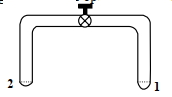
- 2A glass tube of uniform internal radius ( $\mathrm{r}$ ) has a valve separating the two identical ends. Initially, the valve is in a tightly closed position. End $1$ has a hemispherical soap bubble of radius $\mathrm{r}$. End $2$ has sub-hemispherical soap bubble as shown in figure. Just after opening the valve,View Solution
Figure: $Image$
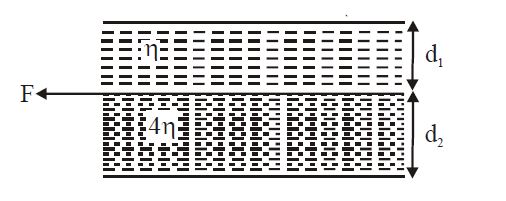
- 3A thin plate separates two liquids of coefficients of viscosity $\eta$ and $4\ \eta$ kept between two fixed plates as shown. If plate has to be pulled by applying minimum force then $\frac{d_2}{d_1}$ isView Solution
- 4View SolutionThe pans of a physical balance are in equilibrium. Air is blown under the right hand pan; then the right hand pan will
- 5A hydraulic automobile lift is designed to lift cars with a maximum mass of $3000\, kg$. The area of cross section a of piston carrying the load is $425\, cm ^{2}$. What is the maximum pressure () would smaller piston have to bear ?View Solution
- 6Two identical cylindrical vessels are kept on the ground and each contain the same liquid of density $d.$ The area of the base of both vessels is $S$ but the height of liquid in one vessel is $x_{1}$ and in the other, $x_{2}$. When both cylinders are connected through a pipe of negligible volume very close to the bottom, the liquid flows from one vessel to the other until it comes to equilibrium at a new height. The change in energy of the system in the process isView Solution
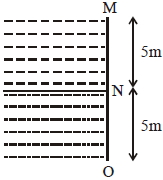
- 7Two liquids of densities $\rho_{1}$ and $\rho_{2}\left(\rho_{2}=2 \rho_{1}\right)$ are filled up behind a square wall of side $10\; \mathrm{m}$ as shown in figure. Each liquid has a height of $5 \;\mathrm{m} .$ The ratio of the forces due to these liquids exerted on upper part $MN$ to that at the lower pait $NO$ is (Assume that the liquids are not mixing)View Solution
- 8A piece of copper having an internal cavity weights $264\, g$ in air and $221\, g$ in water. Find volume (in $cc$) of cavity. Density of $Cu = 8.8\, g/cc$View Solution
- 9View SolutionAs the temperature of water increases, its viscosity
- 10In Guericke's experiment to show the effect of atmospheric pressure, two copper hemispheres were tightly fitted to each other to form a hollow sphere and the air from the sphere was pumped out to create vacuum inside. If the radius of each hemisphere is $R$ and the atmospheric pressure is $p$, then the minimum force required (when the two hemispheres are pulled apart by the same force) to separate the hemispheres isView Solution