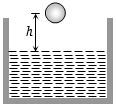
A ball of radius $r $ and density $\rho$ falls freely under gravity through a distance $h$ before entering water. Velocity of ball does not change even on entering water. If viscosity of water is $\eta$, the value of $h$ is given by
Diffcult
Download our app for free and get started
(c)Velocity of ball when it strikes the water surface $v = \sqrt {2gh} $ …(i)
Terminal velocity of ball inside the water
Terminal velocity of ball inside the water
$v = \frac{2}{9}{r^2}g\frac{{\left( {\rho - 1} \right)}}{\eta }$ …(ii)
Equating (i) and (ii) we get
$\sqrt {2gh} = \frac{2}{9}\frac{{{r^2}g}}{\eta }(\rho - 1)$
==> $h = \frac{2}{{81}}{r^4}{\left( {\frac{{\rho - 1}}{\eta }} \right)^2}g$

Download our appand get started for free
Experience the future of education. Simply download our apps or reach out to us for more information. Let's shape the future of learning together!No signup needed.*
Similar Questions
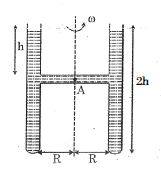
- 1The shown $H$ shaped apparatus contains an ideal incompressible liquid and has dimension as shown in figure . The diameters of the Tubes are small as compared to $h$ and $R$. The apparatus is rotated with a constant angular velocity $\omega$ about a symmetric vertical axis as shown in figure. The pressure at point $A$ isView Solution
- 2Suppose you have taken a dilute solution of oleic acid in such a way that its concentration becomes $0.01 \,cm ^{3}$ of oleic acid per $cm ^{3}$ of the solution. Then you make a thin film of this solution (monomolecular thickness) of area $4\, cm ^{2}$ by considering $100$ spherical drops of radius $\left(\frac{3}{40 \pi}\right)^{\frac{1}{3}} \times 10^{-3}\, cm .$ Then the thickness of oleic acid layer will be $x \times 10^{-14} \,m$. Where $x$ is ...... .View Solution
- 3View SolutionSelect the correct statement regarding stream line flow
- 4View SolutionA body is just floating on the surface of a liquid. The density of the body is same as that of the liquid. The body is slightly pushed down. What will happen to the body
- 5The approximate depth of an ocean is $2700\,\, m.$ The compressibility of water is $45.4 \times 10^{-11} Pa^{-1}$ and density of water is $10^3 \,kg/m^3 $. What fractional compression of water will be obtained at the bottom of the ocean?View Solution
- 6The density of ice is $0.9 \,g / cm ^3$. What percentage by volume of the block of ice floats outside the water is ..........$\%$View Solution
- 7Equal masses of water and a liquid of density $ 2$ are mixed together, then the mixture has a density of ........ $ g / cm^3$View Solution
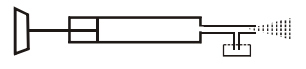
- 8A spray gun is shown in the figure where a piston pushes air out of a nozzle. A thin tube of uniform cross section is connected to the nozzle. The other end of the tube is in a small liquid container. As the piston pushes air through the nozzle, the liquid from the container rises into the nozzle and is sprayed out. For the spray gun shown, the radii of the piston and the nozzle are $20 \ mm$ and $1 \ mm$ respectively. The upper end of the container is open to the atmosphere. $Image$View Solution
$1.$ If the piston is pushed at a speed of $5 \ mms ^{-1}$, the air comes out of the nozzle with a speed of
$(A)$ $0.1 \ ms ^{-1}$ $(B)$ $1 \ ms ^{-1}$ $(C)$ $2 \ ms ^{-1}$ $(D)$ $8 \ ms ^{-1}$
$2.$ If the density of air is $\rho_{ a }$ and that of the liquid $\rho_{\ell}$, then for a given piston speed the rate (volume per unit time) at which the liquid is sprayed will be proportional to
$(A)$ $\sqrt{\frac{\rho_{ a }}{\rho_{\ell}}}$ $(B)$ $\sqrt{\rho_a \rho_{\ell}}$ $(C)$ $\sqrt{\frac{\rho_{\ell}}{\rho_{ a }}}$ $(D)$ $\rho_{\ell}$
Give the answer question $1$ and $2.$
- 9View SolutionAn ice cube contains a large air bubble. The cube is floating on the horizontal surface of water contained in a trough. What will happen to the water level, when the cube melts?
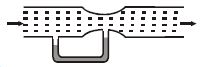
- 10Water flows through the tube shown. Area of cross-section of wide and narrow part are $5$ $cm^2$ $\&$ $2$ $cm^2$. The rate of flow is $500$ $cm^3/sec$. Find difference in mercury level of $U-$ tube .......... $cm$View Solution