Question
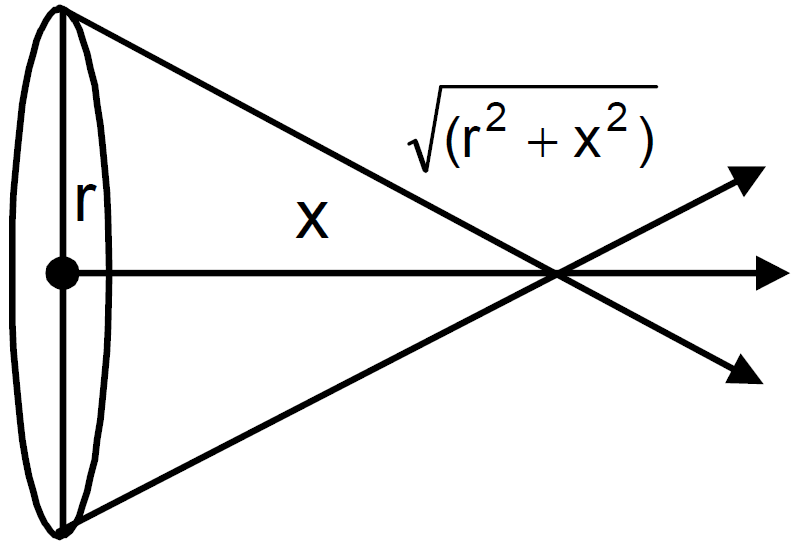
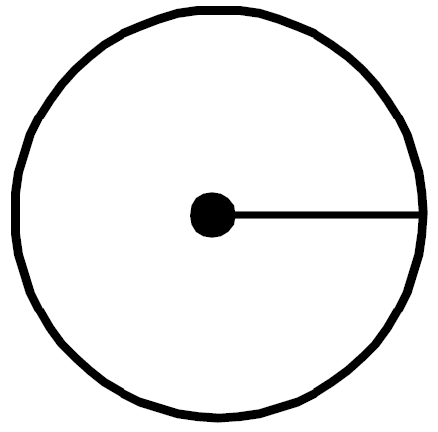
Consider a circular ring of radius r, uniformly charged with linear charge density $\lambda.$ Find the electric potential at a point on the axis at a distance x from the centre of the ring. Using this expression for the potential, find the electric field at this point.
Answer


Radius = r
So, $2\pi\text{r}=$ Circumference
Charge density $=\lambda$
Total charge $=2\pi\text{r}\times\lambda$
Electric potential $=\frac{\text{Kq}}{\text{r}}$
$=\frac{1}{4\pi\in_0}\times\frac{2\pi\text{r}\lambda}{\big(\text{x}^2+\text{r}2\big)^{\frac{1}{2}}}$
$=\frac{\text{r}\lambda}{2\in_0\big(\text{x}^2+\text{r}^2\big)^{\frac{1}{2}}}$

So, Electric field $=\frac{\text{V}}{\text{r}}\cos\theta$
$=\frac{\text{r}\lambda}{2\in_0\big(\text{x}^2+\text{r}^2\big)^{\frac{1}{2}}}\times\frac{\text{x}}{\big(\text{x}^2+\text{r}^2\big)^{\frac{1}{2}}}$
$=\frac{\text{r}\lambda\text{x}}{2\in_0\big(\text{x}^2+\text{r}^2\big)^{\frac{3}{2}}}$

Need a full question paper?

Generate a complete, print-ready paper with questions like this in minutes — across 16+ boards, with answer keys.

Start Generating Free

Similar questions

Given the example of the motion in the following cases:
  1. Where magnitude and direction of the acceleration of the particle changes.
  2. Where the magnitude and direction of acceleration of body remains constant.
  3. Where magnitude of acceleration changes but its direction remains constants.
  4. Where the magnitude of acceleration remains constant but its direction changes.
Compute the bulk modulus of water from the following data: Initial volume = $100.0$ litre, Pressure increase = 100.0 atm ($1\ atm = 1.013 × 10⁵ Pa$), Final volume = $100.5$ litre. Compare the bulk modulus of water with that of air (at constant temperature). Explain in simple terms why the ratio is so large.
Compute the bulk modulus of water from the following data: Initial volume = 100.0 litre, Pressure increase = 100.0 atm ($1 atm = 1.013 × 10⁵ Pa$), Final volume = 100.5 litre. Compare the bulk modulus of water with that of air (at constant temperature). Explain in simple terms why the ratio is so large.
What are the methods of heat transmission? Describe them and explain their practical applications.
Match the technology in column A to its related scientific principle(s) in column B.
S. No
A. Technology
S. No
B. Scientific principle(s)
1.
Steam engine
(i)
Propagation of electromagnetic waves
2.
Nuclear reactor
(ii)
Newton's laws of motion
3.
Radio and television
(iii)
Superconductivity
4.
Computers
(iv)
Role of DNA in heredity
5.
Lasers
(v)
Thermodynamics
6.
Production of ultra high magnetic fields
(vi)
Faraday's law of induction
7.
Rocket propulsion
(vii)
Conversion of gravitational potential energy into electrical energy
8.
Genetic engineering
(viii)
Motion of charged particles in electromagnetic fields.
9.
Electric generator
(ix)
Fission of uranium by slow neutrons
10.
Hydroelectric power
(x)
Amplification by population inversion
11.
Aeroplane
(xi)
Digital logic of electronic circuits
12.
Particle accelerators
(xii)
Bernoulli's principle in fluid dynamics
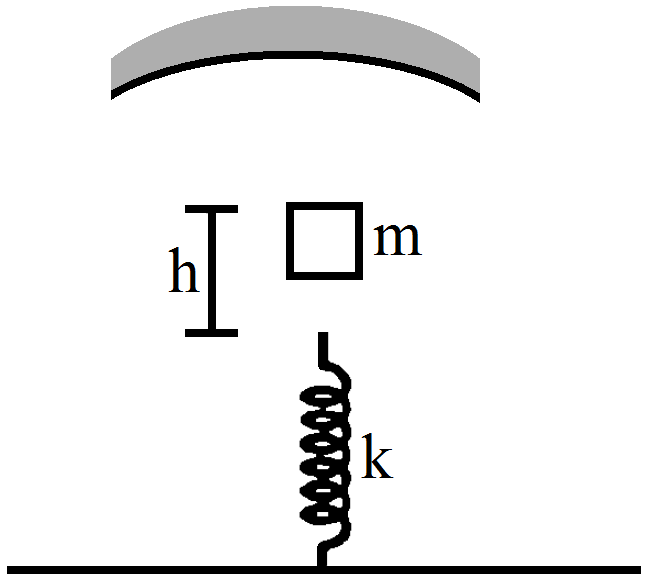
A mass $m = 50g$ is dropped on a vertical spring of spring constant $500N/m$ from a height $h = 10cm$ as shown in figure. The mass sticks to the spring and executes simple harmonic oscillations after that. A concave mirror of focal length $12cm$ facing the mass is fixed with its principal axis coinciding with the line of motion of the mass, its pole being at a distance of $30cm$ from the free end of the spring. Find the length in which the image of the mass oscillates.
Write the law of conservation of angular momentum. Also explain the example.
According to Stefan’s law of radiation, a black body radiates energy $\sigma=\text{T}^4$ from its unit surface area every second where T is the surface temperature of the black body and $\sigma=5.67\times10^{-8}\text{w}/\text{m}^2\text{K}^4$ is known as Stefan’s constant. A nuclear weapon may be thought of as a ball of radius $0.5m$. When detonated, it reaches temperature of 106K and can be treated as a black body.
  1. Estimate the power it radiates.
  2. If surrounding has water at $30C°$, how much water can $10\%$ of the energy produced evaporate in $1s$?
$\big[\text{s}_w=4186.0\text{J/ kgK and L}_v=22.6\times10^5\text{J/ kg}\big]$
  1. If all this energy U is in the form of radiation, corresponding momentum is $\rho=\frac{\text{U}}{\text{c}}$ How much momentum per unit time does it impart on unit area at a distance of 1km?
A calorimeter contains $50 g$ of water at $50^{\circ} \mathrm{C}$. The temperature falls to $45^{\circ} \mathrm{C}$ in 10 minutes. When the calorimeter contains $100 g$ of water -at $50^{\circ} 0$, it takes $18$ minutes for the temperature to become $45^{\circ} \mathrm{C}$. Find the water equivalent of the calorimeter.
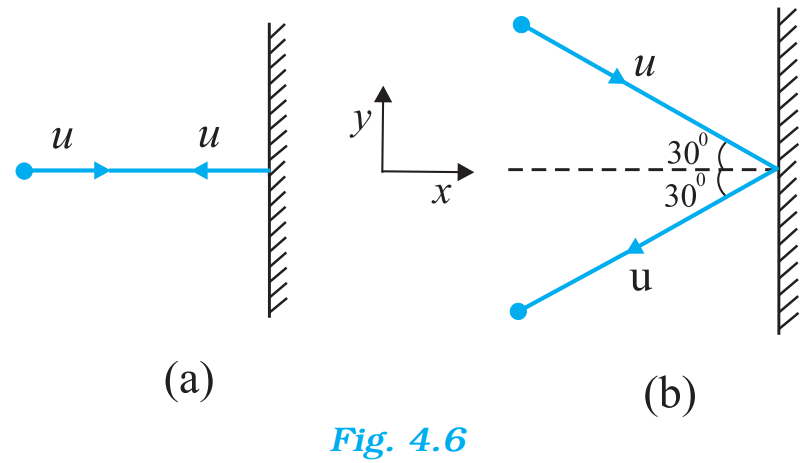
Two identical billiard balls strike a rigid wall with the same speed but at different angles, and get reflected without any change in speed, as shown in Fig. 4.6. What is (i) the direction of the force on the wall due to each ball? (ii) the ratio of the magnitudes of impulses imparted to the balls by the wall ?
Image