An electron (charge $q$ $coulomb$) enters a magnetic field of $H$ $weber/{m^2}$ with a velocity of $v\,m/s$ in the same direction as that of the field the force on the electron is
Easy
Download our app for free and get started
(d) $\overrightarrow F = q(\overrightarrow {v\,} \times \overrightarrow B ) = 0$ as $\overrightarrow {v\,} $ and $\overrightarrow B $ are parallel.

Download our appand get started for free
Experience the future of education. Simply download our apps or reach out to us for more information. Let's shape the future of learning together!No signup needed.*
Similar Questions
- 1An electron moves with speed $2 \times {10^5}\,m/s$ along the positive $x$-direction in the presence of a magnetic induction $B = \hat i + 4\hat j - 3\hat k$ (in $Tesla$) The magnitude of the force experienced by the electron in Newton's is (charge on the electron =$1.6 \times {10^{ - 19}}C)$View Solution
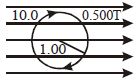
- 2A single circular loop of radius $1.00\, m$ carries a current of $10.0\, mA$. It is placed in $a$ uniform magnetic field of magnitude $0.500\, T$ that is directed parallel to the plane of the loop as suggested in the figure. The magnitude of the torque exerted on the loop by the magnetic field is.View Solution
- 3View SolutionWhich of the following particle will experience maximum acceleration when projected with same speed in transverse magnetic field
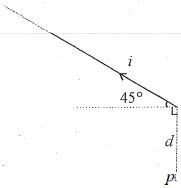
- 4Find the magnitude of magnetic field at point $p$ due to a semi - infinite wire given belowView Solution
- 5If $ m$ is magnetic moment and $B$ is the magnetic field, then the torque is given byView Solution
- 6View SolutionThe radius of curvature of the path of the charged particle in a uniform magnetic field is directly proportional to
- 7An electron revolves around nucleus with rotational frequency $'f'$ in circular orbit, due to this magnetic induction produced at nucleus position is $'B'$ then radius of circular orbit is directly proportional toView Solution
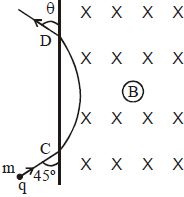
- 8A particle of mass $m = 1.67 \times 10^{-27}\, kg$ and charge $q = 1.6 \times 10^{-19} \, C$ enters a region of uniform magnetic field of strength $1$ $tesla$ along the direction shown in the figure. the time spent by the particle in the magnetic field is......$ns$View Solution
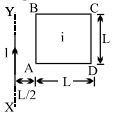
- 9A square loop $ABCD$, carrying a current $i,$ is placed near and coplanar with a long straight conductor $XY$ carrying a current $I,$ the net force on the loop will beView Solution
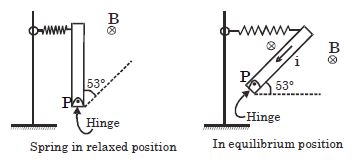
- 10A thin uniform rod with negligible mass and length $l$ is attached to the floor by a frictionless hinge at point $P$ . A horizontal spring with force constant $k$ connects the other end to wall. The rod is in a uniform magnetic field $B$ directed into the plane of paper. What is extension in spring in equilibrium when a current $i$ is passed through the rod in direction shown. Assuming spring to be in natural length initially.View Solution