MCQ
Consider a gas enclosed in a box. A molecule of mass $m,$ having a velocity $-2i +3j +4k$ collides with a wall parallel to the $xz$ plane. What will be its velocity after collision and its change in momentum$?\  i, j\ \&\ k$ are unit vectors along the $x, y\ \&\ z$ axis.
  • $-2i -3j +4k, -6mj$
  • B
    $2i +3j -4k, -6mj$
  • C
    $-2i -3j +4k, 6mj$
  • D
    $2i +3j -4k, 6mj$

Answer

Correct option: A.
$-2i -3j +4k, -6mj$
On collision with a wall parallel to the $xz$ plane, only the $y-$component will change.
Thus, new velocity will be $-2i -3j +4k.$
The change in momentum will be $-3mj -3mj = -6mj.$

Need a full question paper?

Generate a complete, print-ready paper with questions like this in minutes — across 16+ boards, with answer keys.

Start Generating Free

Similar questions

The angles which a vector $\hat i + \hat j + \sqrt 2 \,\hat k$ makes with $X, Y$ and $Z$ axes respectively are
The root mean square speed of smoke particles of mass $5 \times 10^{-17}\,kg$ in their Brownian motion in air at NTP is approximately $.......\,mm\,s ^{-1}$ [Given $k =1.38 \times 10^{-23}\,J\,K ^{-1}$ ]
An aluminium sphere is dipped into water. Which of the following is true?
A person walks $25.0^{\circ}$ north of east for $3.18 \,km$. How far would she have to walk due north and then due east to arrive at the same location?
If $\vec{\text{a}}_1$ and $\vec{\text{a}}_2$ are two non collinear unit vectors and $|\vec{\text{a}}_1+\vec{\text{a}}_2|=\sqrt{3},$ then the value of $(\vec{\text{a}}_1-\vec{\text{a}}_2).(2\vec{\text{a}}_1+\vec{\text{a}}_2)$ is:
Viscosity is a property of:
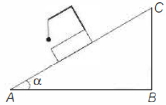
A simple pendulum is attached to a block which slides without friction down an inclined plane $A B C$ having an angle of inclination $\alpha$ as shown below. While the block is sliding down the pendulum oscillates in such a way that at its mean position the direction of the string is
An ideal heat engine exhausting heat at $27^\circ C$ is to have $25\%$ efficiency. It must take heat at:
In order to double the frequency of the fundamental note emitted by a stretched string, the length is reduced to $\frac{3}{4}$$^{th}$ of the original length and the tension is changed. The factor by which the tension is to be changed, is
Two sources of sound of same frequency are placed at a distance of $100\,m$ from each  other. An observer moving in between them hears $4$ beats per second. If the distance  between the sound sources is increased to $400\,m$, then number of beats heard by him will be :-