MCQ
Consider a liquid contained in a vessel. The liquid solid adhesive force is very weak as compared to the cohesive force in the liquid. The shape of the liquid surface near the solid shall be
  • A
    Horizontal
  • B
    Almost vertical
  • C
    Concave
  • Convex

Answer

Correct option: D.
Convex
d
(d) Cohesive force $>$ Adhesive force, so shape of liquid surface near the solid would be convex.

For example mercury surface in glass capillary is convex.

Need a full question paper?

Generate a complete, print-ready paper with questions like this in minutes — across 16+ boards, with answer keys.
Start Generating Free

Similar questions

The correct value of constant R in ideal gas equation in SI units is:
A force $F$ is applied at the centre of a disc of mass $M$. The minimum value of coefficient of friction of the surface for rolling is ............
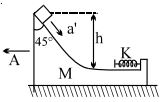
$A$ small block of mass $m$ is placed on $a$ wedge of mass $M$ as shown, which is initially at rest. All the surfaces are frictionless . The spring attached to the other end of wedge has force constant $k$. If $a'$ is the acceleration of $m$ relative to the wedge as it starts coming down and $A$ is the acceleration acquired by the wedge as the block starts coming down, then  Maximum retardation of $M$ is:
A $10.0 \,W$ electrical heater is used to heat a container filled with $0.5 \,kg$ of water.It is found that the temperature of the water and the container rose by $3 \,K$ in $15 \,min$. The container is then emptied, dried and filled with $2 \,kg$ of an oil. It is now observed that the same heater raises the temperature of the container-oil system by $2 \,K$ in $20 \,min$. Assuming no other heat losses in any of the processes, the specific heat capacity of the oil is ................ $ \times 10^3 \,JK ^{-1} kg ^{-1}$
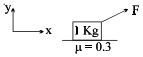
A $\vec F\,\, = \,\,\hat i\, + \,4\hat j\,$ acts on block shown. The force of friction acting on the block is :
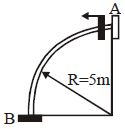
A bead of mass $\frac {1}{2}\,kg$ starts from rest from $A$ to move in a vertical plane along a smooth fixed quarter ring of radius $5\,m$, under the action of a constant horizontal force $F = 5\,N$ as shown. The speed of bead as it reaches the point $B$ is ................ $\mathrm{m}/ \mathrm{s}$ [Take $g = 10\,m/s^2$ ]
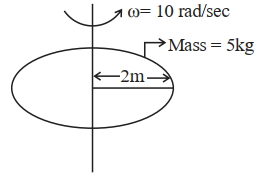
Consider a Disc of mass $5 \mathrm{~kg}$, radius $2 \mathrm{~m}$, rotating with angular velocity of $10 \mathrm{rad} / \mathrm{s}$ about an axis perpendicular to the plane of rotation. An identical disc is kept gently over the rotating disc along the same axis. The energy dissipated so that both the discs continue to rotate together without slipping is ___________$J$.
The angular speed of earth around its own axis is ......... $rad / s$
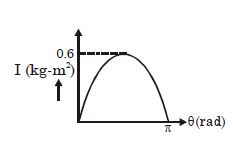
Figure shows the variation of the moment of inertia of a uniform rod, about an axis passing through its centre and inclined at an angle $\theta$ to the length. The moment of inertia of the rod about an axis passing through one of its ends and making an angle $\theta  = \frac{\pi }{3}$ will be ........ $ kg-m^2$.
Simple harmonic motion is such a harmonic motion in which the restoring force F is directly proportional to :