Consider a metallic cube of edge length $L$. Its resistance, $R$, measured across its opposite faces is $R =\frac{ m _{ e } v }{ ne ^2 L ^2}$, where $n$ is the number density and $v$ is the drift speed of electrons in the cube, and $e$ and $m _{ e }$ are the charge and mass of an electron respectively. Assuming the de-Broglie wavelength of the electron to be $L$, the maximum resistance of the sample is closest to ............. $\,\Omega$ $\left(e=1.60 \times 10^{-19} \,C ; m _{ e }=9.11 \times 10^{-31} \,kg\right.$; Planck's constant, $h=6.63 \times 10^{-34} \,Js$ )
KVPY 2021, Advanced


Download our appand get started for free
Experience the future of education. Simply download our apps or reach out to us for more information. Let's shape the future of learning together!No signup needed.*
Similar Questions
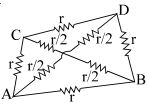
- 1The equivalent resistance between ends $A$ and $B$ isView Solution
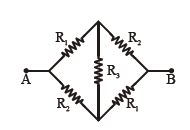
- 2Two identical heaters rated $220\, volt$, $1000\, watt$ are placed in series with each other across $220 \,volt$ lines. If resistance do not change with temperature, then the combined power is ............. $watt$View Solution
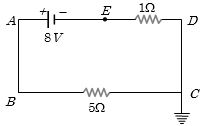
- 3In the given circuit, the potential of the point $E$ isView Solution
- 4Refer to the circuit shown. What will be the total power dissipation in the circuit if $P$ is the power dissipated in $R_1$ ? It is given that $R_2=4 R_1$ and $R_3=12 R_1$ are .......... $P$View Solution
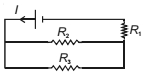
- 5In the circuit shown, the thermal power dissipated in $R_1$ is $P$. The thermal power dissipated in $R_2$ isView Solution
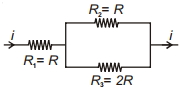
- 6View SolutionIn the circuit shown in the figure below, which of the following statement is incorrect ?
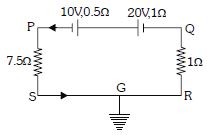
- 7View SolutionAssertion : A current continues to flow in superconducting coil even after switch is off.
Reason : Superconducting coils show Meissner effect
- 8A $10\, m$ long wire of $20\,\Omega$ resistance is connected with a battery of $3\, volt$ $e.m.f.$ (negligible internal resistance) and a $10 \,\Omega$ resistance is joined to it is series. Potential gradient along wire in volt per meter isView Solution
- 9View SolutionA wire of non-uniform cross-section is carrying a steady current. Along the wire
- 10The figure shows a tetrahedron, each side of which has a resistance $r$ Choose the correct diagram $(s),$ which show two-dimensional equivalent of the tetrahedron.View Solution