Question
Consider a radioactive nucleus A which decays to a stable nucleus C through the following sequence:
A → B → C
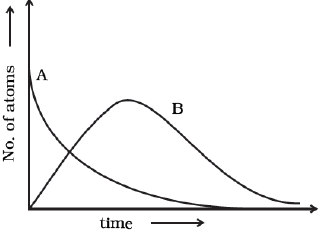
Here B is an intermediate nuclei which is also radioactive. Considering that there are N0 atoms of A initially, plot the graph showing the variation of number of atoms of A and B versus time.
Answer

Consider the situation shown in the graph.

At t = 0, NA = NO while NB = 0. As time increases, NA falls off exponentially, the number of atoms of B increases, becomes maximum and finally decays to zero at ∞ (following exponential decay law).

Need a full question paper?

Generate a complete, print-ready paper with questions like this in minutes — across 16+ boards, with answer keys.

Start Generating Free

Similar questions

Radioactive isotopes are produced in a nuclear physics experiment at a constant rate $\frac{\text{dN}}{\text{dt}}=\text{R}.$ An inductor of inductance 100mH, a resistor of resistance $100\Omega$ and a battery are connected to form a series circuit. The circuit is switched on at the instant the production of radioactive isotope starts. It is found that $\frac{\text{i}}{\text{N}}$ remains constant in time where i is the current in the circuit at time t and N is the number of active nuclei at time t. Find the half-life of the isotope.
A charge q is placed at the centre of the line joining two equal charges Q.
Show that the system of three charges will be in equilibrium if $\text{q}=-\frac{\text{Q}}{4}.$
Explain how the electron was historically discovered.
What do you mean by colour code of carbon resistance ?
How much energy is released in the following reaction?
$\text{ }^7\text{Li + p}\rightarrow\alpha+\alpha.$
Atomic mass of 7Li = 7.0160u and that of 4He = 4.0026u.
Find the time required for a 50Hz alternating current to change its value from zero to the rms value.
An ideal gas expands from 100cm3 to 200cm3 at a constant pressure of 2.0 × 10⁵ Pa when 50J of heat is supplied to it. Calculate,
  1. The change in internal energy of the gas.
  2. The number of moles in the gas if the initial temperature is 300K.
  3. The molar heat capacity Cp at constant pressure.
  4. The molar heat capacity Cv at constant volume.
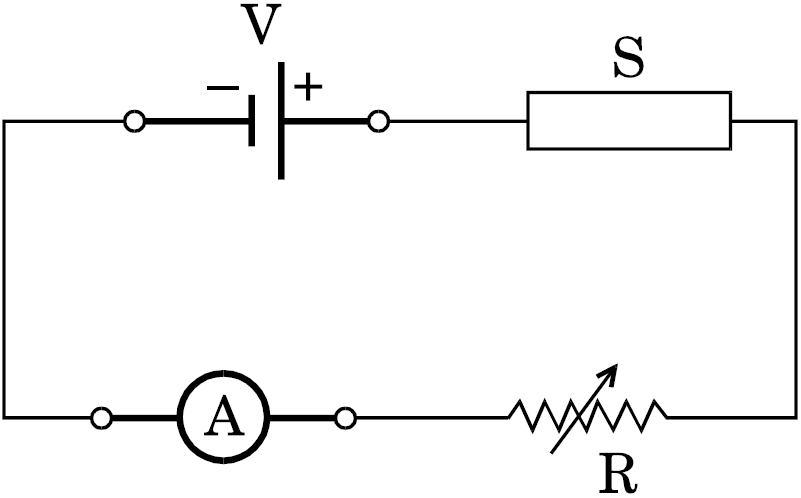
  1. In the following diagram ‘S’ is a semiconductor. Would you increase or decrease the value of R to keep the reading of the ammeter A constant when S is heated? Give reason for your answer.

  1. Draw the circuit diagram of a photodiode and explain its working. Draw its I - V characteristics.
A uniform tube closed at one end, contains a pellet of mercury 10cm long. When the tube is kept vertically with the closed-end upward, the length of the air column trapped is 20cm. Find the length of the air column trapped when the tube is inverted so that the closedend goes down. Atmospheric pressure = 75cm of mercury.
You are given prisms made of crown glass and flint glass with a wide variety of angles. Suggest a combination of prisms which will
  1. deviate a pencil of white light without much dispersion.
  2. disperse (and displace) a pencil of white light without much deviation.