Consider a simple $RC$ circuit as shown in Figure $1$.
Process $1$: In the circuit the switch $S$ is closed at $t=0$ and the capacitor is fully charged to voltage $V_0$ (i.e. charging continues for time $T \gg R C$ ). In the process some dissipation ( $E_D$ ) occurs across the resistance $R$. The amount of energy finally stored in the fully charged capacitor is $EC$.
Process $2$: In a different process the voltage is first set to $\frac{V_0}{3}$ and maintained for a charging time $T \gg R C$. Then the voltage is raised to $\frac{2 \mathrm{~V}_0}{3}$ without discharging the capacitor and again maintained for time $\mathrm{T} \gg \mathrm{RC}$. The process is repeated one more time by raising the voltage to $V_0$ and the capacitor is charged to the same final
take $\mathrm{V}_0$ as voltage
These two processes are depicted in Figure $2$.
($1$) In Process $1$, the energy stored in the capacitor $E_C$ and heat dissipated across resistance $E_D$ are released by:
$[A]$ $E_C=E_D$ $[B]$ $E_C=E_D \ln 2$ $[C]$ $\mathrm{E}_{\mathrm{C}}=\frac{1}{2} \mathrm{E}_{\mathrm{D}}$ $[D]$ $E_C=2 E_D$
($2$) In Process $2$, total energy dissipated across the resistance $E_D$ is:
$[A]$ $\mathrm{E}_{\mathrm{D}}=\frac{1}{2} \mathrm{CV}_0^2$ $[B]$ $\mathrm{E}_{\mathrm{D}}=3\left(\frac{1}{2} \mathrm{CV}_0^2\right)$ $[C]$ $\mathrm{E}_{\mathrm{D}}=\frac{1}{3}\left(\frac{1}{2} \mathrm{CV}_0^2\right)$ $[D]$ $\mathrm{E}_{\mathrm{D}}=3 \mathrm{CV}_0^2$
Given the answer quetion ($1$) and ($2$)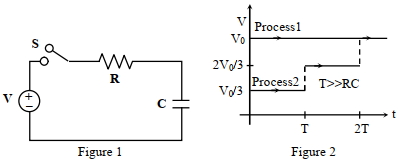
IIT 2017, Advanced


Download our appand get started for free
Experience the future of education. Simply download our apps or reach out to us for more information. Let's shape the future of learning together!No signup needed.*
Similar Questions
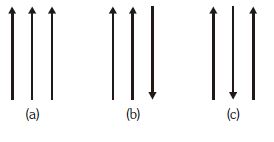
- 1When three electric dipoles are near each other, they each experience the electric field of the other two, and the three dipole system has a certain potential energy. Figure below shows three arrangements $(1)$ , $(2)$ and $(3)$ in which three electric dipoles are side by side. All three dipoles have the same magnitude of electric dipole moment, and the spacings between adjacent dipoles are identical. If $U_1$ , $U_2$ and $U_3$ are potential energies of the arrangements $(1)$ , $(2)$ and $(3)$ respectively thenView Solution
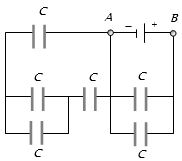
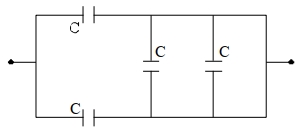
- 2Find equivalent capacitance between $A$ and $B$......$C$View Solution
- 3Three concentric metal shells $A, B$ and $C$ of respective radii $a, b$ and $c (a < b < c)$ have surface charge densities $+\sigma,-\sigma$ and $+\sigma$ respectively. The potential of shell $B$ isView Solution
- 4The ratio of momenta of an electron and an $\alpha$-particle which are accelerated from rest by a potential difference of $100\, volts$ isView Solution
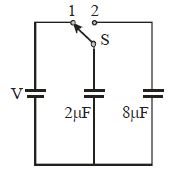
- 5A $2\,\mu F$ Capacitor is charged as shown in the figure. The percentage of its store energy dissipated after the switch $S$ is turned to position $2$, is.....$\%$View Solution
- 6View SolutionA capacitor is charged by using a battery which is then disconnected. A dielectric slab is then slipped between the plates, which results in
- 7The capacity of a condenser is $4 \times {10^{ - 6}}$ farad and its potential is $100\,\,volts$. The energy released on discharging it fully will be.......$Joule$View Solution
- 8The mean electric energy density between the plates of a charged capacitor is (here $q$= charge on the capacitor and $A$= area of the capacitor plate)View Solution
- 9View SolutionThe equivalent capacitance of the combination shown is
- 10View SolutionTwo capacitors of equal capacity are first connected in parallel and then in series. The ratio of the total capacities in the two cases will be