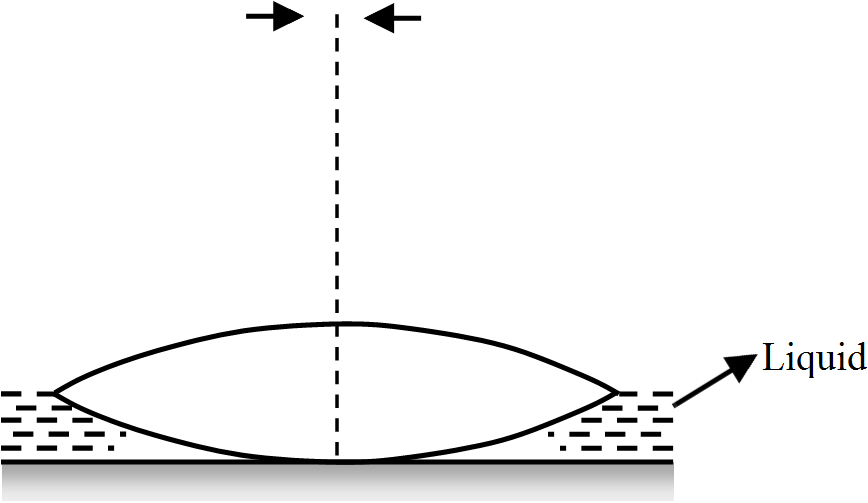
- An equiconvex lens with radii of curvature of magnitude r each, is put over a liquid layer poured on top of a plane mirror. A small needle, with its tip on the principal axis of the lens, is moved along the axis until its inverted real image coincides with the needle itself. The distance of the needle from the lens is measured to be 'a'. On removing the liquid layer and repeating the experiment the distance is found to be 'b'.
- If r = 10cm, a = 15cm, b = 10cm, find the refractive index of the liquid.
Download our app for free and get started
- The focal length $(f_1)$ of lens is given by
Given $f_1= b$
$\Rightarrow\frac{1}{\text{b}}=\frac{2(\text{n}-1)}{\text{r}}$
$\Rightarrow\text{b}=\frac{\text{r}}{2(\text{n}-1)}$
The focal lenght of liquid lens (plano concave lens) is
$\frac{1}{\text{f}_2}=(\text{n}_{\text{l}}-1)(-\frac{1}{\text{r}}-\frac{1}{\propto})$
$=-\frac{(\text{n}_{\text{l}}-1)}{\text{r}}$
$\Rightarrow\text{f}_2=\frac{\text{r}}{(\text{n}_{\text{l}}-1)}$
As glass lens and liquid lens are in contact
$\therefore\frac{1}{\text{f}}=\frac{1}{\text{f}_1}+\frac{1}{\text{f}_2}=\frac{1}{\text{b}}-\frac{(\text{n}_{\text{l}}-1)}{\text{r}}$
Given $f = a$
$\therefore\frac{1}{\text{a}}=\frac{1}{\text{b}}-\frac{\text{n}_{\text{l}}-1}{\text{r}}$
$\Rightarrow\frac{\text{n}_{\text{l}}-1}{\text{r}}=\frac{1}{\text{b}}-\frac{1}{\text{a}}$
$\Rightarrow\text{n}_{\text{l}}-1=\text{r}\big(\frac{1}{\text{b}}-\frac{1}{\text{a}}\big)$
Refractive index of liquid,
- $\text{n}_{\text{l}}=1+\frac{\text{r}}{\text{b}}-\frac{\text{r}}{\text{a}}$
$=1+1-\frac{2}{3}=2-\frac{2}{3}=\frac{4}{3}=1.33$

Download our appand get started for free
Experience the future of education. Simply download our apps or reach out to us for more information. Let's shape the future of learning together!No signup needed.*
Similar Questions
- 1Light is incident from glass $(\mu=1.50)$ to water $(\mu=1.33).$ Find the range of the angle of deviation for which there are two angles of incidence.View Solution
- 2View SolutionA double convex lens has focal length 25cm. The radius of curvature of one of the surfaces is double of the other. Find the radii, if the refractive index of the material of the lens is 1.5.
- 3View SolutionAn astronomical telescope is to be designed to have a magnifying power of 50 in normal adjustment. If the length of the tube is 102cm, find the powers of the objective and the eyepiece.
- 4View Solution
- With the help of a suitable ray diagram, derive the mirror formula for a concave mirror.
- The near point of a hypermetropic person is 50 cm from the eye. What is the power of the lens required to enable the person to read clearly a book held at 25 cm from the eye?
- 5Derive the lens formula, $\frac{1}{\text{f}} = \frac{1}{\text{v}} - \frac{1}{\text{u}}$ for a concave lens, using the necessary ray diagram.View Solution
Two lenses of powers 10 D and – 5 D are placed in contact.- Calculate the power of the new lens.
- Where should an object be held from the lens, so as to obtain a virtual image of magnification 2?
- 6View SolutionHow is the working of a telescope different from that of a microscope?
The focal lengths of the objective and eyepiece of a microscope are 1.25 cm and 5 cm respectively. Find the position of the object relative to the objective in order to obtain an angular magnification of 30 in normal adjustment. - 7A short object of length L is placed along the principal axis of a concave mirror away from focus. The object distance is u. If the mirror has a focal length f, what will be the length of the image? You may take $L < < |v - f|.$View Solution
- 8View Solution
- Draw a labelled ray diagram to obtain the real image formed by an astronomical telescope in normal adjustment position. Define its magnifying power.
- You are given three lenses of power 0.5 D, 4 D and 10 D to design a telescope:
- Which lenses should he used as objective and eyepiece? Justify your answer.
- Why is the aperture of the objective preferred to be large?
- 9View Solution
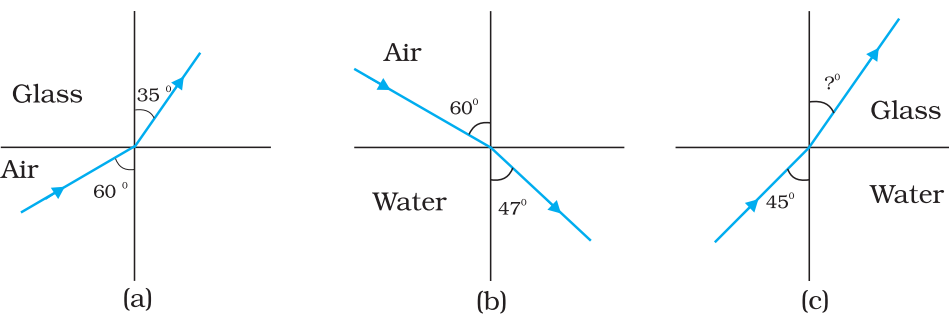
(a) and (b) show refraction of a ray in air incident at 60° with the normal to a glass-air and water-air interface, respectively. Predict the angle of refraction in glass when the angle of incidence in water is 45º with the normal to a water - glass interface.
- 10View SolutionIn many experimental set-ups the source and screen are fixed at a distance say D and the lens is movable. Show that there are two positions for the lens for which an image is formed on the screen. Find the distance between these points and the ratio of the image sizes for these two points.