Question
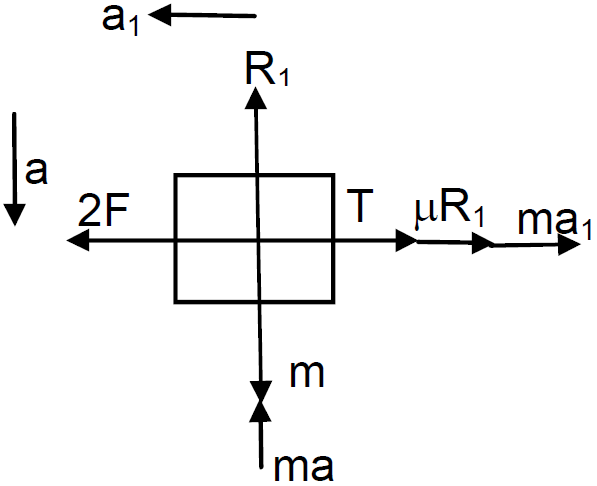
Suppose the entire system of the previous question is kept inside an elevator which is coming down with an acceleration a < g. Repeat parts (a) and (b).
Answer

  1.  

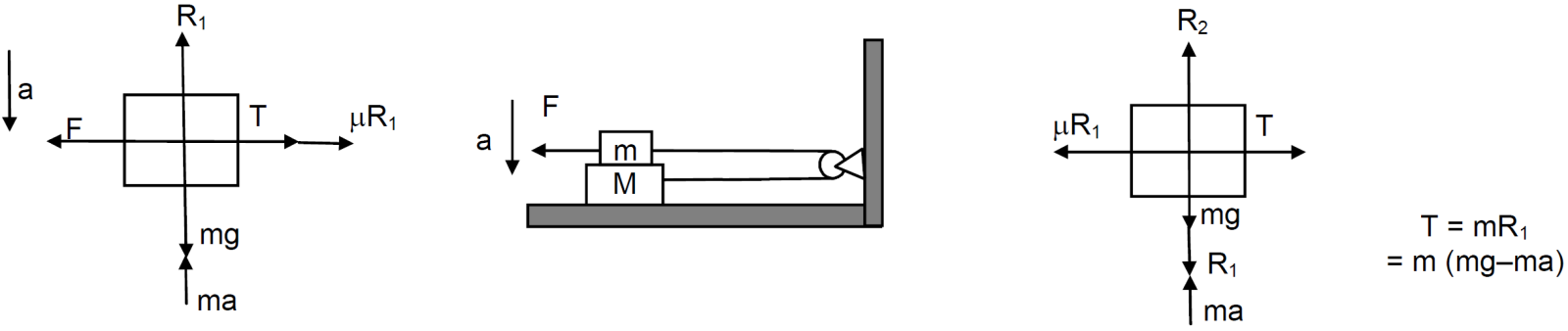
$\text{R}_1+\text{ma}-\text{mg}=0$
$\Rightarrow\text{R}_1=\text{m(g}-\text{a) = mg}-\text{ma} \ ...(\text{i})$
$\text{T}-\mu\text{R}_1=0\Rightarrow\text{T = m(mg}-\text{ma}) \ ...(\text{ii})$
Again, $\text{F}-\text{T}-\mu\text{R}_1=0$
$\Rightarrow\text{F}-\{\mu(\text{mg}-\text{ma})\}-\text{u}(\text{mg}-\text{ma})=0$
$\Rightarrow\text{F}-\mu\text{mg}+\mu\text{ma}-\mu\text{mg}+\mu\text{ma}=0$
$\Rightarrow\text{F}=2\mu\text{mg}-2\mu\text{ma}\Rightarrow\text{F}=2\mu\text{m(g}-\text{a})$
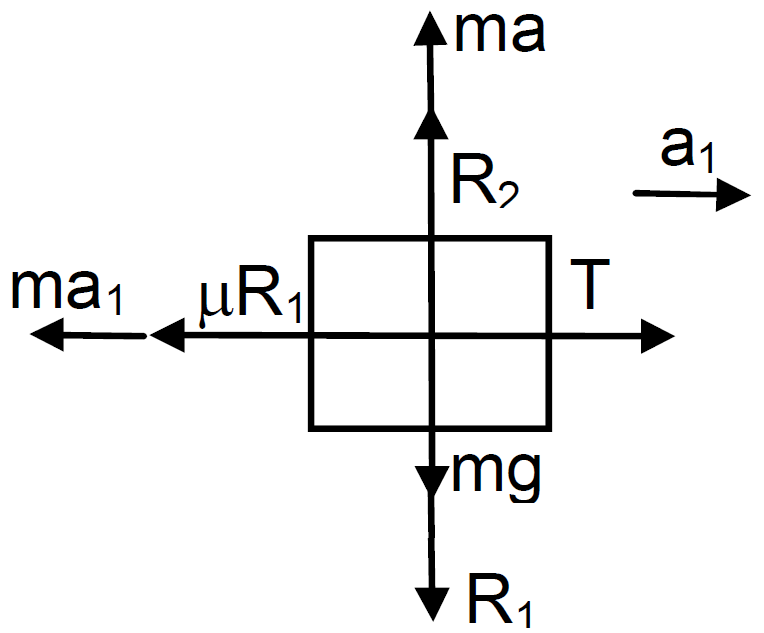
  1. Acceleration of the block be $a_1$

$\text{R}_1=\text{mg}-\text{ma} \ ...(\text{i})$
$2\text{F}-\text{T}-\mu\text{R}_1-\text{ma}_1=0$
$\Rightarrow2\text{F}-\text{t}-\mu\text{mg}+\mu\text{a}-\text{ma}_1=0 \ ...(\text{ii})$

$\text{T}-\mu\text{R}_1-\text{Ma}_1=0$
$\Rightarrow\text{T}=\mu\text{R}_1+\text{Ma}_1$
$\Rightarrow\text{T}=\mu(\text{mg}-\text{ma})+\text{Ma}_1$
$\Rightarrow\text{T}=\mu\text{mg}-\mu\text{ma + Ma}_1$
Subtracting values of F & T, we get
$2(2\mu\text{m(g}-\text{a}))-2(\mu\text{mg}-\mu\text{ma}+\text{Ma}_1)\\-\mu\text{mg}+\mu\text{ma}-\mu\text{a}_1=0$
$\Rightarrow4\mu\text{mg}-4\mu\text{ma}-2\mu\text{mg}+2\mu\text{ma = ma}_1+\text{Ma}_1$
$\Rightarrow\text{a}_1=\frac{2\mu\text{m(g}-\text{a})}{\text{M + m}}$
Both blocks move with this acceleration but in opposite directions.

Need a full question paper?

Generate a complete, print-ready paper with questions like this in minutes — across 16+ boards, with answer keys.
Start Generating Free

Similar questions

For the same objective, find the ratio of the least separation between two points to be distinguished by a microscope for light of 5000A and electrons accelerated through 100V used as the illuminating substance.
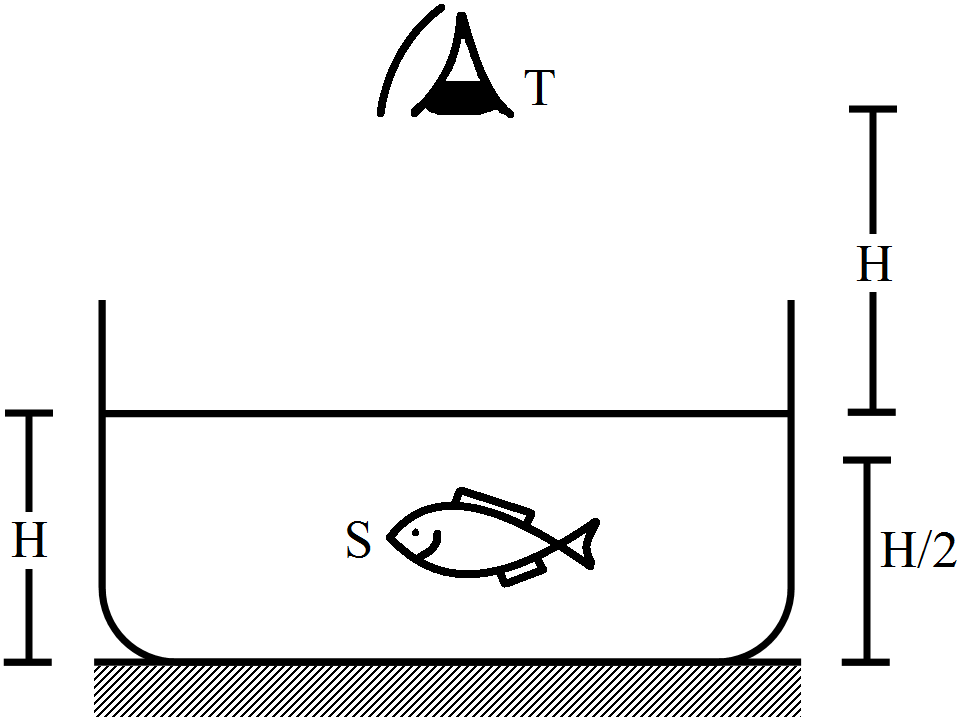
Consider the situation in figure. The bottom of the pot is a reflecting plane mirror, S is a small fish and T is a human eye. Refractive index of water is.
  1. At what distance(s) from itself will the fish see the image(s) of the eye?
  2. At what distance(s) from itself will the eye see the image(s) of the fish.
A particle of mass 100g moving at an initial speed u collides with another particle of same mass kept initially at rest. If the total kinetic energy becomes 0.2J after the collision, what could be the minimum and the maximum value of u.
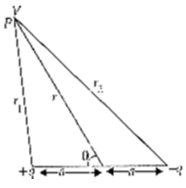
Derive an expression for potential due to a dipole for distances large compared to the size of the dipole. How is the potential due to dipole different from that due to a single charge?
Image
A bar magnet of magnetic moment m and moment of inertia I (about centre, perpendicular to length) is cut into two equal pieces, perpendicular to length. Let T be the period of oscillations of the original magnet about an axis through the mid point, perpendicular to length, in a magnetic field B. What would be the similar period T' for each piece?
Two charges -q each are fixed separated by distance 2d. A third charge q of mass m placed at the mid-point is displaced slightly by x (x < < d) perpendicular to the line joining the two fixed charged as shown in Fig. Show that q will perform simple harmonic oscillation of time period.

$\text{T}=\Big[\frac{8\pi^3\in_0\text{md}^3}{\text{q}^2}\Big]^\frac{1}{2}$.
Explain motion of a charged particle in a magnetic field in the following circumstances :

(a) When a positively charged particle ( $+q$ ) enters perpendicularly in a uniform magnetic field (B) with velocity $v$.

(b) When a positively charged particle enters a magnetic field (B) at an angle $\theta\left(0^{\circ}<\theta<90^{\circ}\right)$.
An electron is emitted with negligible speed from the negative plate of a parallel-plate capacitor charged to a potential difference V. The separation between the plates is d and a magnetic field Bexists in the space, as shown in the figure. Show that the electron will fail to strike the upper plates if $\text{d}>\Big(\frac{2\text{m}_\text{e}\text{v}}{\text{eB}^2}\Big)^{\frac{1}{2}}.$
Two identical metal balls one at $\text{T}_1=300\text{K}$ and the other at $\text{T}_2=600\text{K}$ are kept at a distance of 1m in vacuum. Will the temperatures equalise by radiation? Will the rate of heat gained by the colder sphere be proportional to $\text{T}_2^4-\text{T}_1^4$ as may be expected from the Stefan's law?
Find the wavelength of the radiation emitted by hydrogen in the transitions (a) n = 3 to n= 2, (b) n = 5 to n = 4 and (c) n = 10 to n = 9.