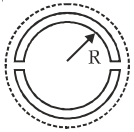
A wooden wheel of radius $R$ is made of two semicircular part (see figure). The two parts are held together by a ring made of a metal strip of cross section area $S$ and length $L$. $L$ is slighly less than $2\pi R$. To fit the ring on the wheel, it is heated so that its temperature rises by $\Delta T$ and it just steps over the wheel.As it cools down to surronding temperature, it presses the semicircular parts together. If the coefficint of linear expansion of the metal is $\alpha$, and its young's modulus is $Y$, the force that one part of wheel applies on the other part is
AIEEE 2012, Diffcult
Download our app for free and get started
$Y = \frac{{F/S}}{{\Delta L/L}} \Rightarrow \Delta L = \frac{{FL}}{{SY}}$
$\therefore L\alpha \Delta T = \frac{{FL}}{{SY}}$ $\left[ {\Delta L = L\alpha \Delta T} \right]$
$\therefore F = SY\alpha \Delta T$
$\therefore $ The ring is pressing the wheel from both sides,
$\therefore {F_{net}} = 2F = 2YS\alpha \Delta T$

Download our appand get started for free
Experience the future of education. Simply download our apps or reach out to us for more information. Let's shape the future of learning together!No signup needed.*
Similar Questions
- 1The interatomic distance for a metal is $3 \times {10^{ - 10}}\,m$. If the interatomic force constant is $3.6 \times {10^{ - 9}}\,N/{{\buildrel _{\circ} \over {\mathrm{A}}}}$, then the Young's modulus in $N/{m^2}$ will beView Solution
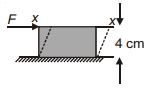
- 2A steel plate of face area $1 \,cm ^2$ and thickness $4 \,cm$ is fixed rigidly at the lower surface. A tangential force $F=10 \,kN$ is applied on the upper surface as shown in the figure. The lateral displacement $x$ of upper surface w.r.t. the lower surface is .............. $m$ (Modulus of rigidity for steel is $8 \times 10^{11} \,N / m ^2$ )View Solution
- 3If the Young's modulus of the material is $3$ times its modulus of rigidity, then its volume elasticity will beView Solution
- 4A wire of cross-sectional area $3\,m{m^2}$ is first stretched between two fixed points at a temperature of $20°C$. Determine the tension when the temperature falls to $10°C$. Coefficient of linear expansion $\alpha = {10^{ - 5}} { ^\circ}{C^{ - 1}}$ and $Y = 2 \times {10^{11}}\,N/{m^2}$ ........ $N$View Solution
- 5A steel wire of diameter $2 \,mm$ has a breaking strength of $4 \times 10^5 \,N.$ the breaking force $......... \times 10^5 \,N$ of similar steel wire of diameter $1.5 \,mm$ ?View Solution
- 6View SolutionThe Bulk Modulus for an incompressible liquid is
- 7View SolutionModulus of rigidity of a liquid
- 8Two exactly similar wires of steel and copper are stretched by equal forces. If the difference in their elongations is $0.5$ cm, the elongation $(l)$ of each wire is ${Y_s}({\rm{steel}}) = 2.0 \times {10^{11}}\,N/{m^2}$${Y_c}({\rm{copper}}) = 1.2 \times {10^{11}}\,N/{m^2}$View Solution
- 9A force $F$ is applied on the wire of radius $r$ and length $L$ and change in the length of wire is $l.$ If the same force $F$ is applied on the wire of the same material and radius $2r$ and length $2L,$ Then the change in length of the other wire isView Solution
- 10The strain energy stored in a body of volume $V$ due to shear strain $\phi$ is (shear modulus is $\eta$ )View Solution