Question
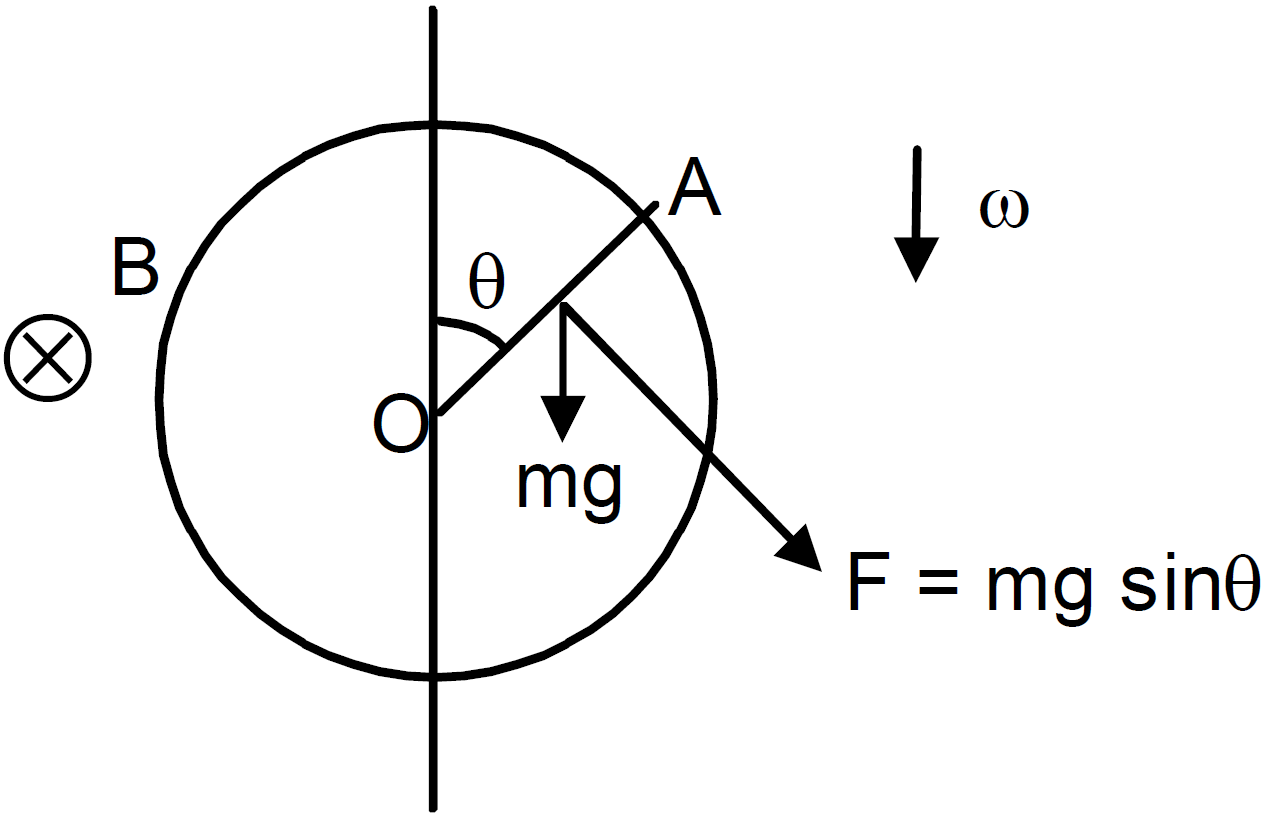
Consider a variation of the previous problem (figure). Suppose the circular loop lies in a vertical plane. The rod has a mass m. The rod and the loop have negligible resistances but the wire connecting O and C has a resistance R. The rod is made to rotate with a uniform angular velocity $\omega$ in the clockwise direction by applying a force at the midpoint of OA in a direction perpendicular to it. Find the magnitude of this force when the rod makes an angle $\theta$ with the vertical.
Answer


We know
$\text{F}=\frac{\text{B}^2\text{a}^3\omega}{2\text{R}}=\text{il}\text{B}$
Component of mg along $\text{F}=\text{mg } \sin \theta$
Net force $=\frac{\text{B}^2\text{a}^3\omega}{2\text{R}}-\text{mg }\sin\theta$

Need a full question paper?

Generate a complete, print-ready paper with questions like this in minutes — across 16+ boards, with answer keys.

Start Generating Free

Similar questions

  1. Draw a neat labelled ray diagram of an astronomical telescope in normal adjustment. Explain briefly its working.
  2. An astronomical telescope uses two lenses of powers 10 D and 1 D. What is its magnifying power in normal adjustment?
A magnifying glass is a converging lens placed close to the eye. A farsighted person uses spectacles having converging lenses. Compare the functions of a converging lens used as a magnifying glass and as spectacles.
A ball is projected vertically upward with a speed of $50\ m/s$. Find:
  1. The maximum height.
  2. The time to reach the maximum height.
  3. The speed at half the maximum height. Take $g = 10\ m/s^2.$
  1. Describe the working principle of a solar cell. Mention three basic processes involved in the generation of emf.
  2. Why are Si and GaAs preferred materials for solar cells?
In a single slit diffraction experiment $,a$ slit of width $d$ is illuminated by red light of wavelength $650 \ nm$. For what value of $d$ will
$i$. the first minimum fall is at an angle of diffraction of $30^\circ$ and
$ii$. the first maximum fall is at an angle of diffraction of $30^\circ$ ?
The electric current in an $X-$ray tube $($from the target to the filament$)$ operating at $40kV$ is $10mA.$ Assume that on an average, $1\%$ of the total kinetic energy of the electron hitting hte target are converted into $X-$rays.
  1. What is the total power emitted as $X-$rays
  2. How much heat is produced in the target every second?
Consider the situation of the previous problem. Find the average electric field energy stored in the capacitor and the average magnetic field energy stored in the coil.
In the given circuit, with steady current, calculate the potential drop across the capacitor in terms of V.
In a Geiger - Marsden experiment, calculate the distance of closest approach to the nucleus of Z = 80, when an α-particle of 8 MeV nergy impinges on it before it comes momentarily to rest and reverses its direction.
How will the distance of closest approach be affected when the kinetic energy of the α-particle is doubled?
  1. A giant refracting telescope at an observatory has an objective lens of focal length $15 m$. If an eyepiece of focal length $1.0 \ cm$ is used, what is the angular magnification of the telescope?
  2. If this telescope is used to view the moon, what is the diameter of the image of the moon formed by the objective lens? The diameter of the moon is $3.48 \times 10^{6 }m,$ and the radius of lunar orbit is $3.8 \times 10^{8 }m$.