Question 13 Marks
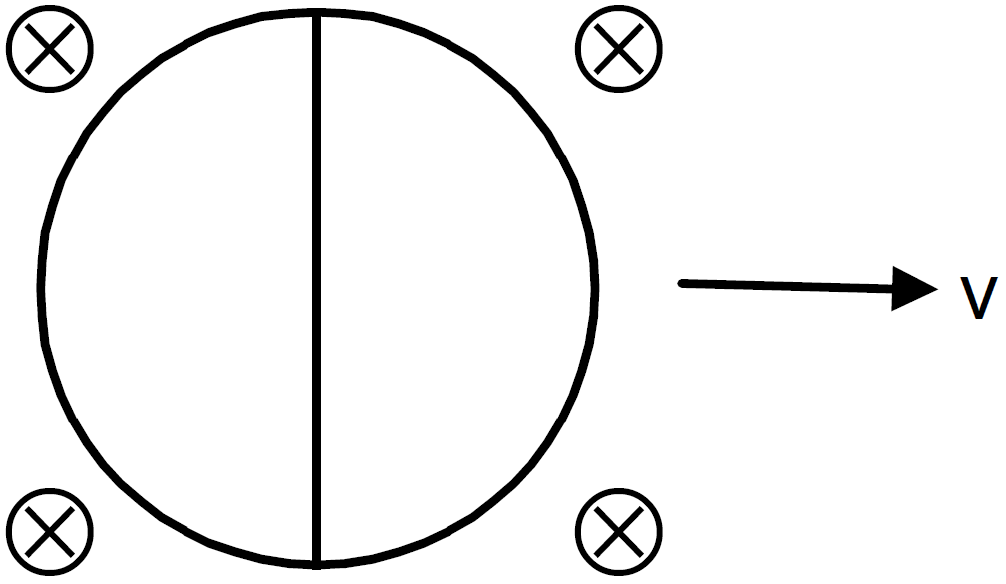
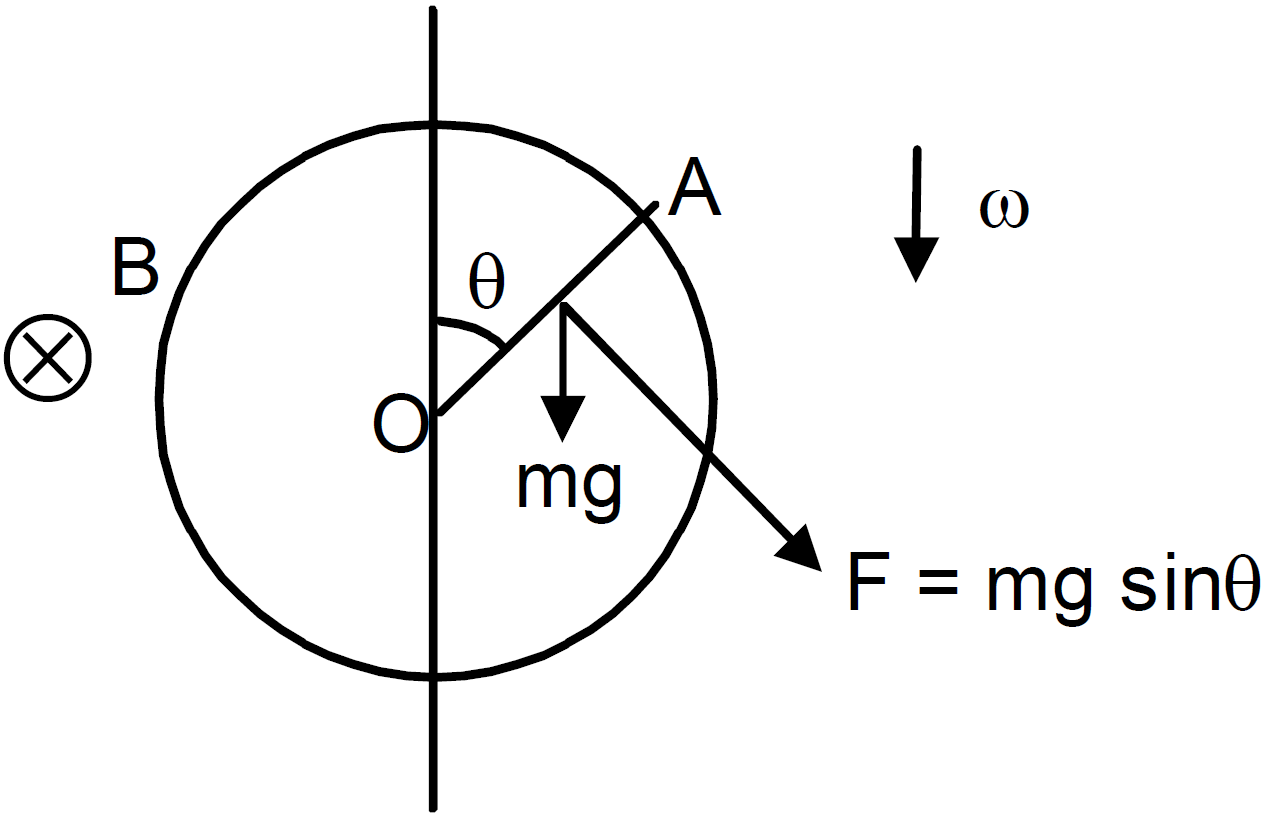
A circular coil of one turn of radius 5.0cm is rotated about a diameter w!th a constant angular speed of 80 revolutions per minute. A uniform magnetic field B = 0.010T exists in a direction perpendicular to the axis of rotation. Find
- The maximum emf induced.
- The average emf induced in the coil over a long period.
- The average of the squares of emf induced over a lone period.
Answer
View full question & answer→emf $=\frac{\text{d}\phi}{\text{dt}}=\frac{\text{dB.A}\cos\theta}{\text{dt}}$ $=\text{BA}\sin\theta=-\text{BA}\omega\sin\theta$ $\Big(\frac{\text{dq}}{\text{dt}}=$ the rate of change of angle between arc vector and $\text{B}=\omega\Big)$
$\Rightarrow\text{e}=0.010\times25\times10^{-4}\times80\times\frac{2\pi\times\pi}{60}$
$\Rightarrow\text{e}=0.66\times10^{-3}=6.66\times10^{-4}\text{V}$
$\text{e}_{\text{av}^2}=\frac{\int\limits_{0}^{\text{T}}\text{B}^2\text{A}^2\omega^2\sin^2\omega\text{t} \ \text{dt}}{\int\limits_{0}^{\text{T}}\text{dt}}$
$\Rightarrow\text{e}_{\text{av}^2}=\frac{\text{B}^2\text{A}^2\omega^2\int\limits_{0}^{\text{T}} \sin^2\omega\text{t} \ \text{dt}}{\int\limits_{0}^{\text{T}}\text{dt}}$
$\Rightarrow\text{e}_{\text{av}^2}=\frac{\text{B}^2\text{A}^2\omega^2\int\limits_{0}^{\text{T}} (1-\cos2\omega\text{t} )\ \text{dt}}{ \ 2\text{T}}$
$\Rightarrow\text{e}_{\text{av}^2}=\frac{\text{B}^2\text{A}^2\omega^2 }{ 2\text{T}}\Big[\frac{\text{t}-\sin2\omega\text{t}}{ \ 2\omega}\Big]_{0}^{\text{T}}$
$\Rightarrow\text{e}_{\text{av}^2}=\frac{\text{B}^2\text{A}^2\omega^2}{ \ 2\text{T}}\Big[\text{T}-\frac{\sin4\pi-\sin0}{2\omega}\Big]=\frac{\text{B}^2\text{A}^2\omega^2}{2}$
$\Rightarrow\text{e}_{\text{av}^2}=\frac{(6.66\times10^{-4})2}{2}$
$=22.1778\times10^{-8}\text{V}^2 \ \big[\because\text{BA}\omega=6.66\times10^{-4}\text{V}\big]$
$\Rightarrow\text{e}-{\text{av}^2}=2.2\times10^{-7}\text{V}^2$
- For maximum emf, $\sin\theta=1$
$\Rightarrow\text{e}=0.010\times25\times10^{-4}\times80\times\frac{2\pi\times\pi}{60}$
$\Rightarrow\text{e}=0.66\times10^{-3}=6.66\times10^{-4}\text{V}$
- The direction of the induced emf changes every instant. Thus, the average emf becomes zero.
- The emf induced in the coil is $\text{e}=-\text{BA}\omega\sin\theta=-\text{BA}\omega\sin \ \omega\text{t}$
$\text{e}_{\text{av}^2}=\frac{\int\limits_{0}^{\text{T}}\text{B}^2\text{A}^2\omega^2\sin^2\omega\text{t} \ \text{dt}}{\int\limits_{0}^{\text{T}}\text{dt}}$
$\Rightarrow\text{e}_{\text{av}^2}=\frac{\text{B}^2\text{A}^2\omega^2\int\limits_{0}^{\text{T}} \sin^2\omega\text{t} \ \text{dt}}{\int\limits_{0}^{\text{T}}\text{dt}}$
$\Rightarrow\text{e}_{\text{av}^2}=\frac{\text{B}^2\text{A}^2\omega^2\int\limits_{0}^{\text{T}} (1-\cos2\omega\text{t} )\ \text{dt}}{ \ 2\text{T}}$
$\Rightarrow\text{e}_{\text{av}^2}=\frac{\text{B}^2\text{A}^2\omega^2 }{ 2\text{T}}\Big[\frac{\text{t}-\sin2\omega\text{t}}{ \ 2\omega}\Big]_{0}^{\text{T}}$
$\Rightarrow\text{e}_{\text{av}^2}=\frac{\text{B}^2\text{A}^2\omega^2}{ \ 2\text{T}}\Big[\text{T}-\frac{\sin4\pi-\sin0}{2\omega}\Big]=\frac{\text{B}^2\text{A}^2\omega^2}{2}$
$\Rightarrow\text{e}_{\text{av}^2}=\frac{(6.66\times10^{-4})2}{2}$
$=22.1778\times10^{-8}\text{V}^2 \ \big[\because\text{BA}\omega=6.66\times10^{-4}\text{V}\big]$
$\Rightarrow\text{e}-{\text{av}^2}=2.2\times10^{-7}\text{V}^2$
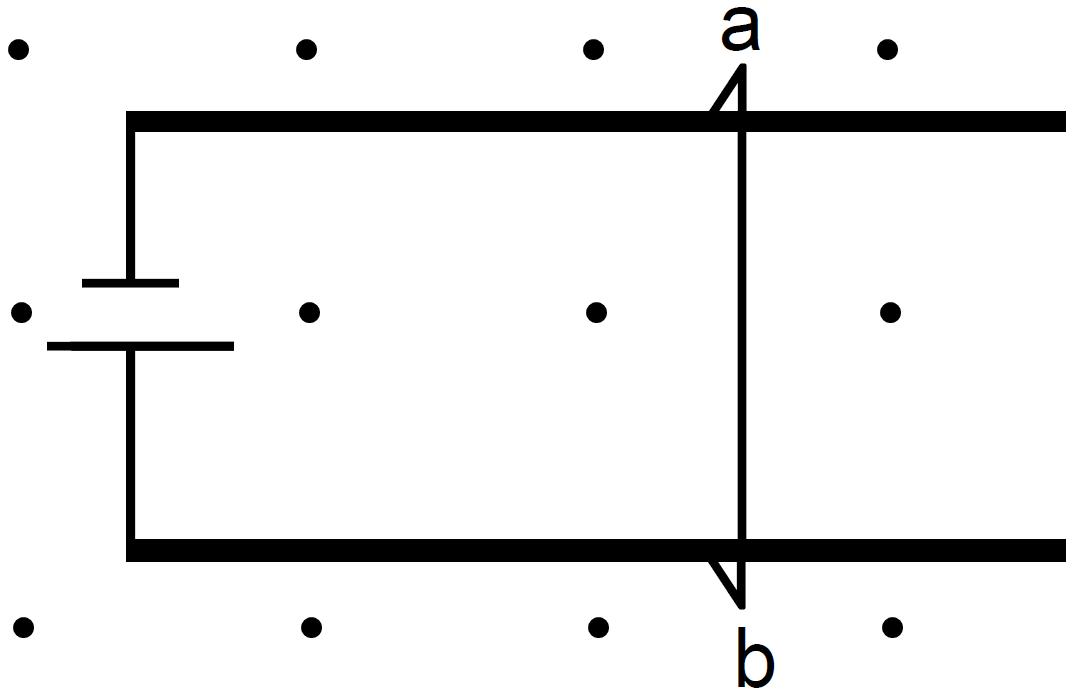
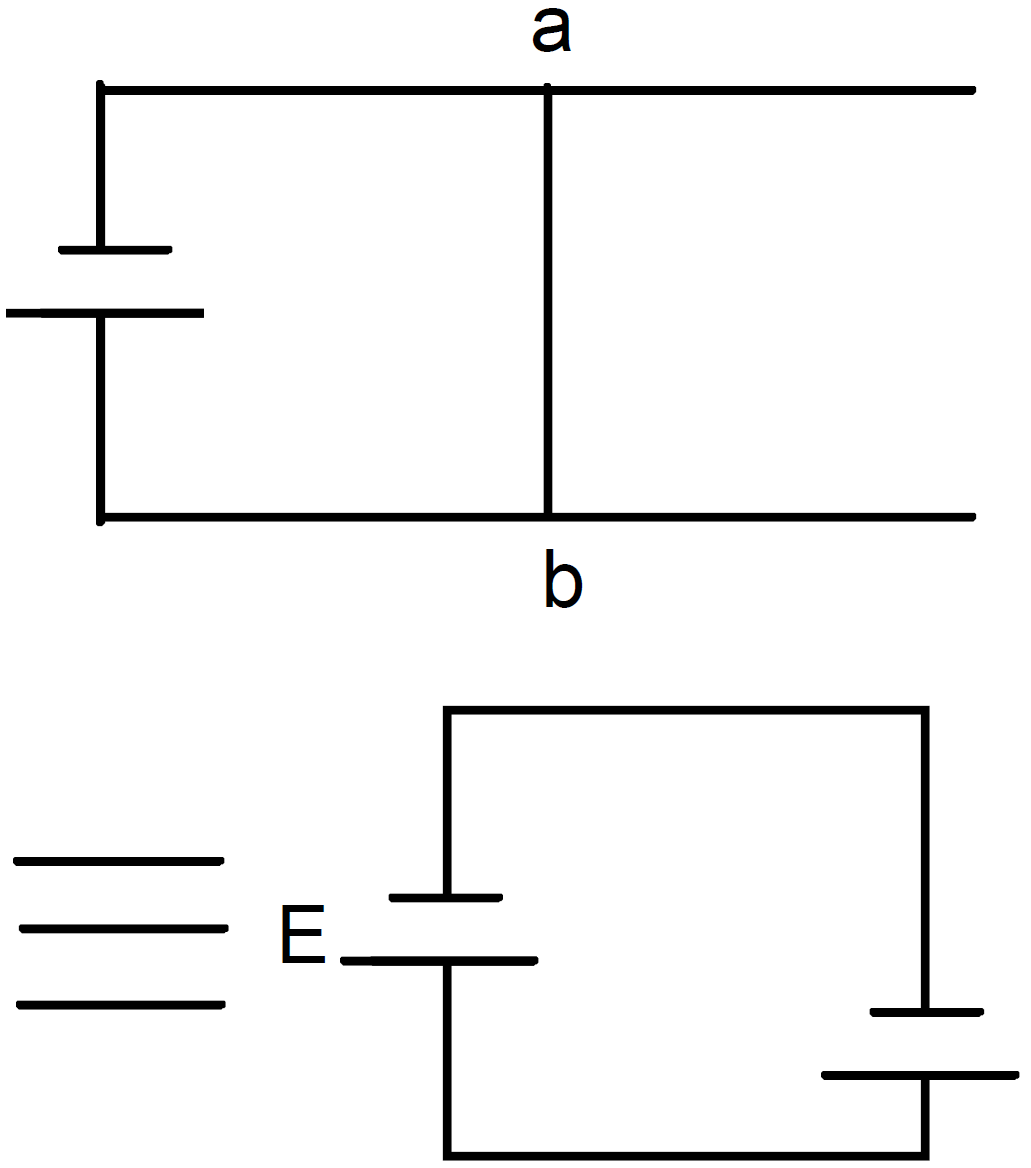 At the given instant, the net emf across the wire (e) is E - Bvl.
 We know
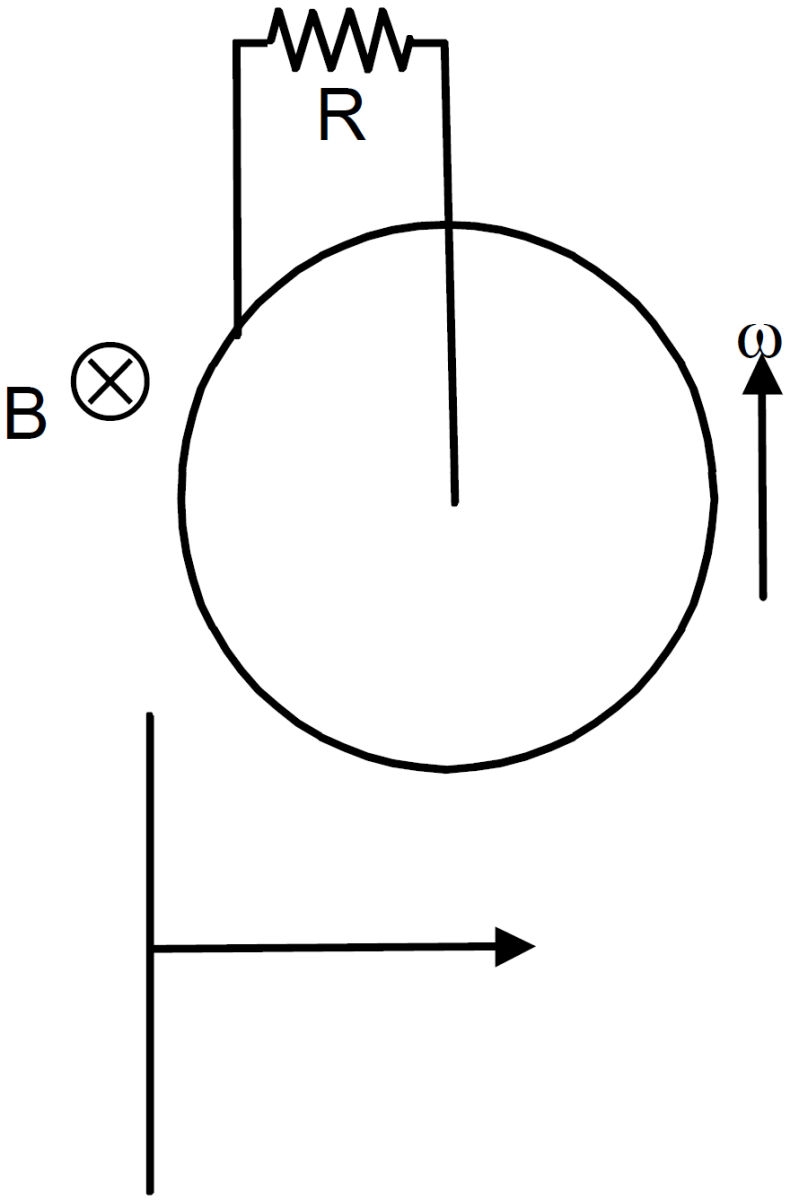 $\text{B}=0.40\text{T},\omega=10 \ \text{rad}/',\text{r}=10\Omega$