Question
  1. Consider an arbitrary electrostatic field configuration. A small test charge is placed at a null point (i.e., where E = 0) of the configuration. Show that the equilibrium of the test charge is necessarily unstable.
  2. Verify this result for the simple configuration of two charges of the same magnitude and sign placed a certain distance apart.

Answer

  1. Let the equilibrium of the test charge be stable. If a test charge is in equilibrium and displaced from its position in any direction, then it experiences a restorinq force towards a null point, where the electric field is zero. All the field lines near the null point are directed inwards towards the null point. There is a net inward flux of electric field through a closed surface around the null point. According to Gauss's law, the flux of electric field through a surface, which is not enclosing any charge, is zero. Hence, the equilibrium of the test charge can be stable.
  2. Two charges of same magnitude and same sign are placed at a certain distance. The mid-point of the joining line of the charges is the null point. When a test charged is displaced along the line, it experiences a restoring force. If it is displaced normal to the joining line, then the net force takes it away from the null point. Hence, the charge is unstable because stability of equilibrium requires restoring force in all directions.

Need a full question paper?

Generate a complete, print-ready paper with questions like this in minutes — across 16+ boards, with answer keys.

Start Generating Free

Similar questions

The number of electrons in an insulator is of the same order as the number of electrons in a conductor. What is then the basic difference between a conductor and an insulator?
Find the radius of gyration of a circular ring of radius r about a line perpendicular to the plane of the ring and passing through one of its particles.
A charge Q is uniformly distributed over a rod of length l. Consider a hypothetical cube of edge l with the centre of the cube at one end of the rod. Find the minimum possible flux of the electric field through the entire surface of the cube.
Figure, shows an aluminium wire of length 60cm joined to a steel wire of length 80cm and stretched between two fixed supports. The tension produced is 40N. The cross-sectional area of the steel wire is $1.0mm^2$ and that of the aluminium wire is $3.0 mm^2$. What could be the minimum frequency of a tuning fork which can produce standing waves in the system with the joint as a node? The density of aluminium is $2.6g/cm^3$ and that of steel is $7.8g/cm^3.$​​​​​​​
A potential difference V is applied across a conductor of length L and diameter D. How is the drift velocity, $V_d,$ of charge carriers in the conductor affected when (i) V is halved, (ii) L is doubled and (iii) D is halved? Justify your answer in each case.
A conducting sphere of radius 10 cm has an unknown charge. If the electric field 20 cm from the centre of the sphere is $1.5 \times 10^3 N/C$ and points radially inward, what is the net charge on the sphere?
Explain the phenomenon of nuclear fission.
Establish an expression for mobility by giving definition of mobility. Establish relation between mobility of free electrons and electric current.
Define magnetic susceptibility of a material. Name two elements, one having positive susceptibility and the other having negative susceptibility. What does negative susceptibility signify
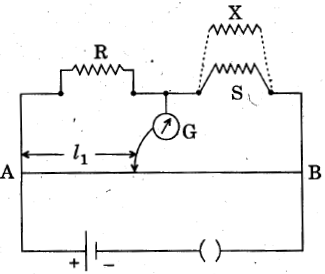
  1. State the principle of working of a meter bridge.
  2. In a meter bridge balance point is found at a distance $l_1$ with resistances R and S as shown in the figure.


When an unknown resistance X is connected in parallel with the resistance S, the balance point shifts to a distance $l_2$. Find the expression for X in terms of $l_1, l_2$ and S.