MCQ
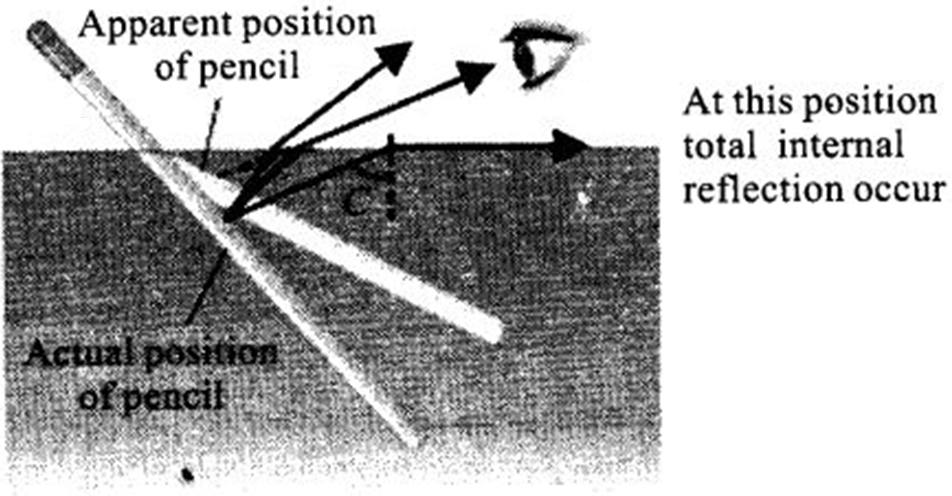
Consider an extended object immersed in water contained in a plane trough. When seen from close to the edge of the trough the object looks distorted because:
  • A
    The apparent depth of the points close to the edge are nearer the surface of the water compared to the points away from the edge.
  • B
    The angle subtended by the image of the object at the eye is smaller than the actual angle subtended by the object in air.
  • C
    Some of the points of the object far away from the edge may not be visible because of total internal reflection.
  • All of the above.

Answer

Correct option: D.
All of the above.
Solution:
Key concept: The light from the pencil is refracted when it passes from the water into air, bending away from the normal as it moves from high to low refractive index.

When light from the submerged object before reaching to the observer gets, refracted from water surface, the rays bend away from normal and the angle subtended by the image of the object at the eye is smaller than the actual angle subtended by the object in air. Also the apparent depth of the .points close to the edge are nearer the surface of the water compared to the points away from the edge.
As we move towards right, the angle of incident increases and becomes equal to critical angle. Hence some of the points of the object far away from the edge may not be visible because of total internal reflection.

Need a full question paper?

Generate a complete, print-ready paper with questions like this in minutes — across 16+ boards, with answer keys.

Start Generating Free

Similar questions

During a negative beta decay
A short bar magnet is placed in the magnetic meridian of the earth with north pole pointing north . Neutral points are found at a distance of $30\, cm$ from the magnet on the East - West line, drawn through the middle point of the magnet. The magnetic moment of the magnet in $Am^2$ is close to: (Given $\frac{{{\mu _0}}}{{4\pi }}\, = 10^{- 7}$ in $SI\,units$ and $B_H\, =$ Horizontal component field $= 3.6\times10^{-5}\, tesla$)
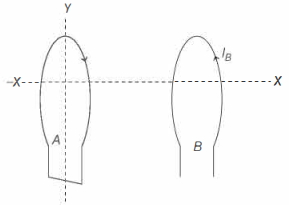
The diagram below shows two circular loops of wire ( $A$ and $B$ ) centred on and perpendicular to the $X$-axis and oriented with their planes parallel to each other. The $Y$-axis passes vertically through loop $A$ (dashed line). There is a current $I_B$ in loop $B$ as shown in the diagram. Possible actions which we might perform on loop $A$ are

$(I)$ move $A$ to the right along $X$-axis closer to $B$

$(II)$ move $A$ to the left along $X$-axis away from $B$

$(III)$ as viewed from above, rotate $A$ clockwise about $Y$-axis

$(IV)$ as viewed from above, rotate $A$ anti-clockwise about $Y$-axis

Which of the actions will induce a current in $A$ only in the direction shown?

Two concave lenses $L_1$ and $L_2$ are kept in contact with each other. If the space between the two lenses is filled with a material of refractive index $\mu\approx1,$ the magnitude of the focal length of the combination:
In the ideal double-slit experiment, when a glass-plate (refractive index $1.5$) of thickness t is introduced in the path of one of the interfering beams (wavelength $\lambda$), the intensity at the position where the central maximum occurred previously remains unchanged. The minimum thickness of the glass-plate is
Choose the correct statement
A magnifying glass is to be used at the fixed object distance of 1 inch. If it is to produce an erect image magnified 5 times its focal length should be
hoose the correct statement from the following:
Radius of a certain orbit of hydrogen atom is $8.48\mathring A $. If energy of electron in this orbit is $\mathrm{E} / \mathrm{x}$, then $\mathrm{x}=. . . . $

(Given $a_0=0.529 \mathring A, E=$ energy of electron in ground state)

When stopping potential is applied in an experiment on photoelectric effect, no photocurrent is observed. This means that: