MCQ
hoose the correct statement from the following:
  • A
    Electric lines of force never cross each other.
  • B
    Electric lines of force end at a positive.
  • C
    The electric field charge inside a conductor are infinity.
  • Lines of electric field point towards regions of lower potential.
Answer

Correct option: D.
Lines of electric field point towards regions of lower potential.
If the lines cross each other at a given location, then there must be two distinctly different values of electric field with their own individual direction at that given location. This could never be the case. Therefore the lines representing the field cannot cross each other at any given location.
Electric field end at a negative charge.
Along the electric field line potential drops.

Need a full question paper?

Generate a complete, print-ready paper with questions like this in minutes — across 16+ boards, with answer keys.

Start Generating Free

Similar questions

A beam of ions with velocity $2 \times {10^5}\,m/s$ enters normally into a uniform magnetic field of $4 \times {10^{ - 2}}\,tesla$. If the specific charge of the ion is $5 \times {10^7}\,C/kg$, then the radius of the circular path described will be.......$m$
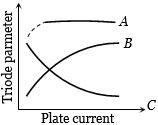
The figure represents variation of triode parameter ($\pi$ or $r_p$ or gm) with the plate current. The correct variation of $\mu$and rp are given, respectively by the curves
In $YDSE$ the separation between the slits is halved and the distance between slit and the screen is doubled. The fringe width is
The wavelength of $L_{\alpha}$ line in $X-$ray spectrum of $_{78}Pt$ is $1.32\  Å.$ The wavelength of $L_{\alpha}$ line in $X-$ray spectrum of another unknown element is $4.17\  Å.$ If screening constant for $L_{\alpha}$ line is $7.4,$ then atomic number of the unknown element is:
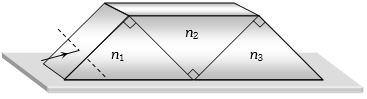
Three right angled prisms of refractive indices ${n_1},{n_2}$ and ${n_3}$ are fixed together using an optical glue as shown in figure. If a ray passes through the prisms without suffering any deviation, then
For a transistor, in a common emitter arrangement, the alternating current gain $\beta$ is given by
A positive point charge Q is brought near an isolated metal cube.
Assertion : A potentiometer of longer length is used for accurate measurement.
Reason : The potential gradient for a potentiometer of longer length with a given source of e.m.f. becomes small.
A homogeneous electric field E and a uniform magnetic field $\vec{B}$ are pointing in the same direction. A proton is projected with its velocity parallel to $\vec{E}$. It will
A current carrying wire in the neighborhood produces