Consider an NPN transistor amplifier in common-emitter configuration. The current gain of the transistor is $100.$ If the collector current changes by $1\ mA$, what will be the change in emitter current
[AllMS 2005]


Download our appand get started for free
Experience the future of education. Simply download our apps or reach out to us for more information. Let's shape the future of learning together!No signup needed.*
Similar Questions
- 1When plate voltage in diode valve is increased from $100$ volt to $150$ volt then plate current increases from $7.5\ mA$ to $12\ mA$. The dynamic plastic resistance will beView Solution
- 2A potential barrier of $0.50 \quad V$ exists across a $P-N$ junction. If the depletion region is $5.0 \times 10^{-7} m$ wide, the intensity of the electric field in this region isView Solution
- 3An $N$-type and $P$-type silicon can be obtained by doping pure silicon withView Solution
- 4In an amplifier the load resistance $R_L$ is equal to the plate resistance $\left(r_p\right)$. The voltage amplification is equal toView Solution
- 5In $P-N$ junction, avalanche current flows in circuit when biasing isView Solution
- 6View SolutionFor germanium crystal, the forbidden energy gap in joules is
- 7In an NPN transistor circuit, the collector current is $10 mA$. If $90 \%$ of the electrons emitted reach the collector, the emitter current ( $i$ ) and base current $(i)$ are given byView Solution
- 8View SolutionThe voltage gain of a triode depends upon
- 9Before the saturation state of a diode at the plate voltages of $400 V$ and $200 V$ respectively the currents are $i$ and $i$ respectively. The ratio $i / i$ will beView Solution
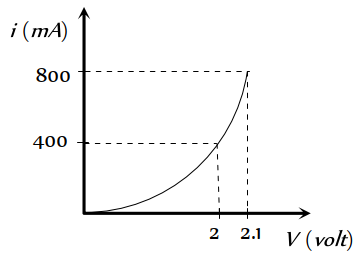
- 10The $i-V$ characteristic of a $P-N$ junction diode is shown below. The approximate dynamic resistance of the $P-N$ junction when a forward bias of $2$ volt is appliedView Solution