MCQ
Consider following compounds :
$(I)\, H_3X - NCS$        $(II)\,H_3Y - NCS$   $(III)\, (H_3X)_2O$   $(IV)\, (H_3Y)_2O$
The incorrect statement regarding given compound is
  • A
    If $Y$ is carbon in compounds $(II)$ and $(IV)$, then both are bent
  • If $X$ is silicon in compounds $(I)$ and $(lll)$, then both are linear
  • C
    If $X$ is carbon and $Y$ is silicon then compound $(I)$ is more basic- than  compound $(II)$
  • D
    If $X$ is silicon and $Y$ is carbon then $X-O-X$ bond angle compounds $(III)$ is  greater than $Y -O-Y$ bond angle in compounds $(IV)$

Answer

Correct option: B.
If $X$ is silicon in compounds $(I)$ and $(lll)$, then both are linear
b

Need a full question paper?

Generate a complete, print-ready paper with questions like this in minutes — across 16+ boards, with answer keys.

Start Generating Free

Similar questions

Consider the following reaction

$N _{2} O _{4}( g ) \rightleftharpoons 2 NO _{2}( g ) ; \Delta H ^{0}=+58 kJ$

For each of the following cases $(a, b),$ the direction in which the equilibrium shifts is:

$(a)$ Temperature is decreased

$(b)$ Pressure is increased by adding $N _{2}$ at constant $T$

A gas (Molar mass $=280\,g\,mol ^{-1}$ ) was burnt in excess $O _{2}$ in a constant volume calorimeter and during combustion the temperature of calorimeter increased from $298.0 K$ to $298.45\,K$. If the heat capacity of calorimeter is $2.5\,kJ\,K ^{-1}$ and enthalpy of combustion of gas is $9\,kJ\,mol ^{-1}$ then amount of gas burnt is $......g$. (Nearest Integer)
How many moles of $P_4$ can be produced by reaction of $0.10$ moles  $Ca_5(PO_4)_3F, 0.36$  moles $SiO_2$ and $0.90$ moles $C$ according to the following reaction?

$4C{a_5}{(P{O_4})_3}F + 18Si{O_2} + 30C \to 3{P_4} + 2Ca{F_2} + 18CaSi{O_3} + 30CO$

Boiling point of alkanes are:
Match List-$I$ with List-$II$
List -$I$ Molecule List - $II$ Shape
$(A)$.  $\mathrm{BrF}_5$ $(I)$.  $T$-shape
$(B)$.  $\mathrm{H}_2 \mathrm{O}$ $(II)$.  See saw
$(C)$.  $\mathrm{ClF}_3$ $(III)$.  Bent
$(D)$.  $\mathrm{SF}_4$ $(IV)$.  Square pyramidal
The end product $(C)$ in the following sequence of reactions is
 
$HC\, \equiv \,CH\,\xrightarrow[{20\% \,{H_2}S{O_4}}]{{1\% \,HgS{O_4}}}A$ $\xrightarrow[{{H_2}O}]{{C{H_3}MgX}}B\xrightarrow{{[O]}}(C)$
 
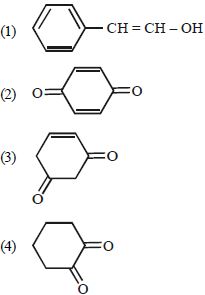
Tautomerism is exhibited by
When electron jumps from $N$ shell to $L$ shell, the energy is :
Which one has a pyramidal structure
$\begin{array}{*{20}{c}}
{C{H_3} - CH = C - C = CH - C{H_3}}\\
{|\,\,\,\,\,\,\,\,\,|}\\
{\,Br\,\,\,\,Br}
\end{array}$

How many geometrical isomers of this compound are possible ?