Question
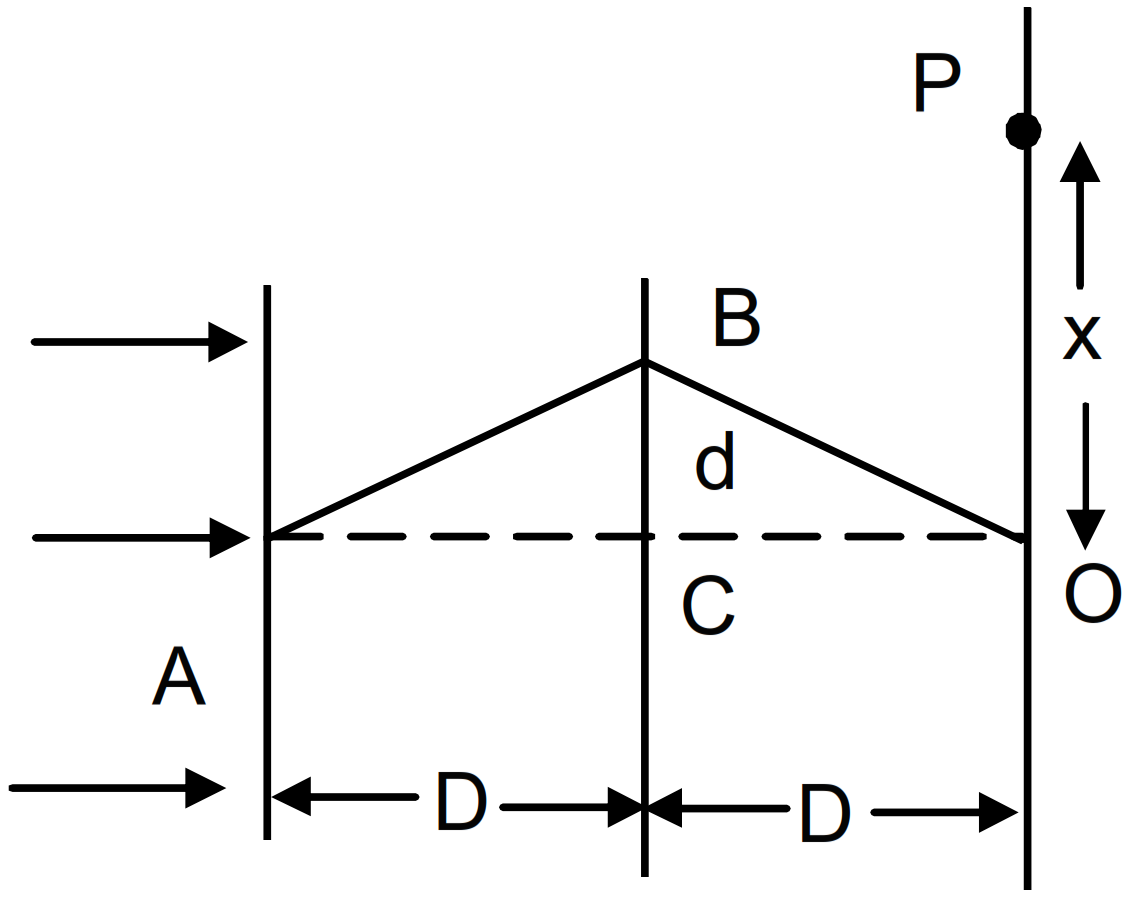
Consider the arrangement shown in figure (17-E4). The distance D is large compared to the separation d between the slits.
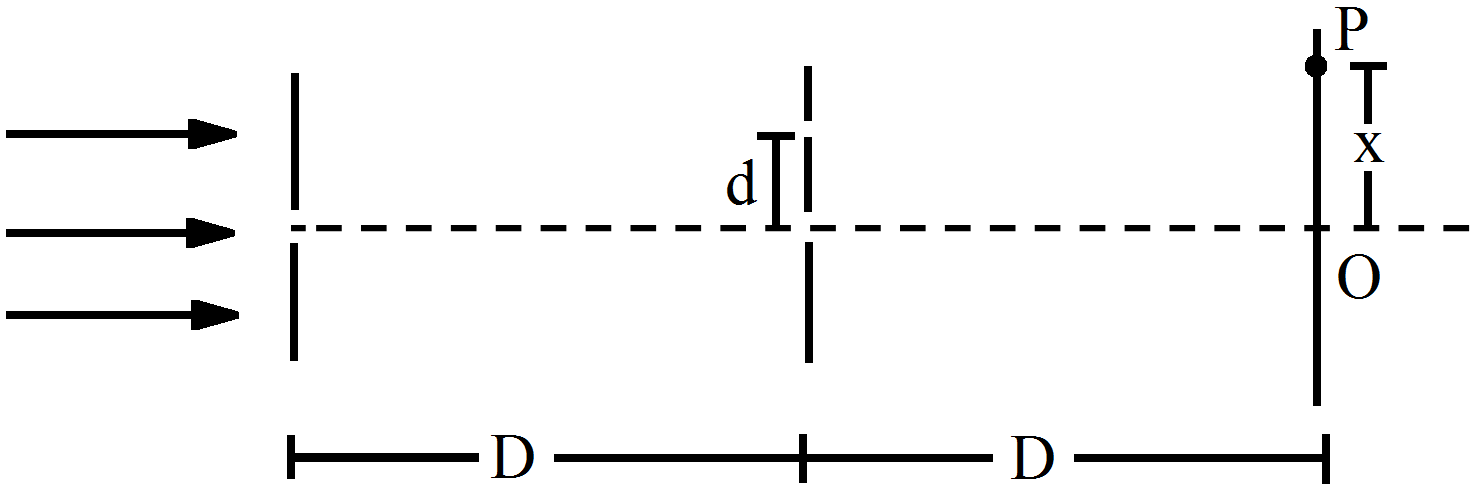
  1. Find the minimum value of d so that there is a dark fringe at 0.
  2. Suppose d has this value. Find the distance x at which the next bright fringe is formed.
  3. Find the fringe-width.

Answer

From the diagram, it can be seen that at point O. Path difference = (AB + BO) - (AC + CO) = 2(AB - AC) [Since, AB = BO and AC = CO] $=2\Big(\sqrt{\text{d}^2+\text{D}^2}-\text{D}\Big)$ For dark fringe, path difference should be odd multiple of $\frac{\lambda}{2}.$ So, $2\Big(\sqrt{\text{d}^2+\text{D}^2}-\text{D}\Big)=(2\text{n}+1)\Big(\frac{\lambda}{2}\Big)$$\Rightarrow\sqrt{\text{d}^2+\text{D}^2}=\text{D}+(2\text{n}+1)\Big(\frac{\lambda}{4}\Big)$
$\Rightarrow\text{D}^2+\text{d}^2=\text{D}^2+(2\text{n}+1)^2\frac{\lambda^2}{16}+(2\text{n}+1)\frac{\lambda\text{D}}{2}$
Neglecting, $(2\text{n}+1)^2\frac{\lambda^2}{16},$ as it is very small We get, $\text{d}=\sqrt{(2\text{n}+1)\frac{\lambda\text{D}}{2}}$ For minimum ‘d’, putting $\text{n}=0\Rightarrow\text{d}_\text{min}=\sqrt{\frac{\lambda\text{D}}{2}}.$

Need a full question paper?

Generate a complete, print-ready paper with questions like this in minutes — across 16+ boards, with answer keys.

Start Generating Free

Similar questions

A sample contains a mixture of $^{108}Ag$ and $^{110}Ag$ isotopes each having an activity of $8.0 \times 10^8$ disintegration per second. $^{110}Ag$ is known to have larger half-life than $^{108}Ag$. The activity A is measured as a function of time and the following data are obtained.
Time (s) Activity (A) ($10^8$ disinte- grations $s^{-1}$) Time (s) Activity (A) ($10^8$ disinte-grations $s^{-1}$)
20 11.799 200 3.0828
40 9.1680 300 1.8899
60 7.4492 400 1.1671
80 6.2684 500 0.7212
100 5.4115    
  1. Plot ln $\Big(\frac{\text{A}}{\text{A}_0}\Big)$ versus time.
  2. See that for large values of time, the plot is nearly linear. Deduce the half-life of $^{110}Ag$ from this portion of the plot.
  3. Use the half-life of $^{110}Ag$ to calculate the activity corresponding to $^{108}Ag$ in the first 50s.
  4. Plot In $\Big(\frac{\text{A}}{\text{A}_0}\Big)$ versus time for $^{108}Ag$ for the first 50s.
  5. Find the half-life of $^{108}Ag$.
Derive a relation for work done in a gravitational field. Using it, (i) find potential difference between a pair of points. (ii) express whether gravitational force is conservative or non-conservative.
Two identical metal balls one at $\text{T}_1=300\text{K}$ and the other at $\text{T}_2=600\text{K}$ are kept at a distance of 1m in vacuum. Will the temperatures equalise by radiation? Will the rate of heat gained by the colder sphere be proportional to $\text{T}_2^4-\text{T}_1^4$ as may be expected from the Stefan's law?
A great physicist of this century (PAM Dirac) loved playing with the numerical values of fundamental constants of nature. This led him to an interesting observation. Dirac found that from the basic constants of atomic physics $m_e, m_p$ and the gravitational constant G, he could arrive at a number with the dimension of time. Further, it was a very large number, its magnitude being close to the present estimate on the age of the universe (~15 billion yr). From the table of fundamental constants in this book, try to see if you too can construct this number (or any other interesting number you can think of). If its coincidence with the age of the universe were significant, what would this imply for the constancy of fundamental constants?
A metallic rod of length $1m$ is rigidly clamped at its midpoint. Longitudinal stationary waves are set up in the rod in such a way that there are two nodes on either side of the midpoint. The amplitude of an antinode is $2 \times 10^{-6}m$. Write the equation of motion at a point $2cm$ from the midpoint and those of the constituent waves in the rod. (Young's modulus = $2 \times 10^{11}Nm^{-2}$ and density = $8000kg m^{-3}$)
Draw the current-voltage characteristics for the device shown in figure. between the terminals A and B.
A parallel-plate capacitor has plate area $100cm^2$ and plate separation 1.0cm. A glass plate (dielectric constant 6.0) of thickness 6.0mm and an ebonite plate (dielectric constant 4.0) are inserted one over the other to fill the space between the plates of the capacitor. Find the new capacitance.
Explain two-dimensional motion by giving an example. Explain the displacement, velocity and acceleration of a particle in two-dimensional motion
Two lead spheres of 20cm and 2cm diameter respectively are placed with centres 100cm apart. Calculate the attraction between them, given the radius of the earth as $6.37 \times 10^8cm$ and its mean density as $5.53 \times 103kgm^{-3}$, specific gravity of lead = 11.5. If the lead spheres are replaced by brass spheres of the same radii, would the force of attraction be the same?
A gas mixture consists of $2.0$ moles of oxygen and $4.0$ moles of neon at temperature T. Neglecting all vibrational modes, calculate the total internal energy of the system. (Oxygen has two rotational modes.)