Question
Explain two-dimensional motion by giving an example. Explain the displacement, velocity and acceleration of a particle in two-dimensional motion

Answer

self

Need a full question paper?

Generate a complete, print-ready paper with questions like this in minutes — across 16+ boards, with answer keys.
Start Generating Free

Similar questions

  1. What is an adiabatic process? Derive expression for the work done during such process.
  2. A refrigerator is to maintain eatable kept inside at $9^\circ C$. If the room temperature is $36^\circ C$. Calculate the co-efficient of performance.
If the linear momentum is increased by 50%, what is the change in its kinetic energy?
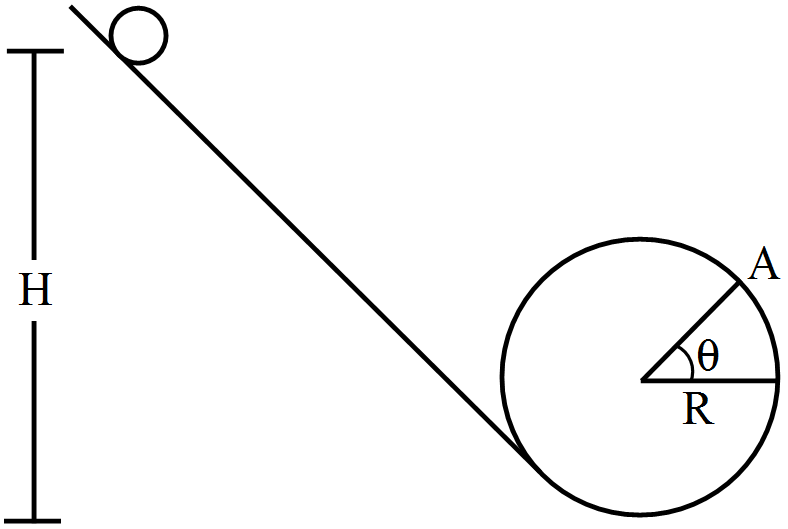
Figure shows a small spherical ball of mass m rolling down the loop track. The ball is released on the linear portion at a vertical height H from the lowest point. The circular part shown has a radius R.
  1. Find the kinetic energy of the ball when it is at a point A where the radius makes an angle $\theta$ with the horizontal.
  2. Find the radial and the tangential accelerations of the centre when the ball is at A.
  3. Find the normal force and the frictional force acting on the ball if H = 60cm, R = 10cm, $\theta=0 $ and m = 70g.
The distance between the centres of carbon and oxygen atoms in carbon monoxide gas molecules is $=1.13\mathring{\text{A}}.$ Locate the centre of mass of the molecules relative to carbon atom.
Write which two modifications van der Walls made in the equation of state, explain these by defining critical temperature critical pressure and critical volume and obtain their values.
A person is standing on a truck moving with a constant velocity of 14.7m/s on a horizontal road. The man throws a ball in such a way that it returns to the truck after the truck has moved 58.8m. Find the speed and the angle of projection:
  1. As seen from the truck.
  2. As seen from the road.
Liquid is flowing steadily through a pipe. Assume that the volume of the liquid flowing out per second depends on (a) the coefficient of viscosity of the liquid $(\eta)$(b) the radius of the pipe (r) and (c) the pressure gradient along the pipe (pressure gradient is drop in pressure per unit length of the pipe, and is equal to P/ l, where P is the difference between the ends of the pipe and I is the length of the pipe). The dimensions of viscosity is [$ML^{-1}T^{-1}$). Deduce by the method of dimensions, the formula for the volume of the liquid flowing out per second.
If one mole of a monoatomic gas is mixed with three moles of a diatomic gas. What is the molar specific heat of mixture at constant value? [Take, $R = 8.31 Jmol^{-1}K^{-1}$]
A thermally insulated, closed copper vessel contains water at $15^{\circ} C$. When the vessel is shaken vigorously for $15$ minutes, the temperature rises to $17^{\circ} C$. The .mass of the vessel is $100\ g$ and that of the water is $200\ g$ . The specific heat capacities of copper and water are $420 . kg ^{-1} K^{-1}$ and $4200\ Jkg ^{-1} K^{-1}$ respectively. Neglect any thermal expansion.
  1. How much heat is transferred to the liquid-vessel system?
  2. How much work has been done on this system?
  3. How much is the increase in internal energy of the system?
Derive a relation for work done in a gravitational field. Using it, (i) find potential difference between a pair of points. (ii) express whether gravitational force is conservative or non-conservative.