Question
A $5 ~ m$ long steel wire hanging from the ceiling of a room has a mass of 25 kg at a radius of 10 cm . The height of the ceiling is 5.21 m . When the body is made to oscillate, it passes through touching the floor. If $Y$ is $2 \times 10^{11} N / m ^2$ and the radius of the wire is 0.05 cm . If so, what will be the velocity of the body at its lowest point?
Answer

Depth of the centre of mass of the moving body (which is a sphere of radius 10 cm and 4 kg)
from the ceiling $=$ Length of the wire + Radius of the object
$\begin{array}{l}=5 m+10 cm \\=5+\frac{10}{100}=5.1 m\end{array}$
Depth of the lowest point of the object from the ceiling $=$ Length of the wire + Diameter of the object
$\begin{array}{l}=5 m+2 \times 10 cm \\=5.2 m\end{array}$
Height of the lowest point of the object from the floor $=$ Height of the ceiling from the floor - (Length of wire + Diameter of the object)
$=5.21-5.20=0.01 m$
$\because$ While oscillating, the body moves touching the floor at the lowest point.
$\therefore$ Increase in length of wire at lowest point $=$ 0.01 m and depth from the ceiling of the centre of mass of the body $=5.1+0.01=5.11 m$
Force applied on the body due to increase in length of wire by 0.01 m
$F=\frac{YAl}{L}$
Here, $\Delta L =$ Increase in length, $A =$ Cross-sectional area, $Y=$ Young's Modulus of elasticity of material of a wire, $L =$ Original length.
$\begin{aligned}
\therefore \quad F & =\frac{Y \times \pi r^2 l}{L} \\& =\frac{2 \times 10^{11} \times 3.14 \times\left(5 \times 10^{-4}\right)^2 \times(0.01)}{5} \\F & =\frac{2 \times 10^{11} \times 3.14 \times 25 \times 10^{-8} \times 10^{-2}}{5} \\
F & =\frac{2 \times 3.14 \times 25 \times 10^1}{5}=314 N\end{aligned}$
The second force on the object is its weight
$W=mg=25 \times 9.8$
$=245 N$, this force is applied downwards
Resultant force on the object
$F=314-245=69 N \text { upwards. }$
$\therefore$ The motion of the body is circular motion and provides resultant centripetal force on the body, if $v$ is the velocity of the body at lowest point then
$\begin{aligned}\frac{m v^2}{r} & =F^{\prime} \\\frac{25 \times v^2}{5.11} & =F^{\prime}=69 \\v^2 & =\frac{69 \times 5.11}{25} \\v & =\sqrt{\frac{69 \times 5.11}{25}} \\& =3.76 m / s\end{aligned}$

Need a full question paper?

Generate a complete, print-ready paper with questions like this in minutes — across 16+ boards, with answer keys.

Start Generating Free

Similar questions

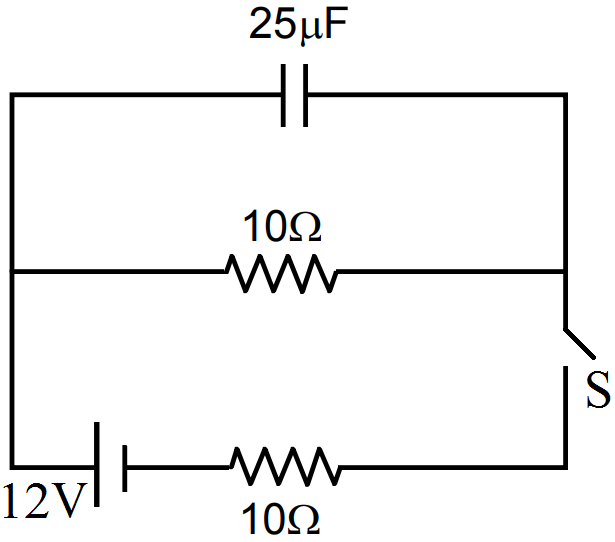
The switch S shown in figure. is kept closed for a long time and is then opened at t = 0. Find the current in the middle $1.0\Omega$ resistor at t = 1ms.
A vessel of volume $V_0$ contains an ideal gas at pressure $P_0$ and temperature T. Gas is continuously pumped out of this vessel at a constant volume-rate dV I dt = r keeping the temperature constant. The pressure of the gas being taken out equals the pressure inside the vessel. Find, (1) the pressure of the gas as a function of time. (2) the time taken before half the original gas is pumped out.
  1. Discuss the motion of a body in a vertical circle. Find the expressions for the minimum velocity at the lowest and highest points while looping a loop.
  2. A bullet of mass $0.01\ kg$ travelling at a speed of $500m/ s$ strikes a block of mass $2\ kg$ which is suspended by a string of length $5m$. The centre of gravity of the block is found to rise a vertical distance of $0.1 m$. What is the speed of the bullet after it emerges from the block? $(g = 9.8ms^{-2})$
Define molar specific heat capacities at constant volume and pressure. Considering thermodynamical process in a cylinder with parameters P, V and T, derive the Mayer's relation.
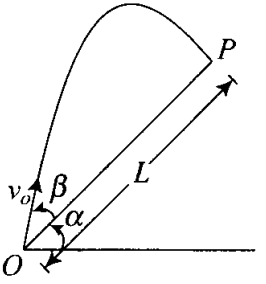
A particle is projected in air at an angle $\beta$ to a surface which itself is inclined at an angle $\alpha$ to the horizontal (Fig.).
  1. Time of flight.
(Hint: This problem can be solved in two different ways:
  1. Point P at which particle hits the plane can be seen as intersection of its trajectory (parobola) and straight line. Remember particle is projected at an angle $(\alpha+\beta)$ w.r.t. horizontal.
  2. We can take x-direction along the plane and y-direction perpendicular to the plane. In that case resolve g (acceleration due to gravity) in two differrent components, $g_x$ along the plane and $g_y$ perpendicular to the plane. Now the problem can be solved as two independent motions in x and y directions respectively with time as a common parameter.)
The speed of a motor launch w.r.t still water is $7ms^{-1}$ and the speed of the stream is $3ms^{-1}$. When the launch began travelling upstream, a float was dropped from it. The launch travelled $4.2km$ upstream, turned about and caught up with the float. How long is it, before the launch reached the float?
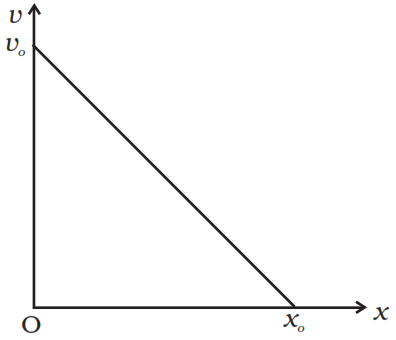
The velocity$-$displacement graph of a particle is shown in Fig.
  1. Write the relation between $v$ and $x$.
  2. Obtain the relation between acceleration and displacement and plot it.
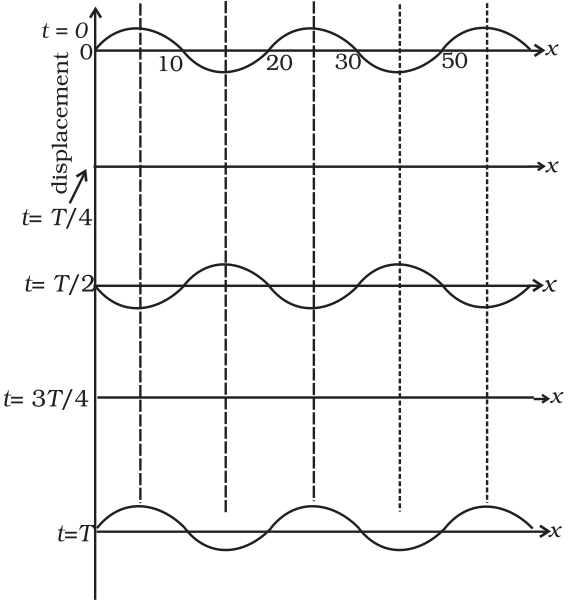
The wave pattern on a stretched string is shown in Interpret what kind of wave this is and find its wavelength.
A marble rolls along a table at a constant speed of $1.00 m / s$ and then falls off the edge of the table to the floor 1.00 m below,
i. How long does the marble take to reach the floor?
ii. At what horizontal distance from the edge of the table does the marble land?
iii. What is its velocity as it strikes the floor?
Show analytically that work done by one mole of an ideal gas during isothermal expansion from volume $V_1$ to volume $V_2$​​​​​​​ is given by, $\text{W}=\text{RT}\log_\text{e}\Big(\frac{\text{V}_2}{\text{V}_1}\Big)$