Question
Consider the decomposition of hydrogen peroxide in alkaline medium which is catalysed by iodide ions.
$\text{2H}_2\text{O}_2\xrightarrow{\text{OH}^-}2\text{H}_2\text{O}+\text{O}_2$
This reaction takes place in two step as given below:
Step-I $\text{H}_2\text{O}_2+\text{I}^-\rightarrow\text{H}_2\text{O}_2+\text{IO}^-\text{ (slow)}$
Step-II $\text{H}_2\text{O}_2+\text{IO}^-\rightarrow\text{H}_2\text{O}_2+\text{I}+\text{O}_2\text{ (fast})$
  1. Write the rate law expression and determine the order of reaction $w.r.t. H_2O_2.$
  2. What is the molecularity of each individual step?
Answer

  1. Rate $= K[H_2O_2]^1 [I^-]^1$
  1. Order of reaction $w.r.t.H_2O_2 = 1.$
  2. Molecularity of step $I = 2$ amd step $II = 2.$

Need a full question paper?

Generate a complete, print-ready paper with questions like this in minutes — across 16+ boards, with answer keys.

Start Generating Free

Similar questions

The following data were obtained during the first order thermal decomposition of $SO_2Cl_2$ at a constant volume:
$\ce{SO_2Cl_2(g) \rightarrow SO_2(g) + Cl_2(g)}$
Experiment
Time/s$^{–1}$
Total pressure/atm
$1$ $0$ $0.4$
$2$ $100$ $0.7$
Calculate the rate constant.
$($Given: $\ce{log4 = 0.6021, log2 = 0.3010).}$
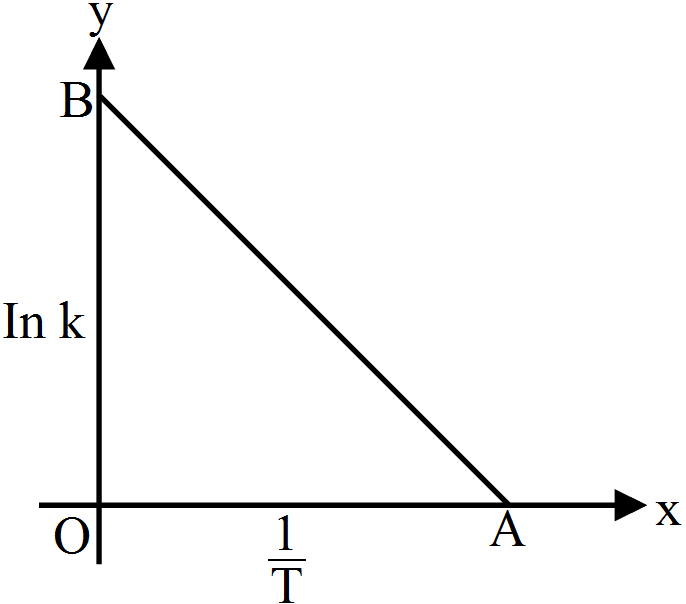
A graph between ln $k$ and $\frac{1}{\text{t}}$ for a reaction is given. Here $k$ is rate constant and $T$ is temperature in Kelvin.If $OA = a$ and $OB = b,$ answer the following:
  1. What is the activation energy $(Ea)$ of the reaction?
  2. What is the frequency factor $(A)$ for the reaction?
For a reaction $2 H _2 O _2 \frac{ I ^{-}}{\text {alkaline medium }} 2 H _2 O + O _2$
the proposed mechanism is as given below:
(1) $H_{2}O_{2}+I^{-}\rightarrow H_{2}O+IO^{-}$ (slow)
(2) $H_{2}O_{2}+IO^{-}\rightarrow H_{2}O+I^{-}+O_{2}$ (fast)
(i) Write rate law for the reaction.
(ii) Write the overall order of reaction.
(iii) Out of steps (1) and (2), which one is rate determining step?
An antifreeze solution is prepared from 222.6 g of thylene glycol (C2H6O2) and 200 g of water. Calculate the molality of the solution. If the density of the solution is $1.072 g mL ^{-1}$ , then what shall be the molarity of the solution?
How do you convert the following:
  1. Prop-1-ene to Propan-2-ol
  2. Bromobenzene to 2-bromoacetophenone
  3. 2-bromobutane to But-2-ene
$\text{E}^\ominus V$ of $Cu$ is $+ 0.34V$ while that of $Zn$ is $– 0.76V.$ Explain.
Explain optical isomerism in co$-$ordination compound.
What are alloys? Name an important alloy which contains some of the lanthanoid metals. Mention its uses.
  1. Explain why an alkylamine is more basic than ammonia.
  2. How would you convert:
  1. Aniline to nitrobenzene.
  2. Aniline to iodobenzene?
Write the mechanism of hydration of ethene to yield ethanol.