Question
  1. Explain why an alkylamine is more basic than ammonia.
  2. How would you convert:
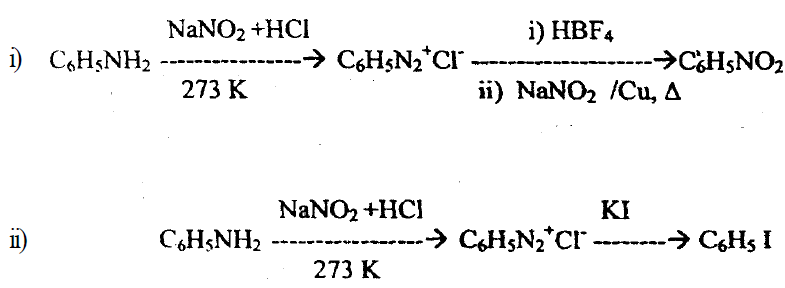
  1. Aniline to nitrobenzene.
  2. Aniline to iodobenzene?

Answer

  1. Due to +1 effect/electron donating character of alkyl group, alkylamine is more basic than ammonia.
  2.  

Need a full question paper?

Generate a complete, print-ready paper with questions like this in minutes — across 16+ boards, with answer keys.

Start Generating Free

Similar questions

The following data were obtained during the first order thermal decomposition of $\ce{SO2Cl2}$ at a constant volume.
$\ce{SO2Cl2 (g) \rightarrow SO2 (g) + Cl2 (g)}$
Experiment $\ce{Time/s}^{-1}$ $\ce{Total pressure/atm}$
$1$ $0$ $0.5$
$2$ $100$ $0.6$
Calculate the rate of the reaction when total pressure is $0.65\ \ce{atm}.$
Calculate the boiling point of a $1M$ aqueous solution $($density $1.04g\ mL^{-1})$ of potassium chloride $(K_b$ for water $= 0.52K \ kg\ mol^{-1},$ Atomic masses: $K = 39u, Cl = 35.5u)$ Assume, potassium chloride is completely dissociated in solution.
Give the formula of each of the following coordination entities:
  1. $Co^{3+}$ ion is bound to one $Cl^–,$ one $NH_3$ molecule and two bidentate ethylenediamine $($en$)$ molecules.
  2. $Ni^{2+}$ ion is bound to two water molecules and two oxalate ions.
Write the name and magnetic behaviour of each of the above coordination entities$.($At. nos. $Co = 27, Ni = 28).$

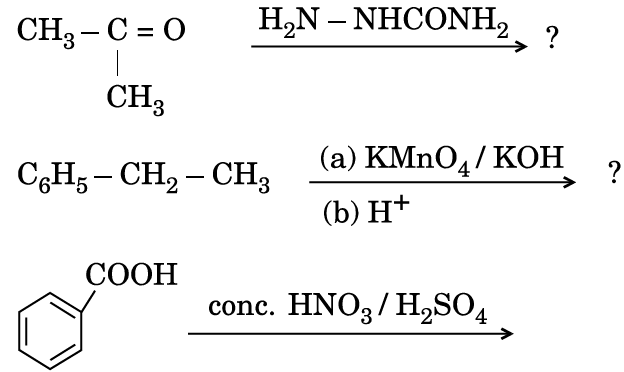
Predict the products of the following reactions:
The decomposition of $NH_3$ on platinum surface is zero order reaction. If rate constant (k) is $4\times10^{-3}Ms^{-1},$ how long will it take to reduce the initial concentration of $NH_{3}$ from 0.1 M to 0.064 M.
(a) Which is the salt of Mn which is isostructural to $KClO _4$ ?
(b) Explain the structure and magnetic properties of manganese and permanganate ions.
A current of $1.50A $ was passed through an electrolytic cell containing $AgNO_3$ solution with inert electrodes. The weight of Ag deposited was $1.50g$. How long did the current flow?
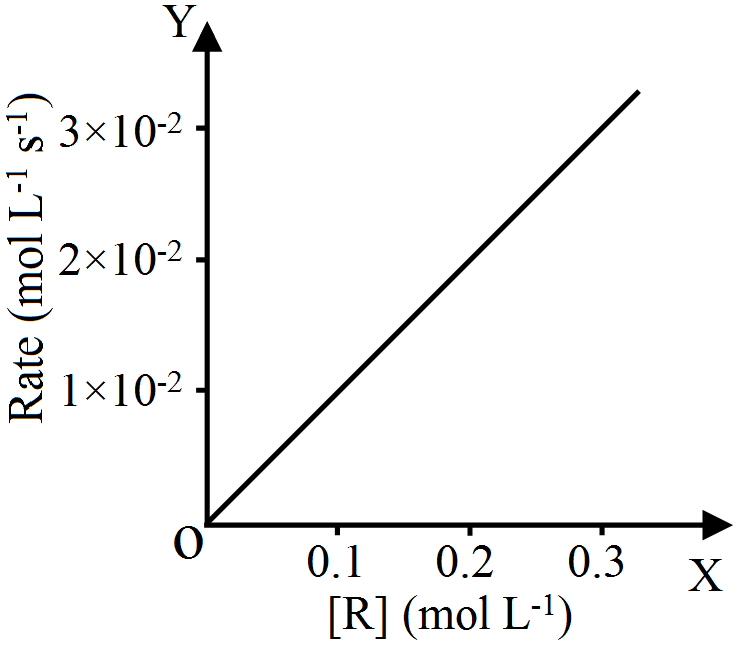
The rate for the reaction $R\rightarrow P$ is rate $= k[R].$ It has been shown graphically below. What is rate constant for the reaction?
Short note on: Maltose
Explain optical isomerism in co$-$ordination compound.