Consider the following
$I.$ Waves created on the surfaces of a water pond by a vibrating sources.
$II.$ Wave created by an oscillating electric field in air.
$III.$ Sound waves travelling under water.
Which of these can be polarized
Easy


Download our appand get started for free
Experience the future of education. Simply download our apps or reach out to us for more information. Let's shape the future of learning together!No signup needed.*
Similar Questions
- 1View SolutionStationary waves are formed when
- 2The tension of a stretched string is increased by $69\%$. In order to keep its frequency of vibration constant, its length must be increased by ..... $\%$View Solution
- 3$y = a\cos (kx + \omega t)$ superimposes on another wave giving a stationary wave having node at $x = 0.$ What is the equation of the other waveView Solution
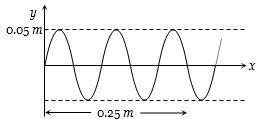
- 4If the speed of the wave shown in the figure is $330m/s$ in the given medium, then the equation of the wave propagating in the positive $x-$direction will be (all quantities are in $M.K.S.$ units)View Solution
- 5Two waves are represented by ${y_1} = a\sin \left( {\omega \,t + \frac{\pi }{6}} \right)$ and ${y_2} = a\cos \omega \,t$. What will be their resultant amplitudeView Solution
- 6Equation of motion in the same direction is given by ${y_1} = A\sin (\omega t - kx)$, ${y_2} = A\sin (\omega t - kx - \theta )$. The amplitude of the medium particle will beView Solution
- 7The phase difference between two waves represented byView Solution
${y_1} = {10^{ - 6}}\sin [100\,t + (x/50) + 0.5]m$
${y_2} = {10^{ - 6}}\cos \,[100\,t + (x/50)]m$
where $ x$ is expressed in metres and $t$ is expressed in seconds, is approximately .... $ rad$
- 8The wavelength is $120 cm$ when the source is stationary. If the source is moving with relative velocity of $60\, m/sec$ towards the observer, then the wavelength of the sound wave reaching to the observer will be ... $cm$ (velocity of sound $= 330 \,m/s$)View Solution
- 9A student plotted the following four graphs representing the variation of velocity of sound in a gas with the pressure $P$. Which one is correctView Solution
- 10The average density of Earth’s crust $10\ km$ beneath the surface is $2.7\ gm/cm^3$ . The speed of longitudinal seismic waves at that depth is $5.4\ km/s$ . The bulk modulus of Earth’s crust considering its behaviour as fluid at that depth isView Solution