Consider the following two statements.
$(A)$ Kirchhoff's junction law follows from the conservation of charge.
$(B)$ Kirchhoff's loop law follows from the conservation of energy.
Which of the following is correct ?
AIPMT 2010, Easy
Download our app for free and get started
Kirchhoff's junction law or Kirchhoff's first law is based on the conservation of charge. Kirchhoff's loop law or Kirchhoff's second law is based on the conservation of energy.
Hence both statements $(A)$ and $(B)$ are correct.
Hence both statements $(A)$ and $(B)$ are correct.

Download our appand get started for free
Experience the future of education. Simply download our apps or reach out to us for more information. Let's shape the future of learning together!No signup needed.*
Similar Questions
- 1Drift speed of electrons, when $1.5\, A$ of current flows in a copper wire of cross section $5\, mm^2$, is $v$. If the electron density in copper is $9 \times 10^{28}\, m^3$ the value of $v$ in $mm/s$ is close to (Take charge of electron to be $= 1.6 \times 10^{-19}\, C$)View Solution
- 2Two resistances equal at $0\,^oC$ with temperature coefficient of resistance $\alpha _1$ and $\alpha _2$ joined in series act as a single resistance in a circuit. The temperature coefficient of their single resistance will beView Solution
- 3A parallel combination of two resistors, of $1 \,\Omega$ each, is connected in series with a $1.5 \,\Omega$ resistor. The total combination is connected across a $10\, V$ battery. The current flowing in the circuit is .............. $A$View Solution
- 4A heater draws a current of $2\,A$ when connected to a $250\,V$ source. The rate of energy dissipation is ............. $W$View Solution
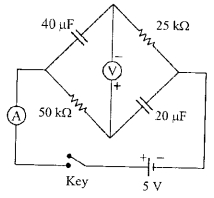
- 5In the circuit shown below, the key is pressed at time $t=0$. Which of the following statement(s) is(are) true?View Solution
($A$) The voltmeter displays $-5 \mathrm{~V}$ as soon as the key is pressed, znd displays $+5 \mathrm{~V}$ after a long time
($B$) The voltmeter will display $0 \mathrm{~V}$ at time $t=\ln 2$ seconds
($C$) The current in the ammeter becomes $1 / e$ of the initial value after $1$ second
($D$) The current in the ammeter becomes zero after a long time
- 6How much energy in kilowatt hour is consumed in operating ten $50\, watt$ bulbs for $10$ hours per day in a month ($30$ days).View Solution
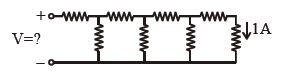
- 7Each element in the finite chain of resistors shown in the figure is $\,1\,\Omega $ . A current of $1\, A$ flows through the final element. Then what is the potential difference $V$ across input terminals of the chain .................. $\mathrm{volt}$View Solution
- 8The temperature dependence of resistances of $Cu$ and undoped $Si$ in the temperature range $300-400\ K$, is best described byView Solution
- 9The lowest resistance which can be obtained by connecting $10$ resistors each of $1/10$ $ohm$ isView Solution
- 10A wire has a resistance of $12\, ohm$. It is bent in the form of equilateral triangle. The effective resistance between any two corners of the triangle isView Solution