Two resistances equal at $0\,^oC$ with temperature coefficient of resistance $\alpha _1$ and $\alpha _2$ joined in series act as a single resistance in a circuit. The temperature coefficient of their single resistance will be
AIIMS 2011, Medium


Download our appand get started for free
Experience the future of education. Simply download our apps or reach out to us for more information. Let's shape the future of learning together!No signup needed.*
Similar Questions
- 1The series combination of two batteries, both of the same emf $10 \mathrm{\;V},$ but different internal resistance of $20\; \Omega$ and $5\; \Omega,$ is connected to the parallel combination of two resistors $30\; \Omega$ and $\mathrm{R}\; \Omega .$ The voltage difference across the battery of internal resistance $20\; \Omega$ is zero, the value of $\mathrm{R}(\text { in } \Omega)$ isView Solution
- 2Assertion : The current density $\vec J$ at any point in ohmic resistor is in direction of electric field $\vec E$ at that point.View Solution
Reason : A point charge when released from rest in a region having only electrostatic field always moves along electric lines of force.
- 3If $n, e, \tau$ and $m$ are representing electron density, charge, relaxation time and mass of an electron respectively, then the resistance of a wire of length / and cross-sectional area $A$ is given byView Solution
- 4A student measures the terminal potential difference $(V)$ of a cell $($ of $emf \;\varepsilon $ and internal resistance $r)$ as a function of the current $(I)$ flowing through it. The slope, and intercept, of the graph between $V$ and $I$, then, respectively, equalView Solution
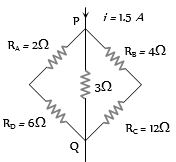
- 5Potential difference between the points $P$ and $Q$ in the electric circuit shown is ................. $V$View Solution
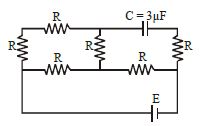
- 6In steady state the potential difference across the capacitor is $10\,\, V.$ Each resistance is of $3\,\Omega $. The cell is ideal. The $emf$ of the cell is .............. $\mathrm{V}$View Solution
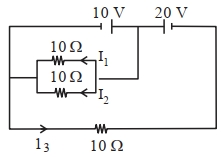
- 7In the given circuit the value of $\left|\frac{I_1+I_3}{I_2}\right|$ isView Solution
- 8The resistance of an electrical toaster has a temperature dependence given by $R\left( T \right) = {R_0}\left[ {1 + \alpha \left( {T - {T_0}} \right)} \right]$ in its range of operation. At ${T_0} = 300\,K,R = 100\,\Omega $ and at $T = 500\,K,\,R = 120\,\Omega $. The toaster is connected to a voltage source at $200\, V$ and its temperature is raised at a constant rate from $300$ to $500\, K$ in $30\, s$. The total work done in raising the temperature isView Solution
- 9The thermo $e.m.f.$ of a thermo-couple is $25\,\mu V{/^o}C$ at room temperature. A galvanometer of $40\, ohm$ resistance, capable of detecting current as low as ${10^{ - 5}}\,A,$ is connected with the thermocouple. The smallest temperature difference that can be detected by this system is ................ $^oC$View Solution
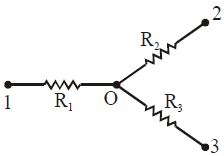
- 10.............. $A$ the current flowing through the resistance $R_2$ of the circuit shown in fig if the resistance are equal to $R_1 = 20\ \Omega, R_2 = 30 \ \Omega$ and $R_3 = 60 \ \Omega$ and potentials of points $1, 2$ and $3$ are equal to $V_1= 20\, V,$ $V_2 = 30\ V$ and $V_3 = 60\ V$View Solution