MCQ
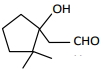
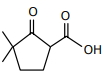
Consider the given reaction, the product $'X^{\prime}$ is:
  • A

  • B

  • C


Answer

Correct option: D.

d
Aldol reaction and than iodo form reaction.

Need a full question paper?

Generate a complete, print-ready paper with questions like this in minutes — across 16+ boards, with answer keys.
Start Generating Free

Similar questions

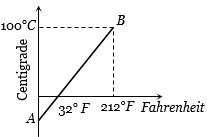
The graph $AB$ shown in figure is a plot of temperature of a body in degree celsius and degree Fahrenheit. Then
A conducting loop of radius $\frac{10}{\sqrt{\pi}}\,cm$ is placed perpendicular to a uniform magnetic field of $0.5\,T$. The magnetic field is decreased to $zero$ in $0.5\,s$ at a steady rate. The induced emf in the circular loop at $0.25\,s$ is:
Assertion: A double convex lens $(\mu = 1.5)$ has focal length $10\,cm$. When the lens is immersed in water $(\mu = 4/3)$ its focal length becomes $40\,cm$

Reason: $\frac{1}{f} = \frac{{{\mu _1} - {\mu _m}}}{{{\mu _m}}} \left( {\frac{1}{{{R_1}}} - \frac{1}{{{R_2}}}} \right)$
If the magnetizing field on a ferromagnetic material is increased, its permeability
The mobility of free electron is greater than that of free holes because
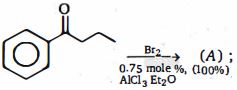
Product $(A)$ of the above reaction is (bromination occur not in the benzene ring)
It is preferable to measure the $e.m.f.$ of a cell by potentiometer than by a voltmeter because of the following possible reasons.
$(i)$ In case of potentiometer, no current flows through the cell.
$(ii)$ The length of the potentiometer allows greater precision.
$(iii)$ Measurement by the potentiometer is quicker.
$(iv)$ The sensitivity of the galvanometer, when using a potentiometer is not relevant.
Which of these reasons are correct?
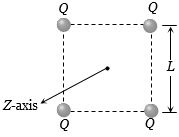
Four point $+ve$ charges of same magnitude $(Q)$ are placed at four corners of a rigid square frame as shown in figure. The plane of the frame is perpendicular to $Z$ axis. If a $-ve$ point charge is placed at a distance $z$ away from the above frame $(z<< L)$ then
The gravitational force on a body of mass $1.5 \,kg$ situated at a point is $45 \,N$. The gravitational field intensity at that point is ......... $N / kg$
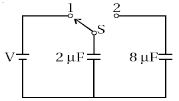
A capacitor of $2\,\, \mu F$ is charged as shown in the diagram. When the switch $S$ is turned to position $2,$ the percentage of its stored energy dissipated is ......$\%$