Question
Consider the mapping $f: A \rightarrow B$ is defined by $f(x) = x - $1 such that $f$ is a bijection.
Based on the above information, answer the following questions.
  1. Domain of $f$ is:
  1. $R - \{2\}$
  2. $R$
  3. $R -\{1, 2\}$
  4. $R - \{0\}$
  1. Range of $f$ is:
  1. $R$
  2. $R - \{2\}$
  3. $R -\{0\}$
  4. $R - \{1, 2\}$
  1. If $g: R - \{2\} \rightarrow R - \{1\}$ is defined by $g(x) = 2f(x) - 1,$ then $g(x)$ in terms of $x$ is:
  1. $\frac{\text{x}+2}{\text{x}}$
  2. $\frac{\text{x}+1}{\text{x}-2}$
  3. $\frac{\text{x}-2}{\text{x}}$
  4. $\frac{\text{x}}{\text{x}-2}$
  1. The function g defined above, is:
  1. One-one
  2. Many-one
  3. into
  4. None of these
  1. A function $f(x)$ is said to be one-one iff.
  1. $f(x_1) = f(x_2) \Rightarrow -x_1= x_2$ 
  2. $f(-x_1) = f(-x_2) \Rightarrow -x_1 = x_2$ 
  3. $f(x_1) = f(x_2) \Rightarrow x_1 = x_2$ 
  4. None of these

Answer

  1. (a) $R - \{2\}$
Solution:

For $f(x)$ to be defined $x - 2; ≠ 0$ i.e., $x; ≠ 2.$

$\therefore$ Domain of $f = R - \{2\}$
  1. (b) $R - \{2\}$
Solution:

Let $y = f(x)$, then $\text{y}=\frac{\text{x}-1}{\text{x}-2}$

$\Rightarrow xy - 2y = x - 1 \Rightarrow xy - x = 2y -$
$\Rightarrow\text{x}=\frac{2\text{y}-1}{\text{y}-1}$

Since, $x \in R - \{2\},$ therefore $y ≠ 1$

Hence, range of $f = R - \{1\}$
  1. (d) $\frac{\text{x}}{\text{x}-2}$
Solution:

We have, $g(x) = 2f(x) - 1$

$=2\Big(\frac{\text{x}-1}{\text{x}-2}\Big)-1=\frac{2\text{x}-2-\text{x}+2}{\text{x}-2}=\frac{\text{x}}{\text{x}-2}$
  1. (a) One-one
Solution:

We have, $g(x)  =\frac{\text{x}}{\text{x}-2}$

Let $g(x_1) = g(x_2) \Rightarrow\frac{\text{x}_1}{\text{x}_{1}-2}=\frac{\text{x}_2}{\text{x}_{2}-2}$

$\Rightarrow x_1x_2 - 2x_1 = x_1x_2 - 2x_2 \Rightarrow 2x_1 = 2x_2 \Rightarrow x_1 = x_2$

Thus, $g(x_1) = g(x_2) \Rightarrow x_1= x_2$​​​​​​​

Hence, $g(x)$ is one-one.
  1. (c) $f(x_1) = f(x_2) \Rightarrow x_1 = x_2$​​​​​​​​​​​​​​

Need a full question paper?

Generate a complete, print-ready paper with questions like this in minutes — across 16+ boards, with answer keys.

Start Generating Free

Similar questions

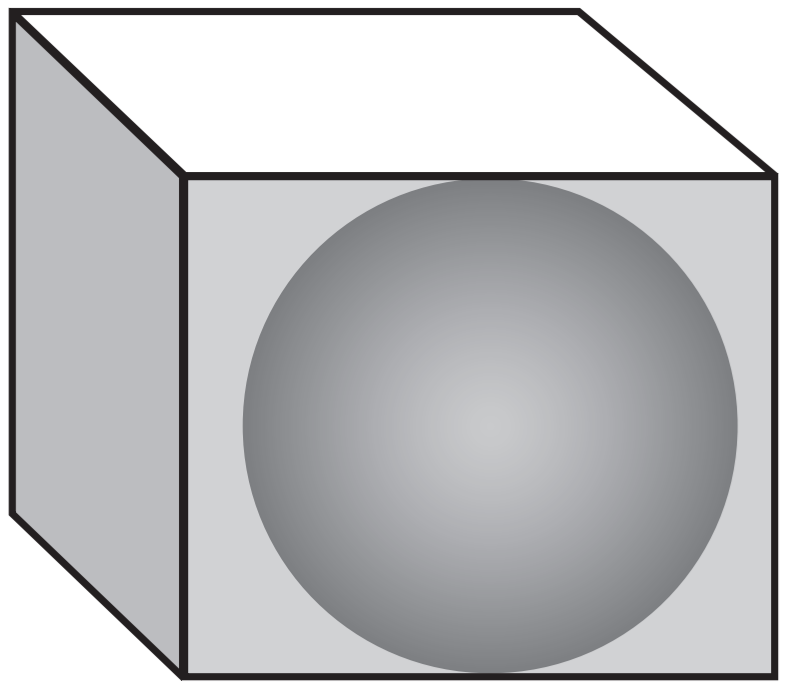
Shreya got a rectangular parallelepiped shaped box and spherical ball inside it as return gift. Sides of the box are $x, 2x,$ and $\frac{\text{x}}{3},$ while radius of the ball is $r.$

Based on the above information, answer the following questions.

  1. If S represents the sum of volume of parallelepiped and sphere, then Scan be written as.
  1. $\frac{4\text{x}^3}{3}+\frac{2}{2}\pi\text{r}^2$
  2. $\frac{2\text{x}^2}{3}+\frac{4}{3}\pi\text{r}^2$
  3. $\frac{2\text{x}^3}{3}+\frac{4}{3}\pi\text{r}^3$
  4. $\frac{2}{3}\text{x}+\frac{4}{3}\pi\text{r}$
  1. If sum of the surface areas of box and ball are given to be constant $k^2$ then $x$ is equal to.
  1. $\sqrt{\frac{\text{k}^2-4\pi\text{r}^2}{6}}$
  2. $\sqrt{\frac{\text{k}^2-4\pi\text{r}}{6}}$
  3. $\sqrt{\frac{\text{k}^2-4\pi}{6}}$
  4. $\text{None of these}$
  1. The radius of the ball, when Sis minimum, is.
  1. $\sqrt{\frac{\text{k}^2}{54+\pi}}$
  2. $\sqrt{\frac{\text{k}^2}{54+4}}$
  3. $\sqrt{\frac{\text{k}^2}{64+3\pi}}$
  4. $\sqrt{\frac{\text{k}^2}{4\pi+3}}$
  1. Relation between length of the box and radius of the ball can be represented as.
  1. $\text{x} = \frac{2}{\text{r}}$
  2. $\text{x}=\frac{\text{r}}{2}$
  3. $\text{x}=\frac{2}{\text{r}}$
  4. $\text{x}=3\text{r}$
  1. Minimum value of $S$ is.
  1. $\frac{\text{k}^2}{2(3\pi+54)^\frac{2}{3}}$
  2. $\frac{\text{k}}{2(3\pi+54)^\frac{3}{2}}$
  3. $\frac{\text{k}^3}{2(4\pi+54)^\frac{1}{2}}$
  4. $\text{None of these}$
Two farmers Ankit and Girish cultivate only three varieties of pulses namely Urad, Massor and Mung. The sale (in ₹) of these varieties of pulses by both the farmers in the month of September and October are given by the following matrices A and B.

Image

September sales (in ₹):

$\mathrm{A}=\left(\begin{array}{ccc}\text { Urad } & \text { Masoor } & \text { Mung } \\10000 & 20000 & 30000 \\50000 & 30000 & 10000\end{array}\right) \text { Ankit }$

October sales (in ₹):

$\mathrm{A}=\left(\begin{array}{ccc}\text { Urad } & \text { Masoor } & \text { Mung } \\5000 & 10000 & 6000 \\20000 & 30000 & 10000\end{array}\right) \text { Ankit }$

(i) Find the combined sales of Masoor in September and October, for farmer Girish.

(ii) Find the combined sales of Urad in September and October, for farmer Ankit.

(iii) Find a decrease in sales from September to October.

OR

If both the farmers receive $2 \%$ profit on gross sales, then compute the profit for each farmer and for each variety sold in October.

In a family there are four children. All of them have to work in their family business to earn their livelihood at the age of 18. Based on the above information, answer the following questions.
  1. Probability that all children are girls, if it is given that elder child is a boy, is:
  1. $\frac{3}{8}$
  2. $\frac{1}{8}$
  3. $\frac{5}{8}$
  4. None of these.
  1. Probability that all children are boys, if two elder children are boys, is:
  1. $\frac{1}{4}$
  2. $\frac{3}{4}$
  3. $\frac{1}{2}$
  4. None of these.
  1. Find the probability that two middle children are boys, if it is given that eldest child is a girl.
  1. $0$
  2. $\frac{3}{4}$
  3. $\frac{1}{4}$
  4. None of these.
  1. Find the probability that all children are boys, if it is given that at most one of the children is a girl.
  1. $0$
  2. $\frac{1}{5}$
  3. $\frac{2}{5}$
  4. $\frac{4}{5}$
  1. Find the probability that all children are boys, if it is given that at least three of the children are boys.
  1. $\frac{1}{5}$
  2. $\frac{2}{5}$
  3. $\frac{3}{5}$
  4. $\frac{4}{5}$
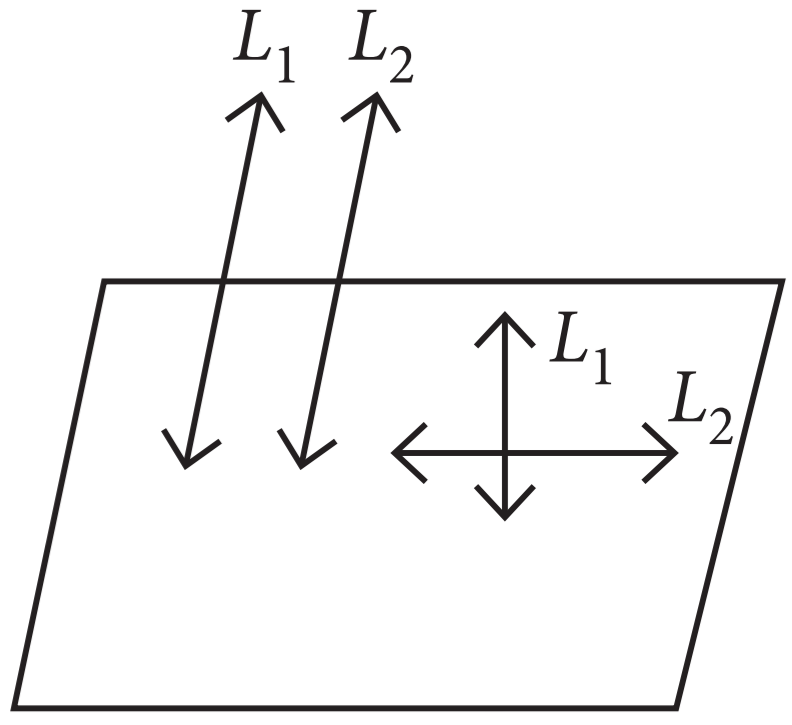
If $a_{1,} b_{1,} c_{1,}$ and $a_{2,}b_{2,} c_2$ are direction ratios of two lines say $L_1$ and $L_2$ respectively. Then $L_1 || L_2$ iff $\frac{\text{a}_1}{\text{a}_2}=\frac{\text{b}_1}{\text{b}_2}=\frac{\text{c}_1}{\text{c}_2}$ and $\text{L}_1\perp\text{L}_2$ iff $a_1a_2 + b_1b_2 + c_1c_2 = 0.$

Based on the above information, answer the following questions.
  1. If $l_{1,} m_1, n_{1,}$ and $l_2, m_2, n_2$ are the direction cosines of $L_1$ and $L_2$ respectively, then $L_1$ will be perpendicular to $L_2,$ iff:
  1. $l_1l_2 + m_1m_2 + n_1n_2 = 0$
  2. $l_1m_2 + m_1l_2 + n_1n_2 = 0$
  3. $\frac{\text{l}_1}{\text{l}_2}=\frac{\text{m}_1}{\text{m}_2}=\frac{\text{n}_1}{\text{n}_2}$
  4. None of these
  1. If $l_1, m_1, n_1$ and $l_2, m_2, n_2$ are direction cosines of $L_1$ and $L_2$ respectively, then $L_1$ will be parallel to $L_2,$ iff:
  1. $l_1l_2 + m_1m_2 + n_1n_2 = 0$
  2. $l_1m_2 + m_1l_2 + n_1n_2 = 0$
  3. $\frac{\text{l}_1}{\text{l}_2}=\frac{\text{m}_1}{\text{m}_2}=\frac{\text{n}_1}{\text{n}_2}$
  4. $m_1n_2 + m_2n_2 + l_1l_2 = 0$
  1. The coordinates of the foot of the perpendicular drawn from the point $A(1, 2, 1)$ to the line joining $B(1, 4, 6)$ and $C(5, 4, 4),$ are:
  1. $(1, 2, 1)$
  2. $(2, 4, 5)$
  3. $(3, 4, 5)$
  4. $(3, 4, 5)$
  1. The direction ratios of the line which is perpendicular to the lines with direction ratios proportional to $(1, -2, -2)$ and $(0, 2, 1)$ are:
  1. $< 1, 2, 1 >$
  2. $< 2,-1, 2 >$
  3. $< -1,2, 2 >$
  4. None of these
  1. The lines $\frac{\text{x}-2}{3}=\frac{\text{y}+1}{-2}=\frac{\text{z}-2}{0}$ and $\frac{\text{x}-1}{1}=\frac{\frac{\text{y}+3}{2}}{\frac{3}{2}}=\frac{\text{z}+5}{2}$ are:
  1. Parallel.
  2. Perpendicular.
  3. Skew lines.
  4. Non-intersecting.
Logarithmic differentiation is a powerful technique to differentiate functions of the form $\text{f}(\text{x})=[\text{u}(\text{x})]^{\text{v}(\text{x})},$ where both u(x) and v(x) are differentiable functions and f and u need to be positive functions. Let function $\text{y}=\text{f}(\text{x})=(\text{u}(\text{x}))^{\text{v}(\text{x})},$ then $\text{y}'=\text{y}\Big[\frac{\text{v}(\text{x})}{\text{u}(\text{x})}\text{u}'(\text{x})+\text{v}'(\text{x})\cdot\log[\text{u}(\text{x})]\Big]$ On the basis of above information, answer the following questions.

  1. Differentiate $x^x$ w.r.t. $x.$
  1. $\text{x}^\text{x}(1+\log\text{x})$
  2. $\text{x}^\text{x}(1-\log\text{x})$
  3. $-\text{x}^\text{x}(1+\log\text{x})$
  4. $\text{x}^\text{x}\log\text{x}$
  1. Differentiate $x^x + a^x+ x^a + a^a$ w.r.t. $x.$
  1. $(1+\log\text{x})+(\text{a}^\text{x}\log\text{a}+\text{ax}^{\text{a}-1})$
  2. $\text{x}^\text{x}(1+\log\text{x})+\log\text{a}+\text{ax}^{\text{a}-1}$
  3. $\text{x}^\text{x}(1+\log\text{x})+\text{x}^\text{a}\log\text{x}+\text{ax}^{\text{a}-1}$
  4. $\text{x}^\text{x}(1+\log\text{x})+\text{a}^\text{x}\log\text{a}+\text{ax}^{\text{a}-1}$
  1. If $\text{x}=\text{e}^\frac{\text{x}}{\text{y}},$ then find $\frac{\text{dy}}{\text{dx}}.$
  1. $-\frac{(\text{x}+\text{y})}{\text{x}\log\text{x}}$
  2. $-\frac{(\text{x}-\text{y})}{\text{x}\log\text{x}}$
  3. $\frac{(\text{x}+\text{y})}{\text{x}\log\text{x}}$
  4. $\frac{\text{x}-\text{y}}{\text{x}\log\text{x}}$
  1. If $y = (2 - x)^3(3 + 2x)^5,$ then find $\frac{\text{dy}}{\text{dx}}.$
  1. $(2-\text{x})^3(3+2\text{x})^5\Big[\frac{15}{3+2\text{x}}-\frac{8}{2-\text{x}}\Big]$
  2. $(2-\text{x})^3(3+2\text{x})^5\Big[\frac{15}{3+2\text{x}}+\frac{3}{2-\text{x}}\Big]$
  3. $(2-\text{x})^3(3+2\text{x})^5\Big[\frac{10}{3+2\text{x}}-\frac{3}{2-\text{x}}\Big]$
  4. $(2-\text{x})^3(3+2\text{x})^5\cdot\Big[\frac{10}{3+2\text{x}}+\frac{3}{2-\text{x}}\Big]$
  1. If $\text{y}=\text{x}^\text{x}\cdot\text{e}^{(2\text{x}+5)},$ then find $\frac{\text{dy}}{\text{dx}}.$
  1. $\text{x}^\text{x}\text{e}^{2\text{x}+5}$
  2. $\text{x}^\text{x}\text{e}^{2\text{x}+5}(3-\log\text{x})$
  3. $\text{x}^\text{x}\text{e}^{2\text{x}+5}(1-\log\text{x})$
  4. $\text{x}^\text{x}\text{e}^{2\text{x}+5}\cdot(3+\log\text{x})$
Ajay enrolled himself in an online practice test portal provided by his school for better practice. Out of 5 questions in a set-I, he was able to solve 4 of them and got stuck in the one which is as shown below.
If A and Bare independent events, P(A) = 0.6 and P(B) = 0.8, then answer the following questions.
  1. $\text{P}(\text{A}\cap\text{B})=$
  1. 0.2
  2. 0.9
  3. 0.48
  4. 0.6
  1. $\text{P}(\text{A}\cup\text{B})=$
  1. 0.92
  2. 0.08
  3. 0.48
  4. 0.64
  1. $\text{P}(\text{B}|\text{A})=$
  1. 0.14
  2. 0.2
  3. 0.6
  4. 0.8
  1. $\text{P}(\text{A}|\text{B})=$
  1. 0.6
  2. 0.9
  3. 0.19
  4. 0.11
  1. P (not A and not B)
  1. 0.01
  2. 0.48
  3. 0.08
  4. 0.91
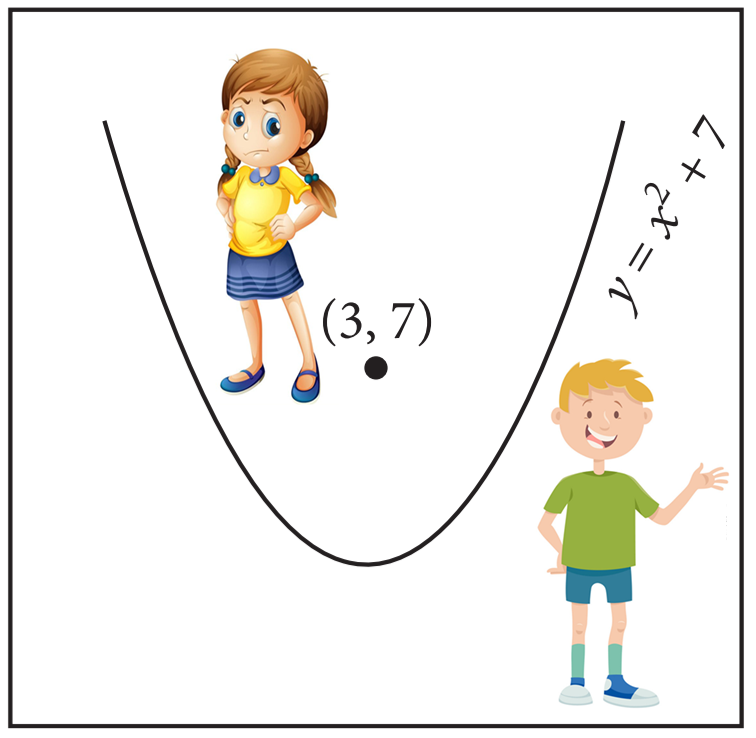
A student Arun is running on a playground along the curve given by $y = x^2 + 7.$ Another student Manila standing at point $(3, 7)$ on playground wants to hit Arun by paper ball when Arun is nearest to Manila.

Based on above information, answer the following questions.

  1. Arun's position at any value of x will be.
  1. $(x^2, y - 7)$
  2. $(x^2, y + 7)$
  3. $(x, x^2 + 7)$
  4. $(x^2, x - 7)$
  1. Distance (say D) between Arun and Manila will be.
  1. $(\text{x}-1)(2\text{x}^2+2\text{x}+3)$
  2. $(\text{x}-3)^2+\text{x}^4$
  3. $\sqrt{(\text{x}-3)+\text{x}^4}$
  4. $\sqrt{(\text{x}-1)(2\text{x}^2+2\text{x}+3)}$
  1. For which real value$(s)$ of $x$, first derivative of $D^2$ w.r.t, x will Vanish?
  1. $1$
  2. $2$
  3. $3$
  4. $4$
  1. Find the position of Arun when Manila will hit the paper hall.
  1. $(5, 32)$
  2. $(1, 8)$
  3. $(3, 7)$
  4. $(3, 16)$
  1. The minimum value of $D$ is.
  1. $3$
  2. $\sqrt{3}$
  3. $5$
  4. $\sqrt{5}$
A card is lost from a pack of $52$ cards. From the remaining cards two cards are drawn at random.
Based on the above information, answer the following questions.
  1. The probability of drawing two diamonds, given that a card of diamond is missing, is:
  1. $\frac{21}{425}$
  2. $\frac{22}{425}$
  3. $\frac{23}{425}$
  4. $\frac{1}{425}$
  1. The probability of drawing two diamonds, given that a card of heart is missing, is:
  1. $\frac{26}{425}$
  2. $\frac{22}{425}$
  3. $\frac{19}{425}$
  4. $\frac{23}{425}$
  1. Let $A$ be the event of drawing two diamonds from remaining $51$ cards and $E_1, E_2, E_3$ and $E_4$ be the events that lost card is of diamond, club, spade and heart respectively, then the approximate  value of $\displaystyle\sum_{\text{i}=1}^{4}\text{P(A|E}_\text{i})$ is:
  1. $0.17$
  2. $0.24$
  3. $0.25$
  4. $0.18$
  1. AU of a sudden, missing card is found and, then two cards are drawn simultaneously without replacement. Probability that both drawn cards are king is:
  1. $\frac{1}{52}$
  2. $\frac{1}{221}$
  3. $\frac{1}{121}$
  4. $\frac{2}{221}$
  1. If two cards are drawn from a well shuffled pack of $52$ cards, one by one with replacement, then probability of getting not a king in $1^{st}$ and $2^{nd}$ draw is:
  1. $\frac{144}{169}$
  2. $\frac{12}{169}$
  3. $\frac{64}{169}$
  4. None of these
A doctor is to visit a patient. From the past experience, it is known that the probabilities that he will come by cab, metro, bike or by other means of transport are respectively $0.3, 0.2, 0.1$ and $0.4$. 'Tile probabilities that he will be late are $0.25, 0.3, 0.35$ and $0.1$ if he comes by cab, metro, bike and other means of transport respectively.

 Based on the above information, answer the following questions.
  1. When the doctor arrives late, what is the probability that he comes by metro?
  1. $\frac{5}{14}$
  2. $\frac{2}{7}$
  3. $\frac{5}{21}$
  4. $\frac{1}{6}$
  1. When the doctor arrives late, what is the probability that he comes by cab?
  1. $\frac{4}{21}$
  2. $\frac{1}{7}$
  3. $\frac{5}{14}$
  4. $\frac{2}{21}$
  1. When the doctor arrives late, what is the probability that he comes by bike?
  1. $\frac{5}{21}$
  2. $\frac{4}{7}$
  3. $\frac{5}{6}$
  4. $\frac{1}{6}$
  1. When the doctor arrives late, what is the probability that he comes by other means of transport?
  1. $\frac{6}{7}$
  2. $\frac{5}{14}$
  3. $\frac{4}{21}$
  4. $\frac{2}{7}$
  1. What is the probability that the doctor is late by any means?
  1. $1$
  2. $0$
  3. $\frac{1}{2}$
  4. $\frac{1}{4}$
In a wedding ceremony, consists of father, mother, daughter and son line up at random for a family photograph, as shown in figure.
Based on the above information, answer the following questions.
  1. Find the probability that daughter is at one end, given that father and mother are in the middle.
  1. $1$
  2. $\frac{1}{2}$
  3. $\frac{1}{3}$
  4. $\frac{2}{3}$
  1. Find the probability that mother is at right end, given that son and daughter are together.
  1. $\frac{1}{2}$
  2. $\frac{1}{3}$
  3. $\frac{1}{4}$
  4. $0$
  1. Find the probability that father and mother are in the middle, given that son is at right end.
  1. $\frac{1}{4}$
  2. $\frac{1}{2}$
  3. $\frac{1}{3}$
  4. $\frac{2}{3}$
  1. Find the probability that father and son are standing together, given that mother and daughter are standing together.
  1. $0$
  2. $1$
  3. $\frac{1}{2}$
  4. $\frac{2}{3}$
  1. Find the probability that father and mother are on either of the ends, given that son is at second position from the right end.
  1. $\frac{1}{3}$
  2. $\frac{2}{3}$
  3. $\frac{1}{4}$
  4. $\frac{2}{5}$