MCQ
Consider the partial decomposition of $A$ is

$2A(g)  \rightleftharpoons  2B(g) + C(g)$
at equilibrium $700\, mL$ gaseous mixture contains $100\, mL$ of gas $C$ at $10\, atm$ and $300\, K$. What is the value of $K_P$ for the reaction

  • A
    $40/7$
  • B
    $1/28$
  • $10/28$
  • D
    $28/10$

Answer

Correct option: C.
$10/28$
c
Initially only $A$ is present ao at eq$^m$ $B$ and $C$ should be present in $2 : 1$

                $2A \to 2B + C$

at eq$^m$   $400$     $200$    $100$

$($ for Ideal gas volume $\%$ $=$ $mole$ $\%$ $)$

$\mathrm{K}_{\mathrm{p}}=\frac{\left(\frac{200}{700} \times 10\right)^{2}\left(\frac{100}{700} \times 10\right)}{\left(\frac{400}{700} \times 10\right)^{2}}=\frac{10}{28}$

Need a full question paper?

Generate a complete, print-ready paper with questions like this in minutes — across 16+ boards, with answer keys.

Start Generating Free

Similar questions

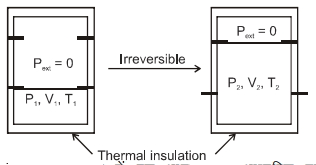
An ideal gas in a thermally insulated vessel at internal pressure $=P_1$, volume $=V_1$ and absolute temperature $= T _1$ expands irreversibly against zero external pressure, as shown in the diagram. The final internal pressure, volume and absolute temperature of the gas are $P _2, V _2$ and $T _2$, respectively. For this expansion,

$(A)$ $q=0$ $(B)$ $T_2=T_1$ $(C)$ $P_2 V_2=P_1 V_1$ $(D)$ $P_2 V_2^\gamma=P_1 V_1^\gamma$

Which of the following reaction is a redox reaction
In the reaction of oxalate with permanganate in acidic medium, the number of electrons involved in producing one molecule of $CO_2$ is
In which condition, the reaction proceeds in the forward direction?
In the reaction of hydrogen bromide with an alkene (in the absence of peroxides),  the first step of the reaction is the ................. to the alkene
In a buffer solution containing equal concentration of $B^-$ and $HB,$ the $K_b$ for $B^-$ is $10^{-10}.$ The $pH$ of buffer solution is
Glucose and fructose are
Wavelength of spectral line emitted is inversely proportional to
Which is the correct order of stability of the following three carbonium ions ?

$(I)$         $C{H_2} = CH\mathop C\limits^ +  HC{H_3}$

$\begin{array}{*{20}{c}} {{\mkern 1mu} {\mkern 1mu} {\mkern 1mu} {\mkern 1mu} \,\,\,\,\,\,\,\,\,\,\,\,\,\,\,\,\,C{H_3}} \\ {\,\,\,\,\,\,\,\,\,\,\,\,\,\,\,\,|\,\,} \\ {(II)\,\,\,\,\,\,\,\,\,\,C{H_2} = C - \mathop {{\text{ }}C}\limits^ +  {H_2}} \end{array}$

$(III)$      $C{H_3}CH = CH\mathop C\limits^ +  {H_2}$

Whether a reaction is endothermic or exothermic can be indicated by :