MCQ
An ideal gas in a thermally insulated vessel at internal pressure $=P_1$, volume $=V_1$ and absolute temperature $= T _1$ expands irreversibly against zero external pressure, as shown in the diagram. The final internal pressure, volume and absolute temperature of the gas are $P _2, V _2$ and $T _2$, respectively. For this expansion,

$(A)$ $q=0$ $(B)$ $T_2=T_1$ $(C)$ $P_2 V_2=P_1 V_1$ $(D)$ $P_2 V_2^\gamma=P_1 V_1^\gamma$
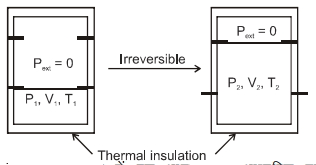
  • $(A,B,C)$
  • B
    $(A,B,D)$
  • C
    $(A,C,D)$
  • D
    $(B,C,D)$

Answer

Correct option: A.
$(A,B,C)$
a
Since the vessel is thermally insulated so

$q =0 $

$p _{ ex }=0 \text {, so } w =0$

so $\Delta U=0$ (ideal gas)

Hence $\Delta T=0$

$\Rightarrow \Delta T=0 \quad \Rightarrow T_2=T_1 \quad \Rightarrow P_2 V_2=P_1 V_1$

The process is however adiabatic irriversible.

So we cannot apply $P _2 V _2^\gamma= P _1 V _1^\gamma$

Hence ans is $( A ),( B ),( C )$

Need a full question paper?

Generate a complete, print-ready paper with questions like this in minutes — across 16+ boards, with answer keys.

Start Generating Free

Similar questions

For which of the following $\Delta E = \Delta H$
Compound of a metal $′M\ ′$ is $\ce{M_2​O_3}$​. The formula of its nitride will be $-$
How many moles of $Mg_3[PO_4]_2$ will contain $0.50\, mole$ of oxygen atoms ?
The solubility product of $PbI _{2}$ is $8.0 \times 10^{-9} .$ The solubility of lead iodide in $0.1$ molar solution of lead nitrate is $x \times 10^{-6} \,mol / L$. The value of $x$ is ....... .(Rounded off to the nearest integer)

$[$ Given $: \sqrt{2}=1.41]$

The volume (in $mL$ ) of $0.1\,M\,AgNO _3$ required for complete precipitation of chloride ions present in $20\,mL$ of $0.01\,M$ solution of $\left[ Cr \left( H _2 O \right)_5 Cl \right] Cl _2$ as silver chloride is $..........$.
Which is the correct representation of the solubility product constant of $A{g_2}Cr{O_4}$
Maximum threat to the world is from :
Which of the following statement is correct regarding following process?

$(i)\,Cl\xrightarrow{E.A.}Cl^-\,\,\,\,\,\,(ii)\,C{{l}^{-}}\xrightarrow{I.E.}Cl\,\,\,\,(iii)\,\,Cl\xrightarrow{I.E.}C{{l}^{+}}\,\,\,(iv)\,\,C{{l}^{+}}\xrightarrow{I.E.}Cl^{2+}$

The amount of $BaSO_4$ formed upon mixing $100\,mL$ of $20.8\%$ $BaCl_2$ solution with $50\,mL$ of $9.8\%$ $H_2SO_4$ solution will be ............. $\mathrm{g}$

( $Ba = 137,\,\,Cl = 35.5,\,\,S = 32,\,\,H = 1$ and $O = 16$ )

The radiation is emitted when a hydrogen atom goes from a high energy state to a lower energy state. The wavelength of one line in visible region of atomic spectrum of hydrogen is $6.5 \times 10^{-7} \, m.$ Energy difference between the two states is :