MCQ
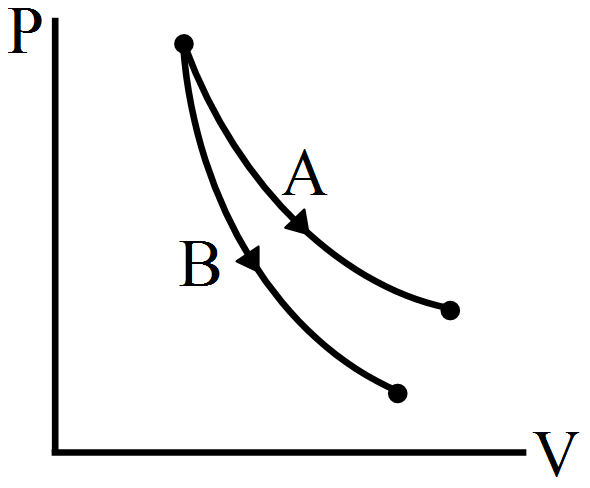
Consider the processes A and B shown in the figure. It is possible that:
  • A
    Both the processes are isothermal.
  • B
    Both the processes are adiabatic.
  • A is isothermal and B is adiabatic.
  • D
    A is adiabatic and B is isothermal.

Answer

Correct option: C.
A is isothermal and B is adiabatic.
The slope of an adiabatic process is greater than that of an isothermal process. Since A and B are initiated from the same initial state, both cannot be isothermal or adiabatic, as they would be overlapping. But the curve of process B is steeper than the curve of process A. Hence, A is isothermal and B is adiabatic.

Need a full question paper?

Generate a complete, print-ready paper with questions like this in minutes — across 16+ boards, with answer keys.
Start Generating Free

Similar questions

A disc rotating about its axis from rest, acquires the angular speed $100 \,rev/s$ in $4$ second. The angle rotated by it during these four seconds (in radian) is ...... $\pi$
The length of a son meter wire $AB$ is $110\; cm$. Where should the two bridges be placed from $A$ to divide the wire in $3$ segments whose fundamental frequencies are in the ratio of $1:2:3$?
The superposition takes place between two waves of frequency $f$ and amplitude $a.$ The total intensity is directly proportional to
A body performing unifom circular motion completed $140$ revolution in a second. Its angular speed is .......... $rad / s$
A man inside a freely falling box throws a heavy ball towards a side wall. The ball keeps on bouncing between the opposite walls of the box. We neglect air resistance and friction. Which of the following figures depicts the motion of the centre of mass of the entire system (man, the ball and the box)?
$Assertion :$ In free expansion of an ideal gas, the entropy increases.
$Reason :$ Entropy increases in all natural processes.
A man measures the period of a simple pendulum inside a stationary lift and finds it to be $T$ sec. If the lift accelerates upwards with an acceleration $\frac{g}{4}$, then the period of the pendulum will be
A ball rolls off the top of a stairway with horizontal velocity $\mathrm{u}$. The steps are $0.1 \mathrm{~m}$ high and $0.1 \mathrm{~m}$ wide. The minimum velocity $\mathrm{u}$ with which that ball just hits the step $5$ of the stairway will be $\sqrt{\mathrm{x}} \mathrm{ms}^{-1}$ where $\mathrm{x}=$___________ [use $\mathrm{g}=10 \mathrm{~m} / \mathrm{s}^2$ ].
In the previous question, the smallest kinetic energy at the bottom of the incline will be achieved by:
The range of a projectile when launched at angle $\theta$ is same as when launched at angle $2 \theta$. What is the value of $\theta$ ?