MCQ
A disc rotating about its axis from rest, acquires the angular speed $100 \,rev/s$ in $4$ second. The angle rotated by it during these four seconds (in radian) is ...... $\pi$
  • A
    $100$
  • B
    $200$
  • C
    $300$
  • $400$

Answer

Correct option: D.
$400$
d
(d)

Initial angular speed, $\omega_0=0 rad / s$

Final angular speed, $\omega=100 rps$

$\Rightarrow \omega=100 \times 2 \pi rad$ $\Rightarrow \omega=200 \pi rad / s$

Time, $t=4 s$

From kinematics:

$\omega =\omega_0+\alpha t$

$\Rightarrow 200 \pi=4 \alpha$

$\Rightarrow \alpha=\frac{200 \pi}{4} rad / s ^2$

where, $\alpha$ is angular acceleration.

Also,

$\theta =\omega_0 t+\frac{1}{2} \alpha t^2$

$\Rightarrow \theta =0+\frac{1}{2} \times \frac{200 \pi}{4} \times 16$

$\Rightarrow \theta =400 \pi$

Need a full question paper?

Generate a complete, print-ready paper with questions like this in minutes — across 16+ boards, with answer keys.
Start Generating Free

Similar questions

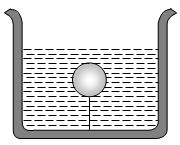
A solid sphere of density $\eta$ $( > 1)$  times lighter than water is suspended in a water tank by a string tied to its base as shown in fig. If the mass of the sphere is m then the tension in the string is given by
If mass of $He$ atom is $4$ times that of hydrogen atom then mean velocity of $He$ is
A point traversed $3 / 4$ th of the circle of radius $R$ in time $t$. The magnitude of the average velocity of the particle in this time interval is
Dimensions of strain are
The temperature of reservoir of Carnot's engine operating with an efficiency of $70\%$ is $1000K.$ The temperature of its sink is ...... $K$
The value of acceleration due to gravity at Earth’s surface is $9.8\, m\,s^{-2}$. The altitude above its surface at which the acceleration due to gravity decreases to $4.9\, m\,s^{-2}$, is close to: (Radius of earth $= 6.4\times10^6\, m$)
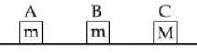
Three blocks $A, B$ and $C$ are lying on a smooth horizontal surface, as shown in the figure. $A$ and $B$ have equal masses, $m$ while $C$ has mass $M$. Block $A$ is given an initial speed $v$ towards $B$ due to which it collides with $B$ perfectly inelastically. The combined mass collides with $C$, also perfectly inelastically. The combined mass collides with $C$, also perfectly inelastically if $\frac{5}{6}^{th}$ of the initial kinetic energy is lost in whole process. What is value of $M/m$ ?
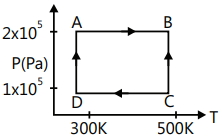
Two moles of helium gas are taken over the cycle $ABCDA$, as shown in the $P-T$ diagram. The net work done on the gas in the cycle $ABCDA$ is ...... $R$
Saturated vapour is compressed to half its volume without any change in temperature, then the pressure will be
$110\; J$ of heat is added to a gaseous system, whose internal energy change is $40\; J$, then the amount of external work done is ........ $J$