Question
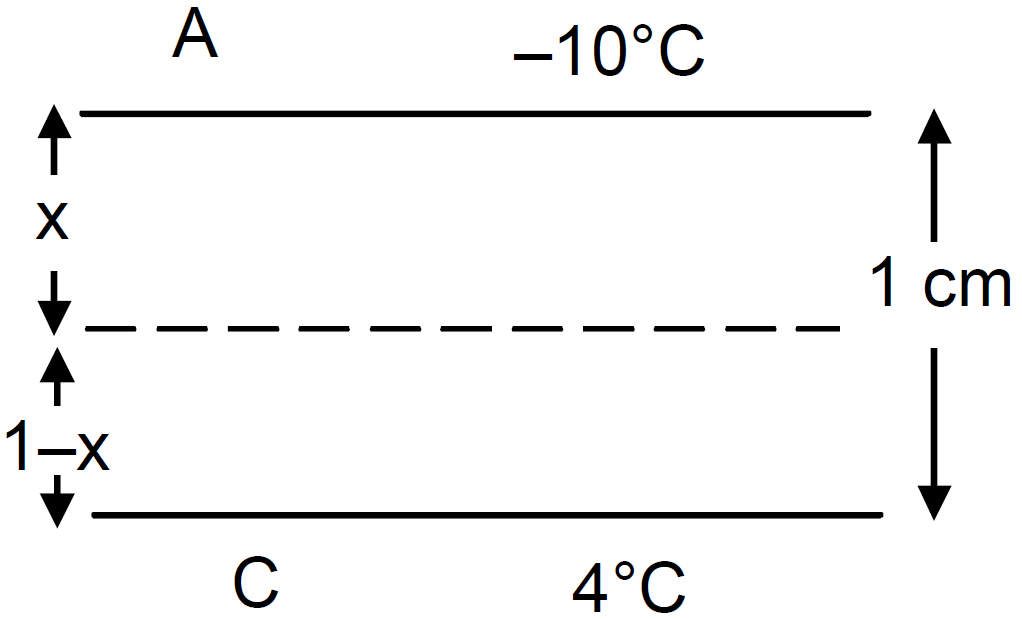
Consider the situation of the previous problem. Assume that the temperature of the water at the bottom of the lake remains constant at 4°C as the ice forms on the surface (the heat required to maintain the temperature of the bottom layer may come from the bed of the lake). The depth of the lake is 1.0m. Show that the thickness of the ice formed attains a steady state maximum value. Find this value. The thermal conductivity of water $=0.50\text{Wm}^{-1}{^{\circ}}\text{C}^{-1}.$ Take other relevant data from the previous problem.
Answer

let ‘B’ be the maximum level upto which ice is formed. Hence the heat conducted at that point from both the levels is the same.
Let $\text{AB}=\text{x}$
i.e., $\frac{\text{Q}}{\text{t}}\text{ice}=\frac{\text{Q}}{\text{t}}\text{water}$
$\Rightarrow\frac{\text{K}_\text{ice}\times\text{A}\times10}{\text{x}}=\frac{\text{K}_\text{water}\times\text{A}\times4}{(1-\text{x})}$
$\Rightarrow\frac{1.7\times10}{\text{x}}=\frac{5\times10^{-1}\times4}{1-\text{x}}$
$\Rightarrow\frac{17}{\text{x}}=\frac{2}{1-\text{x}}$
$\Rightarrow17-17\text{x}=2\text{x}$
$\Rightarrow19\text{x}=17$
$\Rightarrow\text{x}=\frac{17}{19}$
$=0.894\approx89\text{cm}.$

Need a full question paper?

Generate a complete, print-ready paper with questions like this in minutes — across 16+ boards, with answer keys.

Start Generating Free

Similar questions

A helicopter of mass $500\ kg$ rises with a vertical acceleration of $10ms ^{-2}$. The weight of pilot is $60\ kg$. Give the magnitude and direction of :
  1. force on the floor of the helicopter by the pilot
  2. action of the rotor of the helicopter on the surrounding air
  3. force on the helicopter due to the surrounding air.
$($Take $g = 10 ms^{-2}).$
A physical quantity Q is given by$\text{Q}= \frac{\text{A}^2\text{B}^\frac{3}{2}}{\text{C}^{+4}\text{D}^\frac{1}{2}}$
The percentage error in A, B, C, D are 1%, 2%, 4%, 2% respectively. Find the percentage error in Q.
A high jumper can jump $1.5m$ on earth. With the same effort, how high will he be able to jump on a planet whose density is one-third and radius is one-fourth of that of the earth?
Show that a liquid at rest exerts a force perpendicular to the surface of the container at every point.
A 40cm wire having a mass of 3.2g is stretched between two fixed supports 40.05cm apart. In its fundamental mode, the wire vibrates at 220Hz. If the area of cross-section of the wire is $1.0mm^2$, find its Young's modulus.
Find a relation for kinetic energy of a rolling body.
Two vectors $\vec{\text{A}}$ and $\vec{\text{B}}$ are of equal lengths (A = B) and mutually perpendicular. Show by vector diagram that their vector sum $(\vec{\text{A}}+\vec{\text{B}})\text{s}$ and vector difference $(\vec{\text{A}}-\vec{\text{B}})$ will be of the same length and mutually perpendicular.
If the radius of the earth were increased by a factor of 3, by what factor would its density have to be changed to keep 'g' the same?
The magnetic field B inside a long solenoid, carrying a current of $5.00A$, is $3.14 \times 10^{-2}T$. Find the number of turns per unit length of the solenoid.
Find the centre of mass of three particles at the vertices of an equilateral triangle. The masses of the particles are 100g, 150g, and 200g respectively. Each side of the equilateral triangle is 0.5m long.