Question
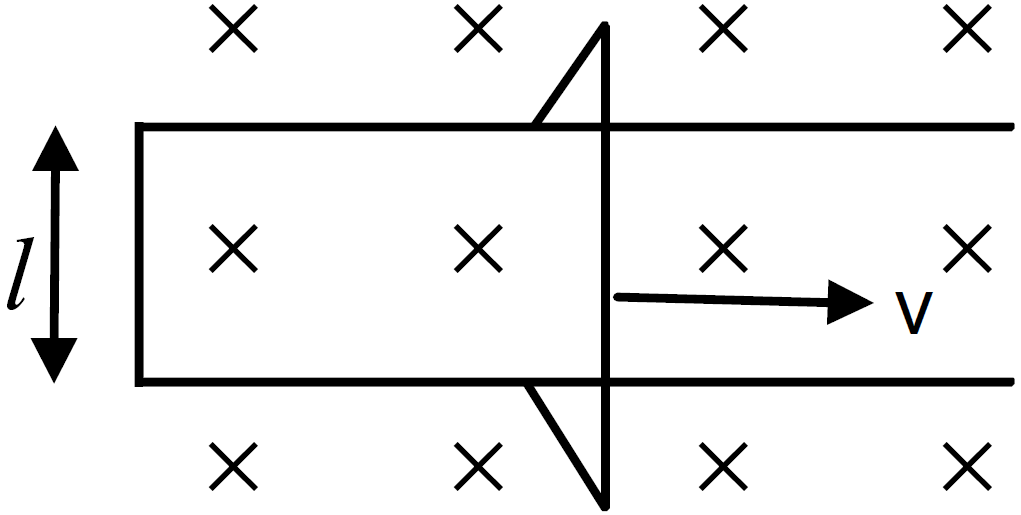
Consider the situation of the previous problem.
  1. Calculate the force needed to keep the sliding wire moving with a constant velocity v.
  2. If the force needed just after $t = 0$ is $F_0$, find the time at which the force needed will be $\frac{\text{F}_0}{2}.$
Answer


$\text{e}=\text{Bvl}$
$\text{i}=\frac{\text{e}}{\text{R}}=\frac{\text{Bvl}}{2\text{r}(\text{l}+\text{vt})}$
  1. $\text{F}=\text{ilB}=\frac{\text{Bvl}}{2\text{r}(\text{l}+\text{vt})}\times\text{lB}=\frac{\text{B}^2\text{l}^2\text{v}}{2\text{r}(\text{l}+\text{vt})}$
  2. Just after $\text{t}=0$
$\text{f}_0=\text{ilB}=\text{lB}\Big(\frac{\text{lBv}}{2\text{rl}}\Big)=\frac{\text{l}\text{B}^2\text{v}}{2\text{r}}$

$\frac{\text{f}_0}{2}=\frac{\text{l}\text{B}^2\text{v}}{4\text{r}}=\frac{\text{l}^2\text{B}^2\text{v}}{2\text{r}(\text{l}+\text{vt})}$

$\Rightarrow2\text{l}=\text{l}+\text{vt}$

$\Rightarrow\text{T}=\frac{\text{l}}{\text{v}}$

Need a full question paper?

Generate a complete, print-ready paper with questions like this in minutes — across 16+ boards, with answer keys.

Start Generating Free

Similar questions

Is it possible that in a Coolidge tube characteristic $\text{L}_\alpha$ X-rays are emitted but not $\text{K}_\alpha$ X-rays?
A free $^{238}U$ nucleus kept in a train emits an alpha particle. When the train is stationary, a nucleus decays and a passenger measures that the separation between the alpha particle and the recoiling nucleus becomes x at time t after the decay. If the decay takes place while the train is moving at a uniform velocity v, the distance between the alpha particle and the recoiling nucleus at a time t after the decay as measured by the passenger is:
  1. State the working principle of a potentiometer. With the help of the circuit diagram, explain how a potentiometer is used to compare the emf’s of two primary cells. Obtain the required expression used for comparing the emfs.
  2. Write two possible causes for one sided deflection in a potentiometer experiment.
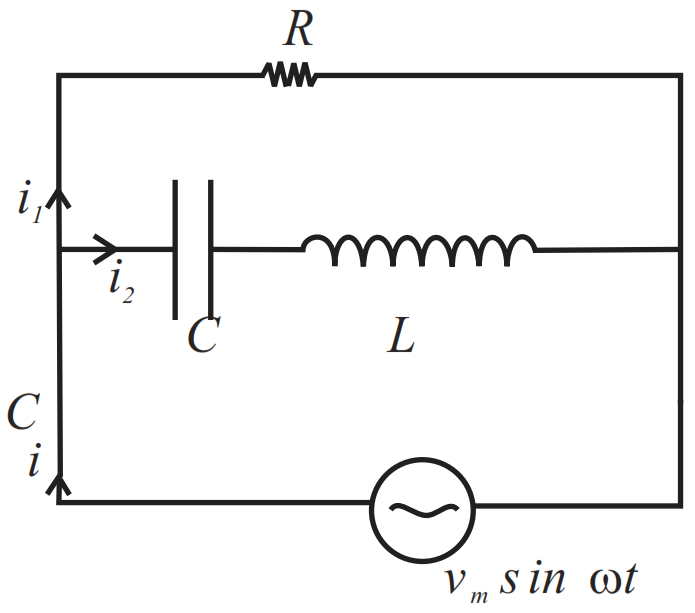
Consider the LCR circuit shown in Fig. Find the net current i and the phase of i. Show that . Find the impedence Z for this circuit.
Are the nucleons fundamental particles, or do they consist of still smaller parts? One way to find out is to probe a nucleon just as Rutherford probed an atom. What should be the kinetic energy of an electron for it to be able to probe a nucleon? Assume the diameter of a nucleon to be approximately $10^{-15}m.$
State the principle of working of p-n diode as a rectifier. Explain, with the help of a circuit diagram, the use of p-n diode as a full wave rectifier. Draw a sketch of the input and output waveforms.

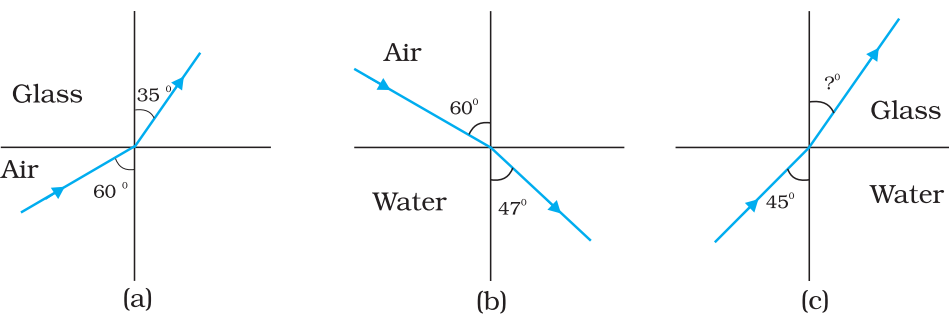
(a) and (b) show refraction of a ray in air incident at 60° with the normal to a glass-air and water-air interface, respectively. Predict the angle of refraction in glass when the angle of incidence in water is 45º with the normal to a water - glass interface.
A concave mirror forms an image of 20cm high object on a screen placed 5.0m away from the mirror. The height of the image is 50cm. Find the focal length of the mirror and the distance between the mirror and the object.
A parallel-plate capacitor of plate area A and plate separation d is charged to a potential difference V and then the battery is disconnected. A slab of dielectric constant K is then inserted between the plates of the capacitor so as to fill the space between the plates. Find the work done on the system in the process of inserting the slab.
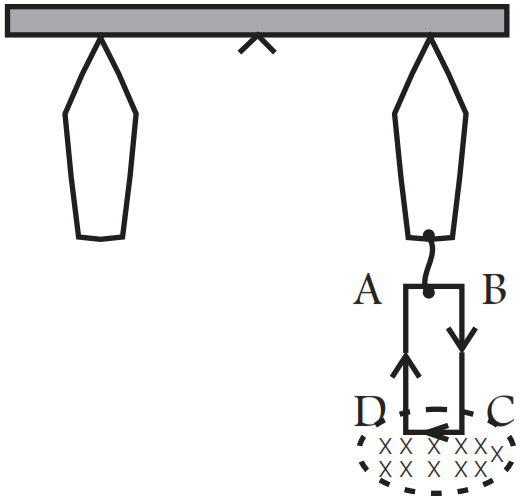
A 100 turn rectangular coil ABCD (in XY plane) is hung from one arm of a balance (Fig). A mass 500g is added to the other arm to balance the weight of the coil. A current 4.9A passes through the coil and a constant magnetic field of 0.2T acting inward (in xz plane) is switched on such that only arm CD of length 1cm lies in the field. How much additional mass 'm' must be added to regain the balance?