A concave mirror forms an image of 20cm high object on a screen placed 5.0m away from the mirror. The height of the image is 50cm. Find the focal length of the mirror and the distance between the mirror and the object.
Download our app for free and get started
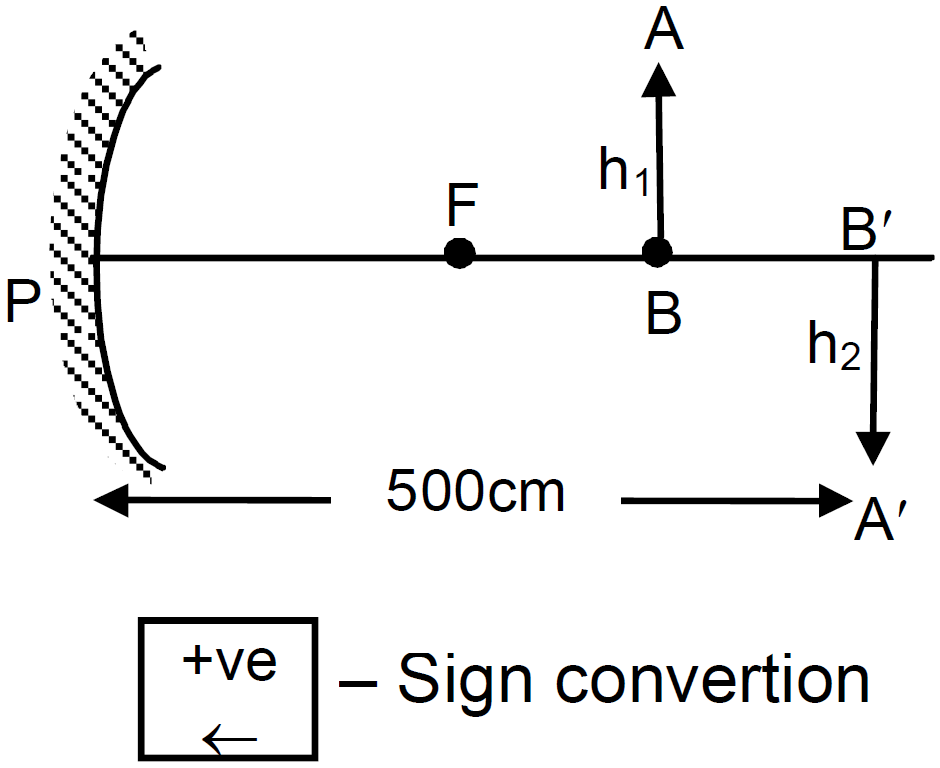
Given that,
$H_1 = 20cm, v = -5m = -500cm, h_2 = 50cm$
Since, $\frac{-\text{v}}{\text{u}}=\frac{\text{h}_2}{\text{h}_1}$
or $\frac{500}{\text{u}}=-\frac{50}{20}$ (because the image in inverted)
or $\text{u}=-\frac{500\times2}{5}=-200\text{cm}=-2\text{m}$
$\frac{1}{\text{v}}+\frac{1}{\text{u}}=\frac{1}{\text{f}}$ or $\frac{1}{-5}+\frac{1}{-2}=\frac{1}{\text{f}}$
or $\text{f}=\frac{-10}{7}=-1.44\text{m}$
So, the focal length is 1.44m.

Download our appand get started for free
Experience the future of education. Simply download our apps or reach out to us for more information. Let's shape the future of learning together!No signup needed.*
Similar Questions
- 1View SolutionA compound microscope has a magnifying power of 100 when the image is formed at infinity. The objective has a focal length of 0.5cm and the tube length is 6.5cm. Find the focal length of the eyepiece.
- 2View SolutionA converging lens of focal length 15cm and a converging mirror of focal length 10cm are placed 50cm apart with common principal axis. A point source is placed in between the lens and the mirror at a distance of 40cm from the lens. Find the locations of the two images formed.
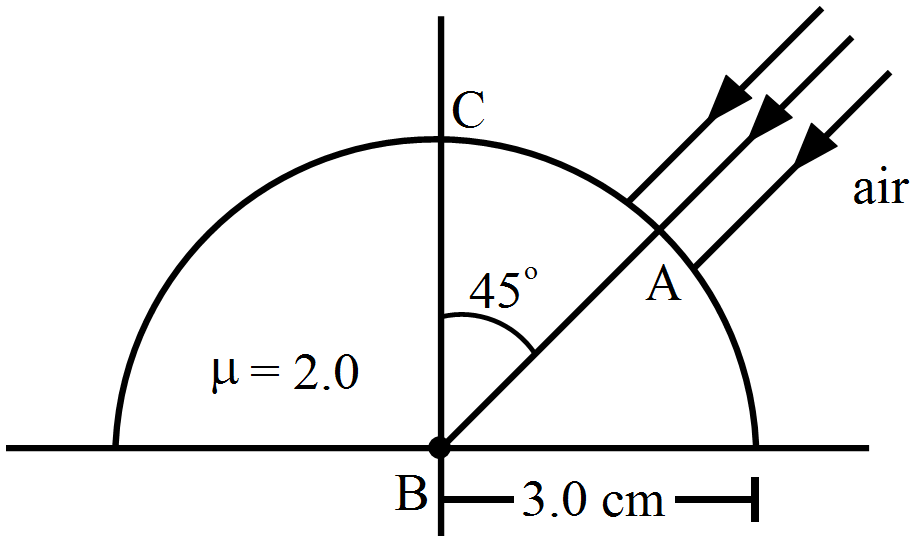
- 3View SolutionFigure shows a transparent hemisphere of radius 3.0cm made of a material of refractive index 2.0.
- A narrow beam of parallel rays is incident on the hemisphere as shown in the figure. Are the rays totally reflected at the plane surface?
- Find the image formed by the refraction at the first surface.
- Find the image formed by the reflection or by the refraction at the plane surface.
- Trace qualitatively the final rays as they come out of the hemisphere.
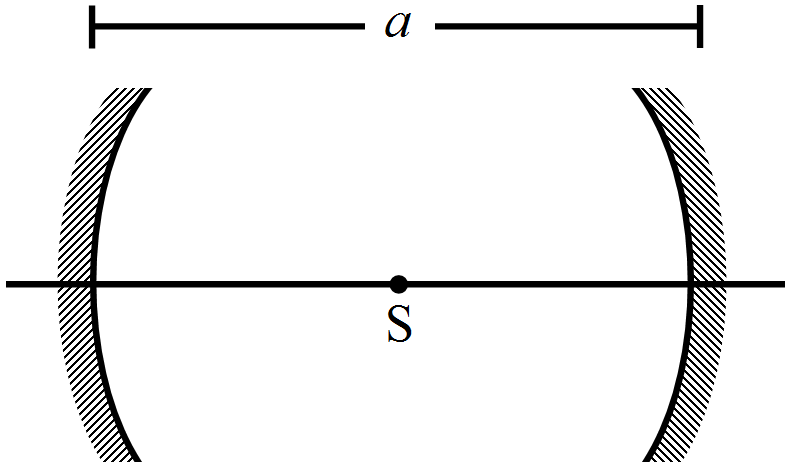
- 4View SolutionA point source S is placed midway between two converging mirrors having equal focal length f. Find the values of d for which only one image is formed.
- 5View SolutionA Cassegrain telescope uses two mirrors. Such a telescope is built with the mirrors 20 mm apart. If the radius of curvature of the large mirror is 220 mm and the small mirror is 140 mm, where will the final image of an object at infinity be?
- 6View SolutionA pin of length 2.0cm lies along the principal axis of a converging lens, the centre being at a distance of 11cm from the lens. The focal length of the lens is 6cm. Find the size of the image.
- 7Find the diameter of the image of the moon formed by a spherical concave mirror of focal length 7.6m. The diameter of the moon is 3450km and the distance between the earth and the moon is $3.8 \times 10^5km.$View Solution
- 8View Solution
- For a ray of light travelling from a denser medium of refractive index $n_1$ to a rarer medium of refractive index $n_2$ prove that $\frac{\text{n}_{2}}{\text{n}_{1}} = \sin \text{i}_{c} ,$ where $i_c$ is the critical angle of incidence for the media.
- Explain with the help of a diagram, how the above principle is used for transmission of video signals using optical fibres.
- 9If light passes near a massive object, the gravitational interaction causes a bending of the ray. This can be thought of as happening due to a change in the effective refrative index of the medium given byView Solution
$\text{n}(\text{r})=1+2\frac{\text{GM}}{\text{rc}^2}$
where r is the distance of the point of consideration from the centre of the mass of the massive body, G is the universal gravitational constant, M the mass of the body and c the speed of light in vacuum. Considering a spherical object find the deviation of the ray from the original path as it grazes the object. - 10View Solution
- An object is placed in front of a concave mirror. It is observed that a virtual image is formed. Draw the ray diagram to show the image formation and hence derive the mirror equation $\frac{1}{\text{f}}=\frac{1}{\text{u}}+\frac{1}{\text{v}}.$
- An object is placed 30cm in front of a plano-convex lens with its spherical surface of radius of curvature 20cm. If the refractive index of the material of the lens is 1.5, find the position and nature of the image formed.