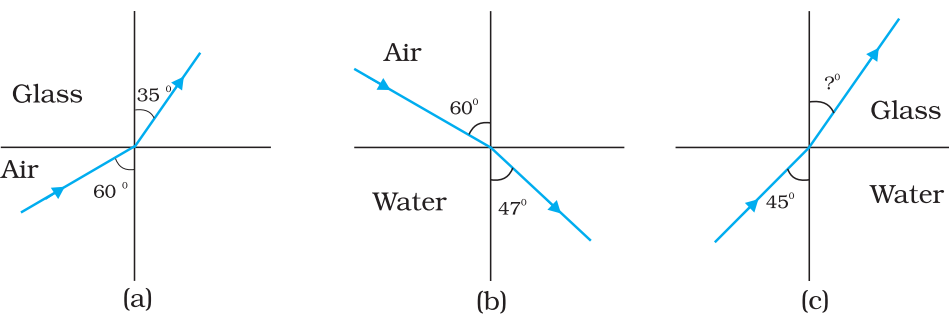
(a) and (b) show refraction of a ray in air incident at 60° with the normal to a glass-air and water-air interface, respectively. Predict the angle of refraction in glass when the angle of incidence in water is 45º with the normal to a water - glass interface.
Exercise
Download our app for free and get started
As per the given figure, for the glass - air interface: Angle of incidence, i = 60° Angle of refraction, r= 35° The relative refractive index of glass with respect to air is given by Snell's law as: $=\text{Mh}_2=6\times4.7=28.2 \ \text{cm}$ $\mu^\circ_\text{g}=\frac{\sin\text{i}}{\sin\text{r}}$ $\frac{\sin 60^\circ}{\sin35^\circ}=\frac{0.8660}{0.5736}=1.51\dots(1)$ As per the given figure, for the air - water interface: Angle of incidence, i = 60° Angle of refraction, r= 47° The relative refractive index of water with respect to air is given by Snell's law as: $\mu^\circ_\text{g}=\frac{\sin\text{i}}{\sin\text{r}}$ $\frac{\sin 60^\circ}{\sin47^\circ}=\frac{0.8660}{0.5736}=1.184\dots(2)$ Using (1) and (2), the relative refractive index of glass with respect to water can be obtained as: $\mu^\text{w}_\text{g}=\frac{\mu^\text{a}_\text{g}}{\mu^\text{a}_\text{w}}$ $=\frac{1.51}{1.184}=1.275$ The following figure shows the situation involving the glass - water interface. 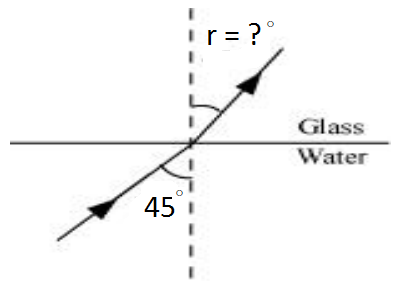 Angle of incidence, i= 45° Angle of refraction = r From Snell's law, rcan be calculated as: $\frac{\sin\text{i}}{\sin\text{r}}=\mu^\text{w}_\text{g}$ $\frac{\sin45^\circ}{\sin\text{r}}=1.275$ $\sin\text{r}=\frac{\frac{1}{\sqrt2}}{1.275}=0.5546$ $\therefore \ \text{r}=\sin^{-1}(0.5546)=38.67^\circ$ Hence, the angle of refraction at the water - glass interface is 38.68°.
Angle of incidence, i= 45° Angle of refraction = r From Snell's law, rcan be calculated as: $\frac{\sin\text{i}}{\sin\text{r}}=\mu^\text{w}_\text{g}$ $\frac{\sin45^\circ}{\sin\text{r}}=1.275$ $\sin\text{r}=\frac{\frac{1}{\sqrt2}}{1.275}=0.5546$ $\therefore \ \text{r}=\sin^{-1}(0.5546)=38.67^\circ$ Hence, the angle of refraction at the water - glass interface is 38.68°.
Download our appand get started for free
Experience the future of education. Simply download our apps or reach out to us for more information. Let's shape the future of learning together!No signup needed.*
Similar Questions
- 1The radii of curvature of a lens are +20cm and +30cm. The material of the lens has a refracting index 1.6. Find the focal length of the lens.View Solution
- If it is placed in air.
- If it is placed in water $(\mu=1.33).$
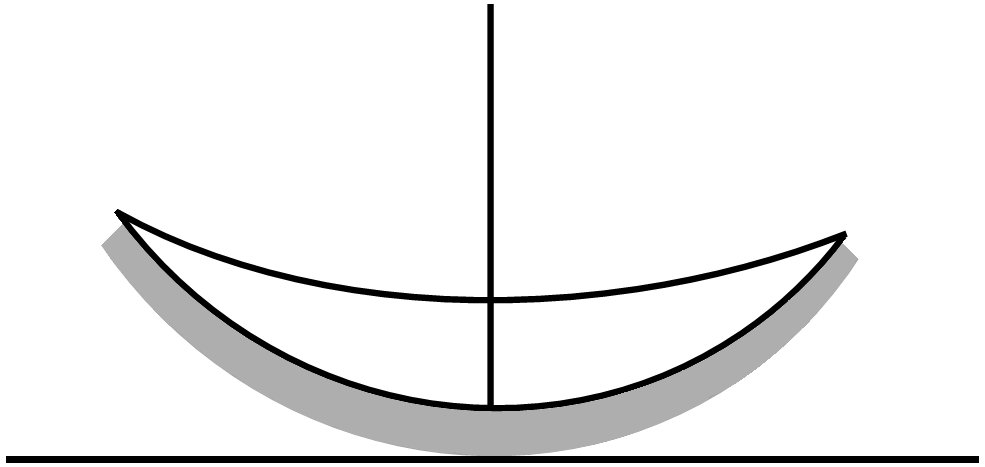
- 2The convex surface of a thin concavo-convex lens of glass of refractive index 1.5 has a radius of curvature 20cm. The concave surface has a radius of curvature 60cm. The convex side is silvered and placed on a horizontal surface as shown in figure.View Solution
- Where should a pin be placed on the axis so that its image is formed at the same place?
- If the concave part is filled with water $\Big(\mu=\frac{4}{3}\Big),$ find the distance through which the pin should be moved so that the image of the pin again coincides with the pin.
- 3View SolutionThe separation between the objective and the eyepiece of a compound microscope can be adjusted between 9.8cm to 11.8cm. If the focal lengths of the objective and the eyepiece are 1.0cm and 6cm respectively, find the range of the magnifying power if the image is always needed at 24cm from the eye.
- 4View SolutionA pin of length 2.00cm is placed perpendicular to the principal axis of a converging lens. An inverted image of size 1.00cm is formed at a distance of 40.0cm from the pin. Find the focal length of the lens and its distance from the pin.
- 5View SolutionWhat is the focal length of a convex lens of focal length 30cm in contact with a concave lens of focal length 20 cm? Is the system a converging or a diverging lens? Ignore thickness of the lenses.
- 6For a glass prism $(\mu=\sqrt{3})$ the angle of minimum deviation is equal to the angle of the prism. Find the angle of the prism.View Solution
- 7View SolutionA diverging lens of focal length 20cm and a converging lens of focal length 30cm are placed 15cm apart with their principal axes coinciding. Where should an object be placed on the principal axis so that its image is formed at infinity?
- 8A hemispherical portion of the surface of a solid glass sphere $(\mu=1.5)$ of radius r is silvered to make the inner side reflecting. An object is placed on the axis of the hemisphere at a distance 3r from the centre of the sphere. The light from the object is refracted at the unsilvered part, then reflected from the silvered part and again refracted at the unsilvered part. Locate the final image formed.View Solution
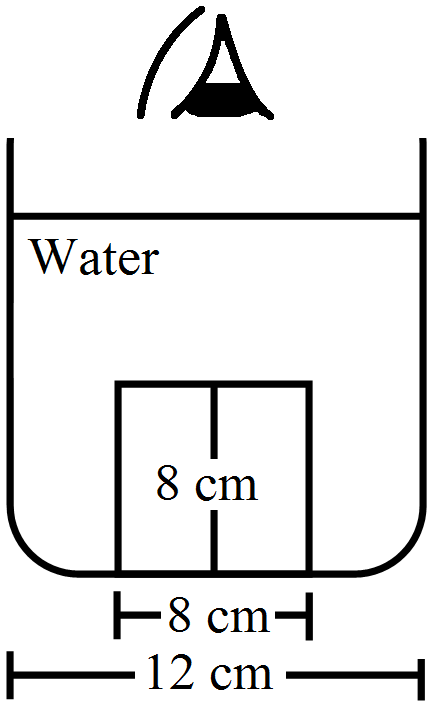
- 9A cylindrical vessel of diameter 12cm contains $800\pi\text{cm}^3$ of water. A cylindrical glass piece of diameter 8.0 cm and height 8.0cm is placed in the vessel. If the bottom of the vessel under the glass piece is seen by the paraxial rays, locate its image. The index of refraction of glass is 1.50 and that of water is 1.33.View Solution
- 10View Solution
- A point object is placed on the principal axis of a convex spherical surface of radius of curvature R, which separates the two media of refractive indices $n_1$ and $n_2(n_2 > n_1)$. Draw the ray diagram and deduce the relation between the object distance (u), image distance (v) and the radius of curvature (R) for refraction to take place at the convex spherical surface from rarer to denser medium.
- A converging lens has a focal length of 20 cm in air. It is made of a material of refractive index 1.6. If it is immersed in a liquid of refractive index 1.3, find its new focal length.