Question
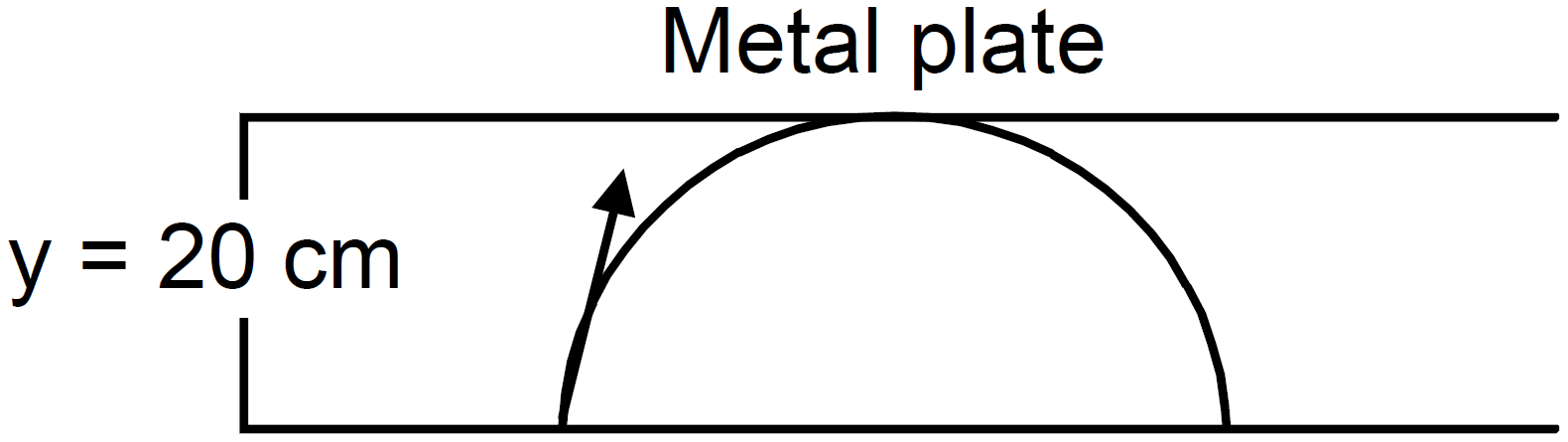
Consider the situation of the previous problem. Consider the fastest electron emitted parallel to the large metal plate. Find the displacement of this electron parallel to its initial velocity before it strikes the large metal plate.
Answer

Here electric field of metal plate $=\text{E}$
$=\frac{\text{p}}{\text{E}_0}$
$=\frac{1\times10^{-19}}{8.85\times10^{-12}}$
$=113\text{v/m}$
accl. $de =\phi=\frac{\text{qE}}{\text{m}}$
$=\frac{1.6\times10^{-19}\times113}{9.1\times10^{-31}}$
$=19.87\times10^{12}$
$\text{t}=\frac{\sqrt{2\text{y}}}{\text{a}}$
$=\frac{\sqrt{2\times20\times10^{-2}}}{19.87\times10^{-31}}$
$=1.41\times10^{-7}\text{sec}$
$K.E. =\frac{\text{hc}}{\lambda}-\text{w}=1.2\text{ev}$
$= 1.2 \times 1.6 \times 10 - 19J [$because in previous problem i.e. in problem $31 : KE = 1.2ev]$
$\therefore\text{v}=\frac{\sqrt{2\text{KE}}}{\text{m}}$
$=\frac{\sqrt{2\times1.2\times1.6\times10^{-19}}}{4.1\times10^{-31}}$
$=0.665\times10^{-6}$
$\therefore$ Horizontal displacement $= Vt \times t$
$= 0.655 \times 10^{-6} \times 1.4 \times 10^{-7}$
$= 0.092m = 9.2\ cm.$​​​​​​​

Need a full question paper?

Generate a complete, print-ready paper with questions like this in minutes — across 16+ boards, with answer keys.
Start Generating Free

Similar questions

  1. Derive an expression for the force between two long parallel current carrying conductors.
  2. Use this expression to define $S.I.$ unit of current.
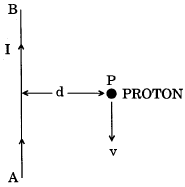
  3. $A$ long straight wire $AB$ carries a current $I. A$ proton $P$ travels with a speed $v,$ parallel to the wire, at a distance $d$ from it in a direction opposite to the current as shown in the figure. What is the force experienced by the proton and what is its direction?
Derive the lens formula $\frac{1}{\text{f}}=\frac{1}{\text{v}}-\frac{1}{\text{u}}$ for a thin concave lens, using the necessary ray diagram.
A wire of length $10\ cm$ translates in a direction making an angle of $60^\circ$ with its length. The plane of motion is perpendicular to a uniform magnetic field of $1.0T$ that exists in the space. Find the emf induced between the ends of the rod if the speed of translation is $20\ cm/s^{-1}.$
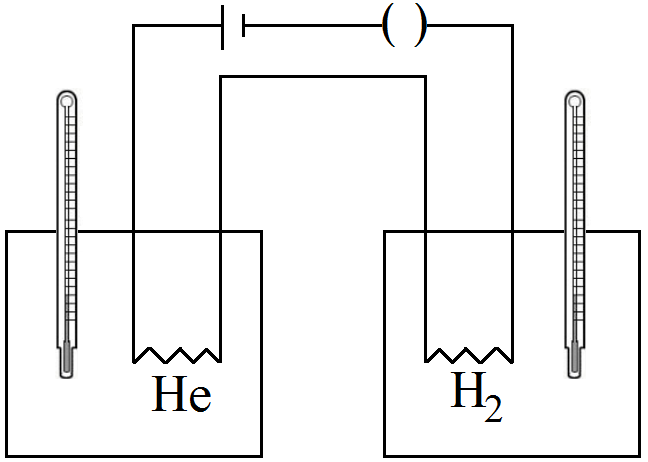
The figure shows two vessels with adiabatic walls, one containing $0.1g$ of helium $\big(\gamma=1.67,\text{M}=4\text{g-mol}^{-1}\big)$ and the other containing some amount of hydrogen $\big(\gamma=1.4,\text{M}=2\text{g-mol}^{-1}\big).$ Initially, the temperatures of the two gases are equal. The gases are electrically heated for some time during which equal amounts of heat are given to the two gases. It is found that the temperatures rise through the same amount in the two vessels. Calculate the mass of hydrogen.
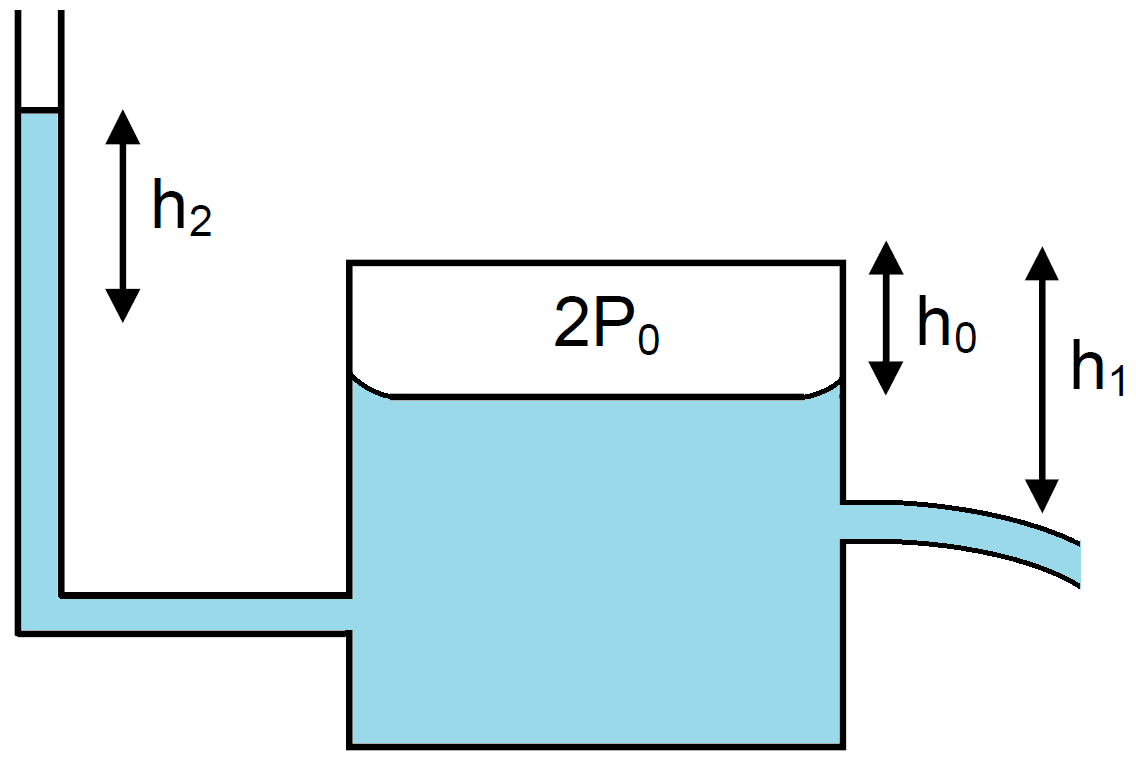
Figure. shows a large closed cylindrical tank containing water. Initially the air trapped above the water surface has a height $h_0$ and pressure $2p_0$ where $p_0$ is the atmospheric pressure. There is a hole in the wall of the tank at a depth $h_1$ below the top from which water comes out. A long vertical tube is connected as shown.
  1. Find the height $h_2$ of the water in the long tube above the top initially.
  2. Find the speed with which water comes out of the hole.
  3. Find the height of the water in the long tube above the top when the water stops coming out of the hole.
Consider the following very rough model of a beryllium atom. The nucleus has four protons and four neutrons confined to a small volume of radius $10^{-15}m$. The two 1s electrons make a spherical charge cloud at an average distance of $1.3 \times 10^{-11}m$ from the nucleus, whereas the two $2\ s$ electrons make another spherical cloud at an average distance of $5.2 \times 10^{-11}m$ from the nucleus. Find the electric field at:
  1. A point just inside the $1\ s$ cloud.
  2. A point just inside the $2\ s$ cloud.
  1. In the explanation of photo electric effect, we asssume one photon of frequency $ν$ collides with an electron and transfers its energy. This leads to the equation for the maximum energy $E_\text{max}$ of the emitted electron as,
  1. $\text{E}_\text{max}=\text{hv}-\phi_0$
    where $\phi_0$ is the work function of the metal. If an electron absorbs $2$ photons $($each of frequency $ν)$ what will be the maximum energy for the emitted electron?
  2. Why is this fact $($two photon absorption$)$ not taken into consideration in our discussion of the stopping potential?
A long, straight wire carries a current i. Let $B_1$, be the magnetic field at a point Pat a distance d from the wire. Consider a section of length l of this wire such that the point $P$ lies on a perpendicular bisector of the section. Let $B2$ be the magnetic field at this point due to this section only. Find the value of $\frac{\text{d}}{\text{l}}$ so that $B_2$_ differs from $B_1$, by $1\%.$
State Biot-Savart law, giving the mathematical expression for it.
Use this law to derive the expression for the magnetic field due to a circular coil carrying current at a point along its axis.
How does a circular loop carrying current behave as a magnet?
The magnetic field B and the magnetic intensity H in material are found to be 1.6T and 1000A/m reepectively. Calculate the relative permeability $\mu_\text{r}$ and the susceptibility x of the material.