Question
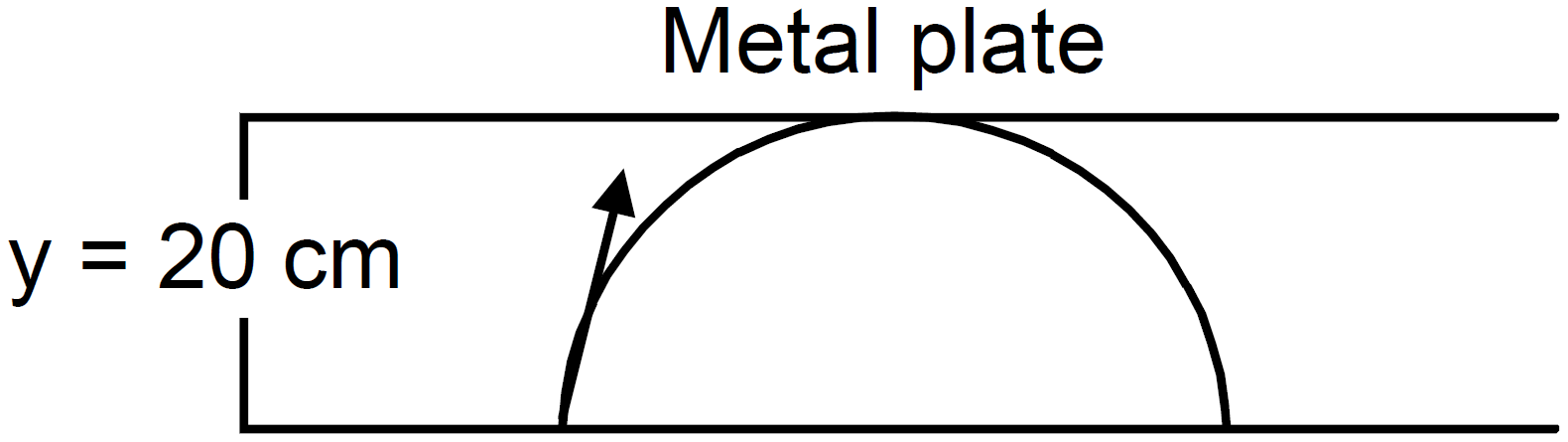
Consider the situation of the previous problem. Consider the fastest electron emitted parallel to the large metal plate. Find the displacement of this electron parallel to its initial velocity before it strikes the large metal plate.
Answer

Here electric field of metal plate $=\text{E}=\frac{\text{p}}{\text{E}_0}$
$=\frac{1\times10^{-19}}{8.85\times10^{-12}}=113\text{v/m}$
accl. de $=\phi=\frac{\text{qE}}{\text{m}}$
$=\frac{1.6\times10^{-19}\times113}{9.1\times10^{-31}}=19.87\times10^{12}$
$\text{t}=\frac{\sqrt{2\text{y}}}{\text{a}}=\frac{\sqrt{2\times20\times10^{-2}}}{19.87\times10^{-31}}=1.41\times10^{-7}\text{sec}$
K.E. $=\frac{\text{hc}}{\lambda}-\text{w}=1.2\text{ev}$
= 1.2 × 1.6 × 10 - 19J [because in previous problem i.e. in problem 31 : KE = 1.2ev]
$\therefore\text{v}=\frac{\sqrt{2\text{KE}}}{\text{m}}$
$=\frac{\sqrt{2\times1.2\times1.6\times10^{-19}}}{4.1\times10^{-31}}=0.665\times10^{-6}$
$\therefore$ Horizontal displacement = Vt × t
= 0.655 × 10-6 × 1.4 × 10-7 = 0.092m = 9.2cm.

Need a full question paper?

Generate a complete, print-ready paper with questions like this in minutes — across 16+ boards, with answer keys.

Start Generating Free

Similar questions

A particle is observed from two frames S1 and. S2. The frame Smoves with respect to Swith an acceleration a. Let F1 and F2 be the pseudo forces on the particle when seen from S1 and S2 respectively. Which of the following are not possible?
  1. F1 = 0, F2 ≠ 0
  2. F1 ≠ 0, F2 = 0
  3. F1 ≠ 0, F2 ≠ 0
  4. F= 0, F= 0
(i) Obtain an expression for torque acting on a rectangular current carrying coil in a uniform magnetic field. (ii) Calculate magnetic dipole of a circular electric current loop.
Let us list some of the factors, which could possibly influence the speed of wave propagation:
  1. Nature of the source.
  2. Direction of propagation.
  3. Motion of the source and/or observer.
  4. Wavelength.
  5. Intensity of the wave.
On which of these factors, if any, does
  1. The speed of light in vacuum,
  2. The speed of light in a medium (say, glass or water), depend?
Can the instantaneous power output of an ac source ever be negative? Can the average power output be negative?
A calorimeter contains 50g of water at 50°C. The temperature falls to 45°C in 10 minutes. When the calorimeter contains 100g of water·at 50°0, it takes 18 minutes for the temperature to become 45°C. Find the water equivalent of the calorimeter.
A thin paper of thickness 0.02mm having a refractive index 1.45 is pasted across one of the slits in a Young's double slit experiment. The paper transmits $\frac{4}{9}$ of the light energy falling on it.
  1. Find the ratio of the maximum intensity to the minimum intensity in the fringe pattern.
  2. How many fringes will cross through the centre if an identical paper piece is pasted on the other slit also? The wavelength of the light used is 600nm.
Explain electric charge. Verify by experiment that there is repulsion between like charges and attraction between unlike charges.
A diverging lens of focal length 20cm and a converging lens of focal length 30cm are placed 15cm apart with their principal axes coinciding. Where should an object be placed on the principal axis so that its image is formed at infinity?
Consider a situation similar to that of the previous problem except that the ends of the rod slide on a pair of thick metallic rails laid parallel to the wire. At one end the rails are connected by resistor of resistance R.
  1. What force is needed to keep the rod sliding at a constant speed v?
  2. In this situation what is the current in the resistance R?
  3. Find the rate of heat developed in the resistor.
  4. Find the power delivered by external agent exerting the force on the rod.
Consider a metal ring kept (supported by a cardboard) on top of a fixed solenoid carrying a current I (see Fig). The centre of the ring coincides with the axis of the solenoid. If the current in the solenoid is switched off, what will happen to the ring?