Question
Explain electric charge. Verify by experiment that there is repulsion between like charges and attraction between unlike charges.

Answer

SELF

Need a full question paper?

Generate a complete, print-ready paper with questions like this in minutes — across 16+ boards, with answer keys.

Start Generating Free

Similar questions

4 × 10²³ tritium atoms are contained in a vessel. The half-life of decay tritium nuclei is 12.3y. Find:
  1. The activity of the sample.
  2. The number of decay in the next 10 hours.
  3. The number of decays in the next 6.15y.
Gautam went for a vacation to the village where his grandmother lived. His grandmother took him to watch ‘nautanki’ one evening. They noticed a blackbox connected to the mike lying nearby. Gautam’s grandmother did not know what that box was. When she asked this question to Gautam, he explained to her that it was an amplifier.
  1. Which values were displayed by the grandmother? How can inculcation of these values in students be promoted?
  2. What is the function of an amplifier?
  3. Which basic electronic device is used in the amplifier?
A wave travelling on a string, at a speed of 10m/s causes each particle of the string to oscillate with a time period of 20ms.
  1. What is the wavelength of the wave?
  2. If the displacement of a particle is 1.5mm at a certain instant, what will be the displacement of a particle 10cm away from it at the same instant?
Define total internal reflection. Establish the relation between $u, v$ and $f$ for a spherical mirror. Draw the necessary ray diagram. ### Define lateral displacement. Derive the lens maker formula.
$
\frac{1}{f}=\left(n_{21}-1\right)\left(\frac{1}{R_1}-\frac{1}{R_2}\right)
$
Draw the necessary ray diagram. (Where the signs have their usual meanings.)
A particle of charge 2.0 × 10⁻⁸C and mass 2.0 × 10⁻¹⁰g is projected with a speed of 2.0 × 10³m/s-1in a region with a uniform magnetic field of 0.10T. The velocity is perpendicular to the field. Find the radius of the circle formed by the particle and also the time period.
Figure shows a charge array known as an electric quadrupole. For a point on the axis of the quadrupole, obtain the dependence of potential on r for r/a >> 1, and contrast your results with thatdue to an electric dipole, and an electric monopole (i.e., a single charge).

Given below are some famous numbers associated with electromagnetic radiations in different contexts in physics. State the part of the electromagnetic spectrum to which each belongs.
  1. 21 cm (wavelength emitted by atomic hydrogen in interstellar space).
  2. 1057 MHz (frequency of radiation arising from two close energy levels in hydrogen; known as Lamb shift).
  3. 2.7 K [temperature associated with the isotropic radiation filling all space-thought to be a relic of the ‘big-bang’ origin of the universe].
  4. 5890 Å - 5896 Å [double lines of sodium]
  5. 14.4 keV [energy of a particular transition in 57Fe nucleus associated with a famous high resolution spectroscopic method (Mössbauer spectroscopy)].
The bob of a stationary pendulum is given a sharp hit to impart it a horizontal speed of $\sqrt{3\text{gl}}.$ Find the angle rotated by the string before it becomes slack.
A right angled prism of refractive index n has a plane of refractive index n1 so that n1 < n, cemented to its diagonal face. The assembly is in air. A ray is incident on AB.
  1. Calculate the angle of incidence at AB for which the ray strikes the diagonal face at the critical angle.
  2. Assuming n = 1.352, calculate the angle of incidence at AB for which the refracted ray passes through the diagonal face undeviated.
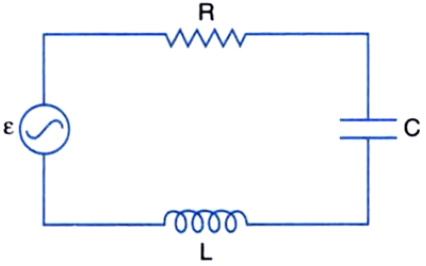
Figure shows a series LCR circuit connected to a variable frequency 230V source. L = 5.0H, C = 80μF, R = 40Ω.

  1. Determine the source frequency which drives the circuit in resonance
  2. Obtain the impedance of the circuit and the amplitude of current at the resonating frequency.
  3. Determine the rms potential drops across the three elements of the circuit. Show that the potential drop across the LC combination is zero at the resonating frequency.