Question
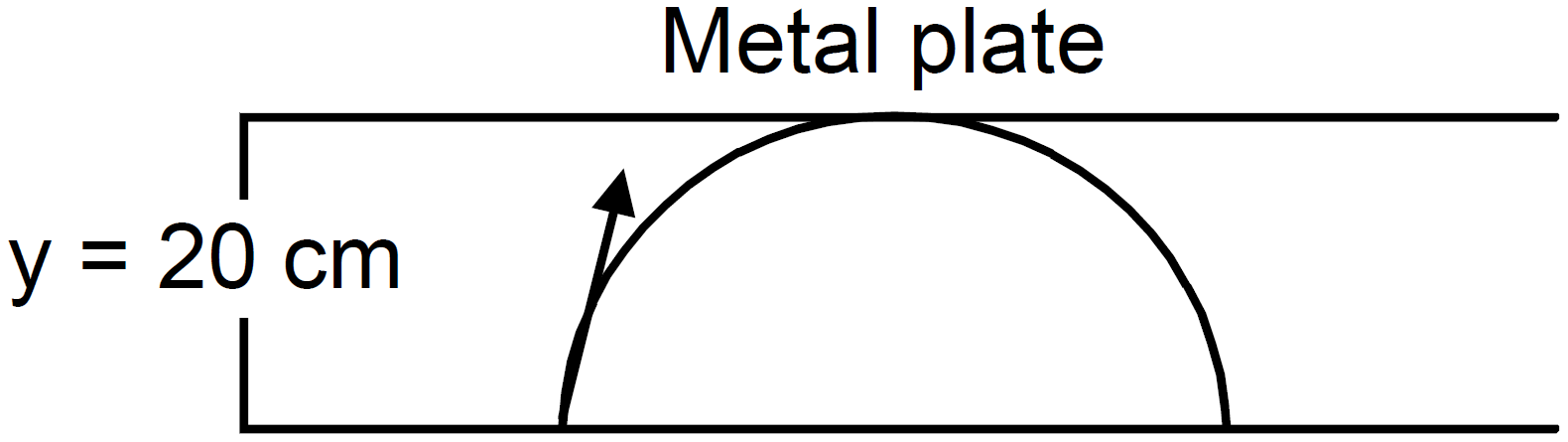
Consider the situation of the previous problem. Consider the fastest electron emitted parallel to the large metal plate. Find the displacement of this electron parallel to its initial velocity before it strikes the large metal plate.
Answer

Here electric field of metal plate $=\text{E}=\frac{\text{p}}{\text{E}_0}$
$=\frac{1\times10^{-19}}{8.85\times10^{-12}}=113\text{v/m}$
accl. de $=\phi=\frac{\text{qE}}{\text{m}}$
$=\frac{1.6\times10^{-19}\times113}{9.1\times10^{-31}}=19.87\times10^{12}$
$\text{t}=\frac{\sqrt{2\text{y}}}{\text{a}}=\frac{\sqrt{2\times20\times10^{-2}}}{19.87\times10^{-31}}=1.41\times10^{-7}\text{sec}$
K.E. $=\frac{\text{hc}}{\lambda}-\text{w}=1.2\text{ev}$
= 1.2 × 1.6 × 10 - 19J [because in previous problem i.e. in problem 31 : KE = 1.2ev]
$\therefore\text{v}=\frac{\sqrt{2\text{KE}}}{\text{m}}$
$=\frac{\sqrt{2\times1.2\times1.6\times10^{-19}}}{4.1\times10^{-31}}=0.665\times10^{-6}$
$\therefore$ Horizontal displacement = Vt × t
= 0.655 × 10-6 × 1.4 × 10-7 = 0.092m = 9.2cm.

Need a full question paper?

Generate a complete, print-ready paper with questions like this in minutes — across 16+ boards, with answer keys.
Start Generating Free

Similar questions

i. Draw a ray diagram showing the image formation by a compound microscope. Obtain the expression for total magnification when the image is formed at infinity.
ii. How does the resolving power of a compound microscope get affected, when
1. focal length of the objective is decreased.
2. the wavelength of light is increased ? Give reasons to justify your answer.
The separation between the objective and the eyepiece of a compound microscope can be adjusted between 9.8cm to 11.8cm. If the focal lengths of the objective and the eyepiece are 1.0cm and 6cm respectively, find the range of the magnifying power if the image is always needed at 24cm from the eye.
Is it possible that in a Coolidge tube characteristic $\text{L}_\alpha$ X-rays are emitted but not $\text{K}_\alpha$ X-rays?
Explain the Function of a $n-p-n$ transistor as a switch with necessary circuit diagram.
A sample of an ideal gas $(\gamma=1.5)$ is compressed adiabatically from a volume of 150cm3 to 50cm3. The initial pressure and the initial temperature are 150kPa and 300K. Find,
  1. The number of moles of the gas in the sample.
  2. The molar heat capacity at constant volume.
  3. The final pressure and temperature.
  4. The work done by the gas in the process.
  5. The change in internal energy of the gas.
What happens when a forward bias is applied to a $p-n$ junction?
The Bohr model for the H-atom relies on the Coulomb’s law of electrostatics. Coulomb’s law has not directly been verified for very short distances of the order of angstroms. Supposing Coulomb’s law between two opposite charge +q1, -q2 is modified to
$|\text{F}|=\frac{\text{q}_1\text{q}_2}{(4\pi\in_0)}\frac{1}{\text{r}^2}.\text{r}\geq\text{R}_0$
$=\frac{\text{q}_1\text{q}_2}{(4\pi\in_0)}\frac{1}{\text{R}^2_0}\Big(\frac{\text{R}_0}{\text{r}}\Big)^{\in}.\text{r}\geq\text{R}_0$
Calculate in such a case, the ground state energy of a H-atom, if $\in=0.1,\text{R}_0=1\mathring{\text{A}}$.
A bulb with rating 250V, 100W is connected to a power supply of 220V situated 10m away using a copper wire of area of cross-section 5mm2. How much power will be consumed by the connecting wires? Resistivity of copper $1.7\times10^{-8}\Omega-\text{m}$.
k transparent slabs are arranged one over another. The refractive indices of the slabs are $\mu_1,\mu_2,\mu_3, \ ...\mu_{\text{k}}$ and the thicknesses are t1, t2, t3, ... tk . An object is seen through this combination with nearly perpendicular light. Find the equivalent refractive index of the system which will allow the image to be formed at the same place.
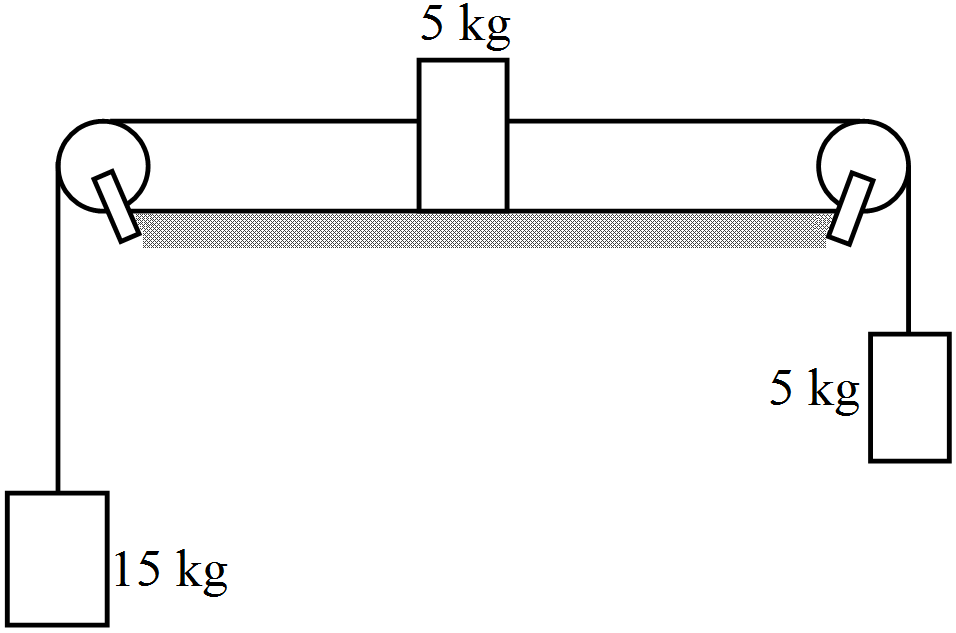
The friction coefficient between the table and the block shown in figure is 0.2. Find the tensions in the two strings.