Question
Consider the situation of the previous problem. Define displacement resistance $\text{R}_\text{d}=\frac{\text{V}}{\text{i}_\text{d}}$ of the space between the plates, where V is the potential difference between the plates and $i_d$ is the displacement current. Show that $R_d$ varies with time as $\text{R}_\text{d}=\text{R}\big(\text{e}^{\text{t}/\tau}-1\big)$
Answer

$\text{E}=\frac{\text{Q}}{\in_0\text{A}}$ (Electric field)
$\phi=\text{E.A.}=\frac{\text{Q}}{\in_0\text{A}}\frac{\text{A}}{2}=\frac{\text{Q}}{\in_02}$
$\text{i}_0=\in_0\frac{\text{d}\phi_\text{E}}{\text{dt}}=\in_0\frac{\text{d}}{\text{dt}}\Big(\frac{\text{Q}}{\in_02}\Big)$
$=\frac{1}{2}\Big(\frac{\text{dQ}}{\text{dt}}\Big)$

Need a full question paper?

Generate a complete, print-ready paper with questions like this in minutes — across 16+ boards, with answer keys.

Start Generating Free

Similar questions

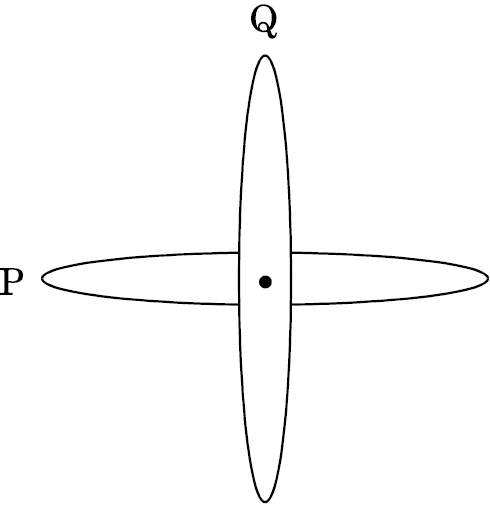
Two identical loops P and Q each of radius 5 cm are lying in perpendicular planes such that they have a common centre as shown in the figure. Find the magnitude and direction of the net magnetic field at the common centre of the two coils, if they carry currents equal to 3 A and 4 A respectively.
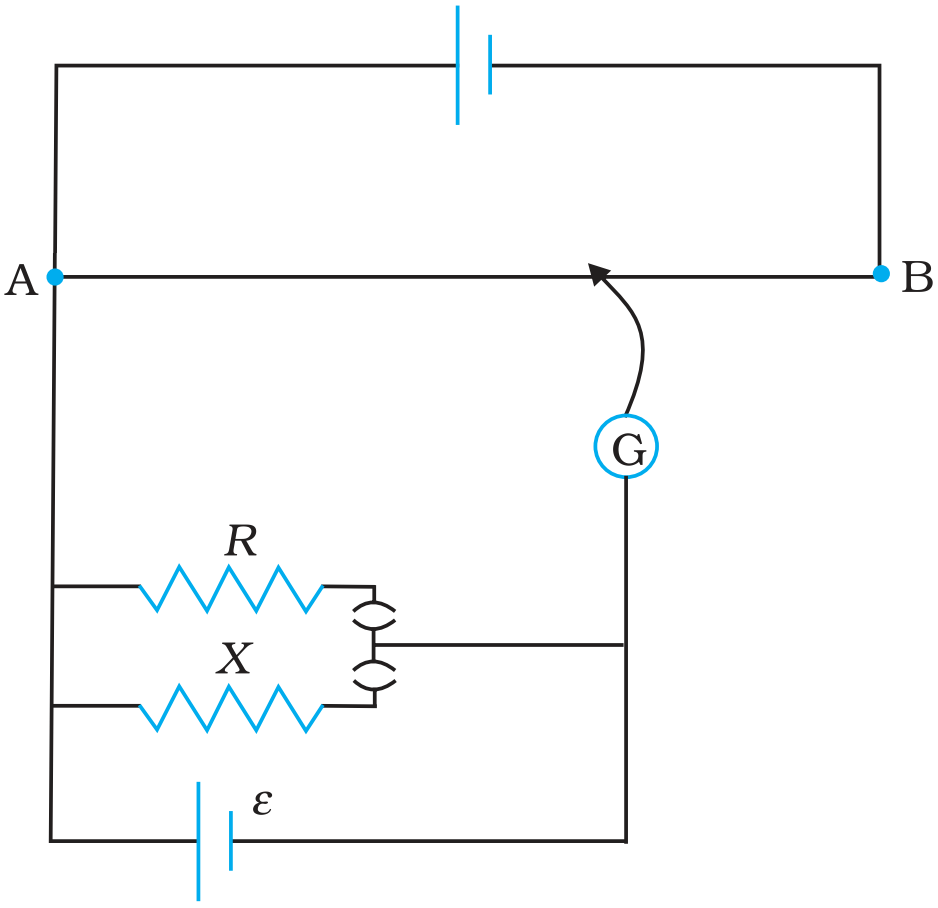
Figure shows a potentiometer circuit for comparison of two resistances. The balance point with a standard resistor $\text{R}=10.0\ \Omega$ is found to be 58.3 cm, while that with the unknown resistance X is 68.5 cm. Determine the value of X. What might you do if you failed to find a balance point with the given cell of emf $\varepsilon?$
A square plate of mass 120g and edge 5.0cm rotates about one of the edges. If it has a uniform angular acceleration of $0.2rad/s^2$, what torque acts on the plate?
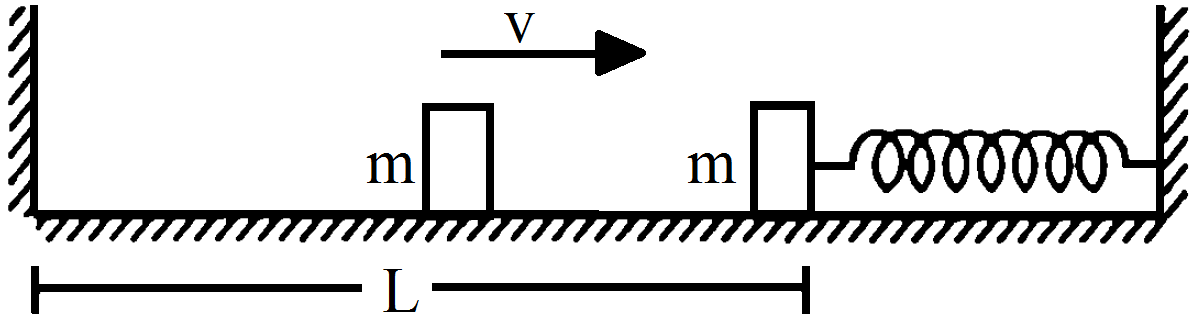
The left block in figure moves at a speed v towards the right block placed in equilibrium. All collisions to take place are elastic and the surfaces are frictionless. Show that the motions of the two blocks are periodic. Find the time period of these periodic motions. Neglect the widths of the blocks.
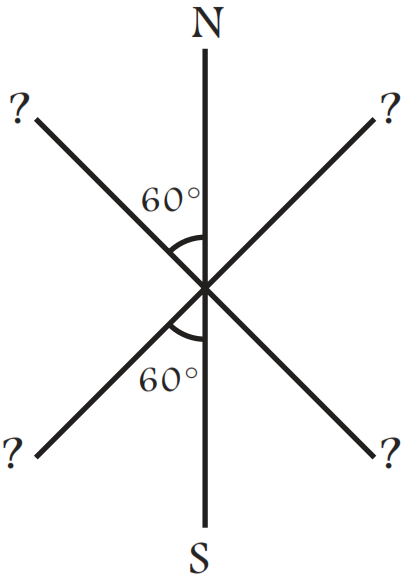
Three identical bar magnets are rivetted together at centre in the same plane as shown in Fig. This system is placed at rest in a slowly varying magnetic field. It is found that the system of magnets does not show any motion. The north-south poles of one magnet is shown in the Fig. Determine the poles of the remaining two.
The maximum speed and acceleration of a particle executing simple harmonic motion are 10cm/s and $50cm/s^2$. Find the position(s) of the particle when the speed is 8cm/s.
Write statement of Lenz's law of electromagnetism. A 2 m long straight vertical wire is falling perpendicularly to horizontal component at speed of 5 $m / s$ in the magnetic field of earth of $0.3 \times 10^{-4} T$. Calculate the magnitude of instantaneous value of induced emf across the ends of the wire.
A square coil of side 10 cm consists of 20 turns and carries a current of 12 A. The coil is suspended vertically and the normal to the plane of the coil makes an angle of 30º with the direction of a uniform horizontal magnetic field of magnitude 0.80 T. What is the magnitude of torque experienced by the coil?
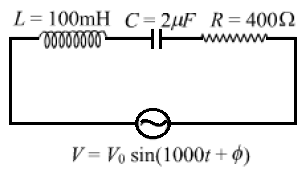
  1. Find the value of the phase difference between the current and the voltage in the series LCR circuit shown below. Which one leads in phase: current or voltage?
  2. Without making any other change, find the value of the additional capacitor $C_1,$ to be connected in parallel with the capacitor C, in order to make the power factor of the circuit unity.
A thin conducting spherical shell of radius R has charge Q spread uniformly over its surface. Using Gauss’s law, derive an expression for an electric field at a point outside the shell.Draw a graph of electric field E(r) with distance r from the centre of the shell for $0\underline{<}\text{r}\underline{<}\infty.$