Question
The maximum speed and acceleration of a particle executing simple harmonic motion are 10cm/s and $50cm/s^2$. Find the position(s) of the particle when the speed is 8cm/s.

Answer

$\text{v}_{\text{max}}=10\text{cm/sec}.$$\Rightarrow\text{r}\omega=10$
$\Rightarrow\omega^2=\frac{100}{\text{r}^2}\ ...(1)$
$\text{A}_{\text{max}}=\omega^2\text{r}=50\text{cm/sec}$
$\Rightarrow\omega^2=\frac{50}{\text{y}}=\frac{50}{\text{r}}\ ...(2)$
$\therefore\frac{100}{\text{r}^2}=\frac{50}{\text{r}}$
$\Rightarrow\text{r}=2\text{cm}.$
$\therefore\omega=\sqrt{\frac{100}{\text{r}^2}}=5\sec^2$
Again, to find out the positions where the speed is 8m/sec,
$\text{v}^2=\omega^2(\text{r}^2-\text{y}^2)$
$\Rightarrow64=25(4-\text{y}^2)$
$\Rightarrow4-\text{y}^2=\frac{64}{25}$
$\Rightarrow\text{y}^2=1.44$
$\Rightarrow\text{y}=\sqrt{1.44}$
$\Rightarrow\text{y}=\pm1.2\text{cm}$ from mean position.

Need a full question paper?

Generate a complete, print-ready paper with questions like this in minutes — across 16+ boards, with answer keys.
Start Generating Free

Similar questions

The specification on a heater coil is 250V, 500W. Calculate the resistance of the coil. What will be the resistance of a coil of 1000W to operate at the same voltage?
A semiconductor has equal electron and hole concentration of $2 \times 10^8/m^3$. On doping with a certain impurity, the hole concentration increases to $4 × 10^{10}/m^3.$
  1. What type of semiconductor is obtained on doping?
  2. Calculate the new electron and hole concentration of the semiconductor.
  3. How does the energy gap vary with doping?
A proton is projected with a velocity of $3 \times 10^6\ ms^{-1}$ perpendicular to a uniform magnetic field of 0.6T. Find the acceleration of the proton.
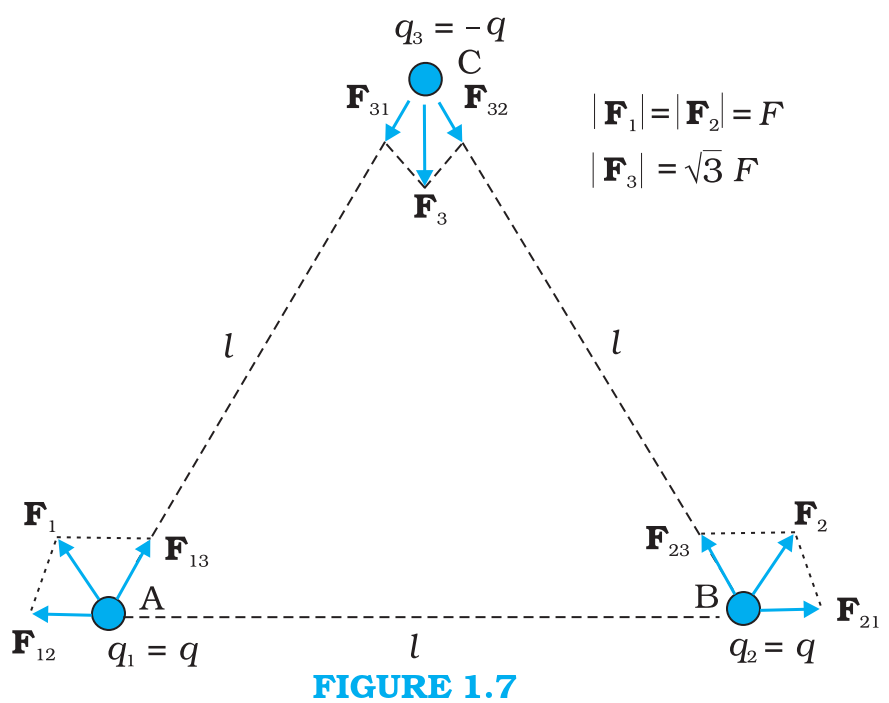
Consider the charges q, q, and –q placed at the vertices of an equilateral triangle, as shown in Fig. 1.7. What is the force on each charge?
Image
In the given circuit, the potential difference across the inductor L and resistor R are 200V and 150V respectively and the rms. value of current is 5A. Calculate (i) the impedance of the circuit and (ii) the phase angle between the voltage and the current.
The weight of an object is more at the poles than at the equator. Is it benificial to purchase goods at equator and sell them at the pole? Does it matter whether a spring balance is used or an equal-beam balance is used?
Two particles have equal masses of 5.0g each and opposite charges of $+4.0 \times 10^{-5}\ C$ and $-4.0 \times 10^{-5}C$. They are released from rest with a separation of 1.0m between them. Find the speeds of the particles when the separation is reduced to 50cm.
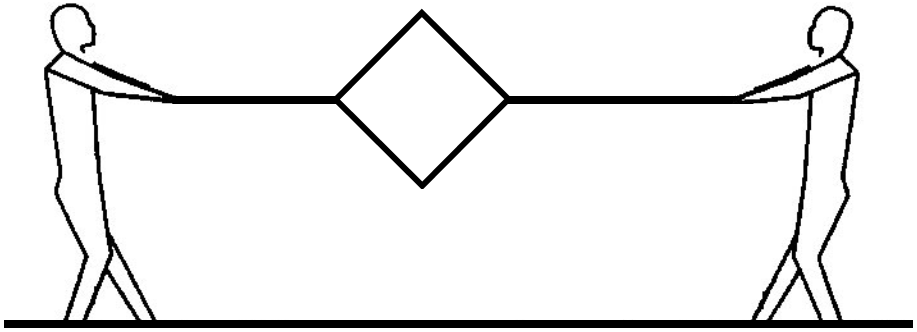
Figure shows a metallic square frame of edge a in a vertical plane. A uniform magnetic field B exists in the space in a direction perpendicular to the plane of the figure. Two boys pull the opposite corners of the square to deform it into a rhombus. They start pulling the corners at t = 0 and displace the corners at a uniform speed u.
  1. Find the induced emf in the frame at the instant when the angles at these corners reduce to 60°.
  2. Find the induced current in the frame at this instant if the total resistance of the frame is R.
  3. Find the total charge which flows through a side of the frame by the time the square is deformed into a straight line.
Mass of a particle depends on its speed. Does the attraction of the earth on the particle also depend on the particle's speed?
Does the temperature of a body depend on the frame from which it is observed?