Question
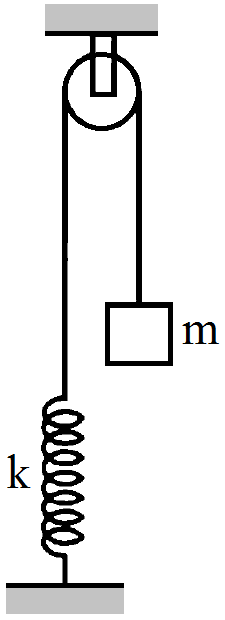
Consider the situation shown in figure. Initially the spring is unstretched when the system is released from rest. Assuming no friction in the pulley, find the maximum elongation of the spring.
Answer

Mass of the body = m

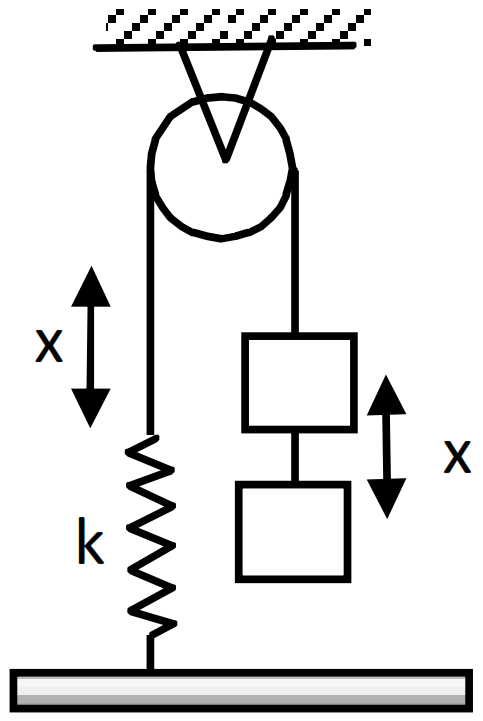
Let the elongation be x

So, $\frac{1}{2}\text{kx}^2=\text{mgx}$

$\Rightarrow\text{x}=2\text{mg}/\text{k}$
Need a full question paper?

Generate a complete, print-ready paper with questions like this in minutes — across 16+ boards, with answer keys.
Start Generating Free

Similar questions

In which of the following examples of motion, can the body be considered approximately a point object:
A monkey sitting on top of a man cycling smoothly on a circular track.
A block of mass 250g slides down an incline of inclination 37° with a uniform speed. Find the work done against the friction as the block slides through 1.0m.
An object is rotating with uniform angular acceleration. If the rotation is started from rest state then the angular displacement after time will be proportional to what power of time?
Two cylinders A and B of equal capacity are connected to each other via a stopcock. A contains a gas at standard temperature and pressure. B is completely evacuated. The entire system is thermally insulated. The stopcock is suddenly opened. Answer the following:
What is the final pressure of the gas in A and B?
If the simple pendulum (including the base) start falling freely, then what will be the period of oscillation? Give positive reason.
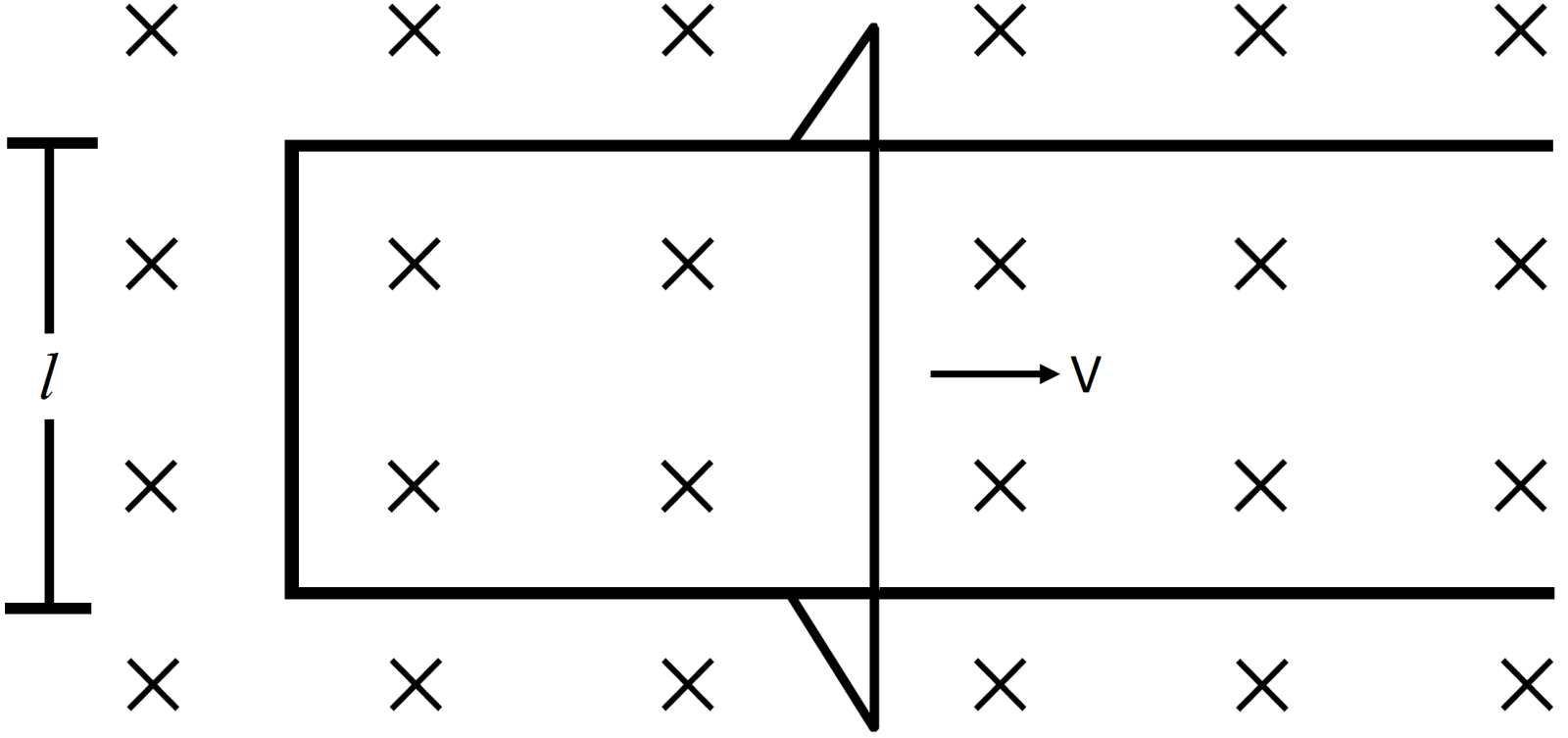
Figure shows a long U-shaped wire of width l placed in a perpendicular magnetic field B. A wire of length l is slid on the U-shaped wire with a constant velocity v towards right. The resistance of all the wires is r per unit length. At t = 0, the sliding wire is close to the left edge of the U-shaped wire. Draw an equivalent circuit diagram, showing the induced emf as a battery. Calculate the current in the circuit.

How is the time period affected when the U-tube is filled with an equal amount of sweet sherbet instead of water and is made to oscillate?
Explain graphically that number of beats formed per second is n = v1 - v2 where v1 and v2 be the frequency of two superimposing waves.
Is there any lower limit to the electric force between two particles placed at a separation of 1cm ?
Find the torque of a force $7 \tilde{ i }$ $+3 \overline{ j }-5 \tilde{ k }$ about the origin. The force acts on a particle whose position vector is $\tilde{ i }-\tilde{ j }+\tilde{ k }$.