MCQ
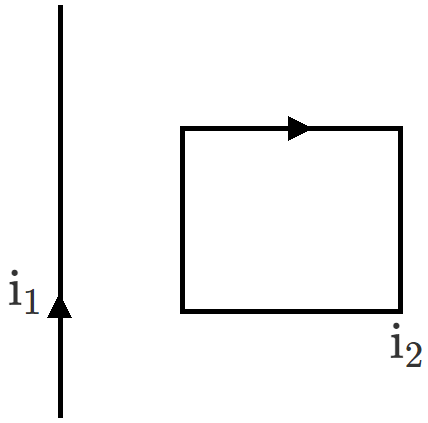
Consider the situation shown in figure. The straight wire is fixed but the loop can move under magnetic force. The loop will:
  • A
    Remain stationary.
  • Move towards the wire.
  • C
    Move away from the wire.
  • D
    Rotate about the wire.

Answer

Correct option: B.
Move towards the wire.
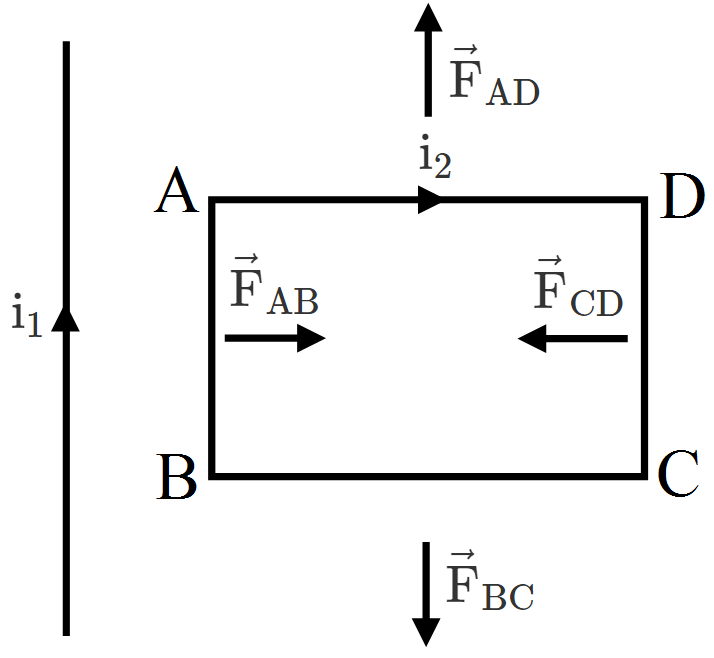
$\overrightarrow{\text{F}}_\text{AD}+\overrightarrow{\text{F}}_\text{BC}=0$
$\overrightarrow{\text{F}}_\text{AB}>\overrightarrow{\text{F}}_\text{CD}$
Force acting on the wire per unit length carrying current $i_2$ due to the wire carrying current $i_1$ placed at $a$ distance $d$ is given by,
$\text{F}=\frac{\mu_0\text{i}_1\text{i}_2}{2\pi\text{d}}$
So, forces per unit length acting on sides $AB$ and $CD$ are as follows:
$\text{F}_\text{AB}=\frac{\mu_0\text{i}_1\text{i}_2}{2\pi\text{d}} \ ($Towards the wire$)$
$\text{F}_\text{CD}=\frac{\mu_0\text{i}_1\text{i}_2}{2\pi(\text{d}+\text{a})} \ ($Away from the wire$)$
Here, $F_{AB} > F_{CD}$ because force is inversly proportional to the distance from the wire and wire $AB$ is closer to the wire carrying current $i_{1.}$
The forces per unit length acting on sides $BC$ and $DA$ will be equal and opposite, as they are equally away from the wire carrying current $i_1,$ with current $i_2$ flowing in the opposite direction.
$\therefore\text{F}_\text{BC}=-\text{F}_\text{DA}$
Now,
Net force:
$\text{F} = \text{F}_\text{AB}+\text{F}_\text{BC}+\text{F}_\text{CD}+\text{F}_\text{DA}$
$\Rightarrow\text{F}=\frac{\mu_0\text{i}_1\text{i}_2}{2\pi\text{d}}+\text{F}_\text{BC}-\frac{\mu_0\text{i}_1\text{i}_2}{2\pi(\text{d+a})}-\text{F}_\text{BC}$
$\Rightarrow\text{F}=\frac{\mu_0\text{i}_1\text{i}_2}{2\pi}\Big(\frac{1}{\text{d}}-\frac{1}{\text{d+a}}\Big)$
$\Rightarrow\text{F}=\frac{\mu_0\text{i}_1\text{i}_2\text{a}}{2\pi\text{d}(\text{d+a})}$
$($Towards the wire$)$
Therefore, the loop will move towards the wire.

Need a full question paper?

Generate a complete, print-ready paper with questions like this in minutes — across 16+ boards, with answer keys.

Start Generating Free

Similar questions

 A normal eye is not able to see objects closer than 25cm because:
  1. The focal length of the eye is 25cm.
  2. The distance of the retina from the eye-lens is 25cm.
  3. The eye is not able to decrease the distance between the eye-lens and the retina beyond a limit.
  4. The eye is not able to decrease the focal length beyond a limit.
In a normal operation of a transistor:
  1. The base-emitter junction is forward-biased.
  2. The base-collector junction is forward-biased.
  3. The base-emitter junction is reverse-biased.
  4. The base-collector junction is reverse-biased.
If the Q value of an endothermic reaction is 11.32MeV, then the minimum energy of the reactant nuclei to carry out the reaction is (in laboratory frame of reference)
Two capacitors each of capacity C are connected in parallel. The equivalent capacity is :
The absorption of radio waves by the atmosphere depends upon:
In a microscope, the focal length of the objective lens in comparison to focal length of the eye lens is :
Consider the following two equations:
  1. $\text{L}=\text{I}\omega$
  2. $\frac{\text{dL}}{\text{dt}}=\Gamma$
In noninertial frames:
  1. Both A and Bare true.
  2. A is true but B is false.
  3. B is true but A is false.
  4. Both A and Bare false.
Pick out correct statement from the following regarding photons: 
Two bodies $A$ and $B$ having equal surface areas are maintained at temperatures $10^\circ C$ and $20^\circ C$. The thermal radiation emitted in a given time by $A$ and $B$ are in the ratio:
Towards the centre of sun(a) Density decreases(b) Pressure decreases(c) Temperature decreases(d) Density and pressure increases