MCQ
Consider the two idealised systems $(i)$ a parallel plate capacitor with large plates and small separation and $(ii)$ a long solenoid of length $L >> R$, radius of cross-section. In $(i)\, E$ ideally treated as a constant between plates and zero outside. In $(ii)$ magnetic field is constant inside the solenoid and zero outside. These idealised assumptions, however, contradict fundamental laws as below
  • A
    Case $(i)$ contradicts Gauss' law for electrostatic fields
  • Case $(ii)$ contradicts Gauss' law for magnetic fields
  • C
    Case $(i)$ agrees with $\oint {E.dl = 0} $
  • D
    Case $(ii)$ contradicts $\oint {H.dl = {I_{en}}} $
Answer

Correct option: B.
Case $(ii)$ contradicts Gauss' law for magnetic fields
b
As Gauss' law states,$\oint\limits_s {E.dS}  = \frac{q}{{{\varepsilon _0}}}$ electrostatic field. It does not contradict for electrostatic fields as the electric field lines do not form continuous closed path. According to Gauss' law in magnetic field, $\oint\limits_s {E.dS}  = 0$ It contradicts for magnetic field, because there is a magnetic field inside the solenoid and no field outside the solenoid carrying current but the magnetic field lines form the closed path.

Need a full question paper?

Generate a complete, print-ready paper with questions like this in minutes — across 16+ boards, with answer keys.

Start Generating Free

Similar questions

For a common base configuration of PNP transistor $\frac{1_{ C }}{1_{ E }}=0.98$ then maximum current gain in common emitter configuration will be
Two concentric hollow metallic spheres of radii $r_1$ and $r_2 (r_1 > r_2)$ contain charges $q_1$ and $q_2$ respectively. The potential at a distance $x$ between $r_1$ and $r_2$ will be
The incorrect statement regarding the lines of force of the magnetic field B is
If there had been one eye of the man, then
In Young's double slit experiment, the wavelength of red light is $7800\, Å$ and that of blue light is $5200\, Å$. The value of $n$ for which nth bright band due to red light coincides with $(n + 1)^{th}$ bright band due to blue light, is :
Two small spheres each of mass $10 \,mg$ are suspended from a point by threads $0.5 \,m$ long. They are equally charged and repel each other to a distance of $0.20 \,m$. The charge on each of the sphere is $\frac{ a }{21} \times 10^{-8} \, C$. The value of $a$ will be ...... .

$\left[\right.$ Given $\left.g=10 \,ms ^{-2}\right]$

When a bar magnet falls through a long hollow metal cylinder fixed with its axis vertical, the final acceleration of the magnet is
Charge is distributed within a sphere of radius $R$ with a volume charge density $\rho (r) = \frac{A}{{{r^2}}}{e^{ - 2r/a}}$ where $A$ and $a$ are constants. If $Q$ is the total charge of this charge distribution, the radius $R$ is.
A ray of light falls on the surface of a spherical glass paper weight making an angle α with the normal and is refracted in the medium at an angle β. The angle of deviation of the emergent ray from the direction of the incident ray
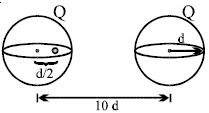
Two spherical, nonconducting, and very thin shells of uniformly distributed positive charge $Q$ and radius d are located a distance $10d$ from each other. A positive point charge $q$ is placed inside one of the shells at a distance $d/2$ from the center, on the line connecting the centers of the two shells, as shown in the figure. What is the net force on the charge $q $ ?