MCQ
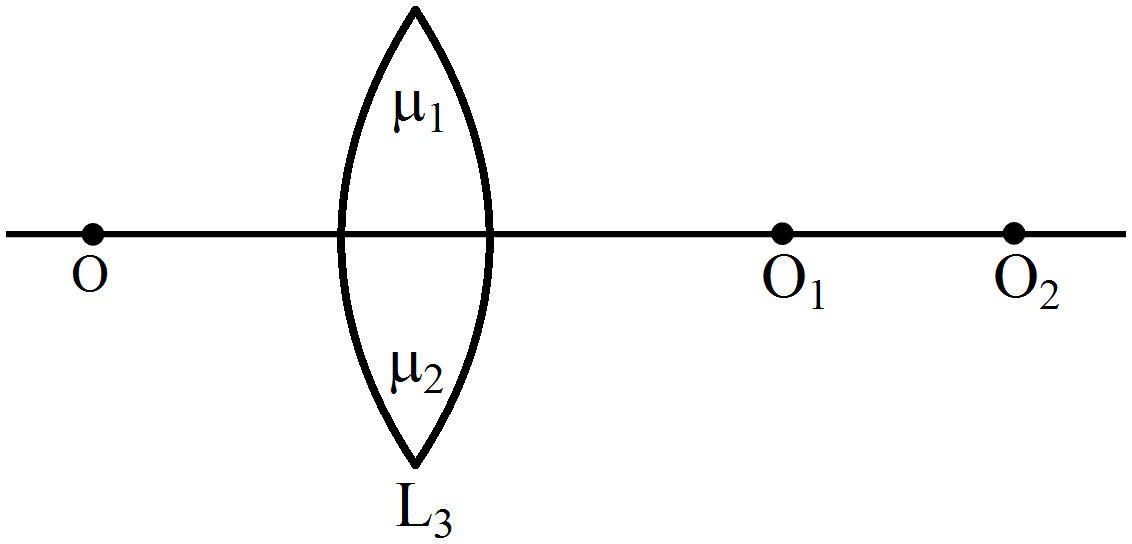
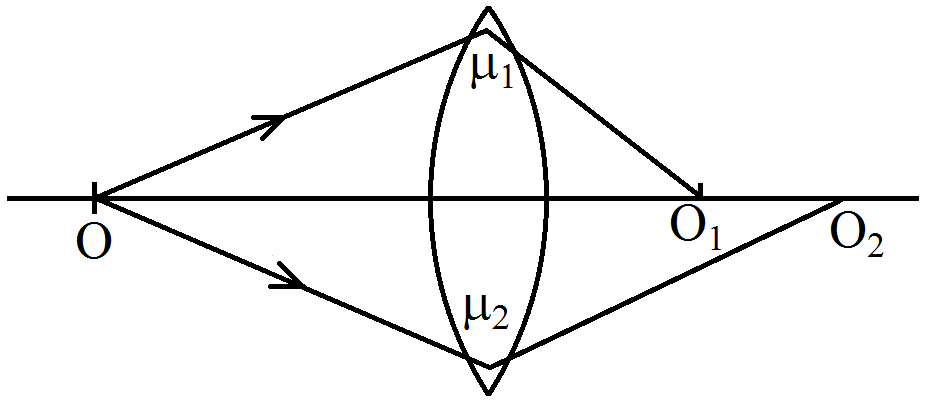
Consider three converging lenses $L_1, L_2$ and $L_3$ having identical geometrical construction. The index of refraction of $\mathrm{L}_1$ and $\mathrm{L}_2$ are $\mu_1$ and $\mu_2$ respectively. The upper half of the lens $\mathrm{L}_3$ has a refractive index $\mu_1$ and the lower half has $\mu_2$. A point object $O$ is imaged at $O_1$ by the lens $L_1$ and at $O_2$ by the lens $L_2$ placed in same position. If $L_3$ is placed at the same place:
  • A
    There will be an image at $\mathrm{O}_1$
  • B
    There will be an image at $\mathrm{O}_2$
  • Both $A$ and $B$
  • D
    The only image will form away from $\mathrm{O}_2$.
Answer

Correct option: C.
Both $A$ and $B$

It rays are Passing through $\mathrm{m}_1$ then Image will be form at $"\mathrm{O}_1"$ and If rays are Passing through $\mathrm{m}_2$ then Image will be form at $"\mathrm{O}_2".$

Need a full question paper?

Generate a complete, print-ready paper with questions like this in minutes — across 16+ boards, with answer keys.

Start Generating Free

Similar questions

A ring of mass $m$ moves from point $1$ to point $2$ along a smooth rigid horizontal wire with a constant speed $v$. The average force acting the ring over the time of its motion from $1$ to $2$ is
Energy evolved in a chemical reaction:
A stone projected with a velocity u at an angle $\theta$ with the horizontal reaches maximum height $H_1$. When it is projected with velocity u at an angle $\left( {\frac{\pi }{2} - \theta } \right)$ with the horizontal, it reaches maximum height $ H_2$. The relation between the horizontal range R of the projectile, $H_1$ and $H_2$ is
$Assertion :$ Smaller drops of liquid resist deforming forces better than the larger drops
$Reason :$ Excess pressure inside a drop is directly proportional to its surface area.
Two cars $P$ and $Q$ start from a point at the same time in a straight line and their positions are represented by $ x_p(t)=at+bt^2 $ and $x_Q(t)= ft- t^2$. At what time do the cars have the same velocity $?$ 
If the surface tension of a liquid is $T$, the gain in surface energy for an increase in liquid surface by $A$ is
A car is travelling in the north direction. To stop, it produces a deceleration of $60\ m/ s^2$. Which of the following is a correct representation for the deceleration?
The radius of gyration of a disc of mass $50\,g$ and radius $2.5\,cm$ , about an axis passing through its centre of gravity and perpendicular to the plane, is ....... $cm$.
Tangential acceleration of a particle moving in a circle of radius $1$ $m$ varies with time $t$ as (initial velocity of particle is zero). Time after which total acceleration of particle makes and angle of $30^o$ with radial acceleration is
The angle between the two vectors $\vec A = 3\hat i + 4\hat j + 5\hat k$ and $\vec B = 3\hat i + 4\hat j - 5\hat k$ will be....... $^o$