Consider two thin identical conducting wires covered with very thin insulating material. One of the wires is bent into a loop and produces magnetic field $B_1,$ at its centre when a current $I$ passes through it.The second wire is bent into a coil with three identical loops adjacent to each other and produces magnetic field $B_2$ at the centre of the loops when current $I/3$ passes through it. The ratio $B_1 : B_2$ is
JEE MAIN 2014, Diffcult


Download our appand get started for free
Experience the future of education. Simply download our apps or reach out to us for more information. Let's shape the future of learning together!No signup needed.*
Similar Questions
- 1View SolutionThe tangent galvanometer, when connected in series with a standard resistance can be used as
- 2View SolutionWhen a magnetic field is applied in a direction perpendicular to the direction of cathode rays, then their
- 3Two concentric coils each of radius equal to $2\pi \,{\rm{ }}cm$ are placed at right angles to each other. $3$ $ampere$ and $4$ $ampere$ are the currents flowing in each coil respectively. The magnetic induction in $Weber/{m^2}$ at the centre of the coils will be $({\mu _0} = 4\pi \times {10^{ - 7}}\,Wb/A.m)$View Solution
- 4Two identical conducting wires $AOB$ and $COD$ are placed at right angles to each other. The wire $AOB$ carries an electric current $I_1$ and $COD$ carries a current $I_2$ . The magnetic field on a point lying at a distance $d$ from $O$, in a direction perpendicular to the plane of the wires $AOB$ and $COD$, will be given byView Solution
- 5Two particles $A$ and $B$ of masses ${m_A}$ and ${m_B}$ respectively and having the same charge are moving in a plane. A uniform magnetic field exists perpendicular to this plane. The speeds of the particles are ${v_A}$ and ${v_B}$ respectively, and the trajectories are as shown in the figure. ThenView Solution
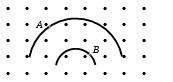
- 6Consider the two idealised systems $(i)$ a parallel plate capacitor with large plates and small separation and $(ii)$ a long solenoid of length $L >> R$, radius of cross-section. In $(i)\, E$ ideally treated as a constant between plates and zero outside. In $(ii)$ magnetic field is constant inside the solenoid and zero outside. These idealised assumptions, however, contradict fundamental laws as belowView Solution
- 7A galvanometer of $50\, ohm$ resistance has $25$ divisions. A current of $4 \times 10^{-4}$ ampere gives a deflection of one division. To convert this galvanometer into a voltmeter having a range of $25\, volts$, it should be connected with a resistance ofView Solution
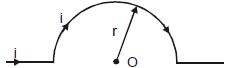
- 8A portion of a conductive wire is bent in the form of a semicircle of radius $r$ as shown below in fig. At the centre of semicircle, the magnetic induction will beView Solution
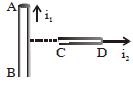
- 9An infinitely long straight conductor $AB$ is fixed and a current is passed through it. Another movable straight wire $CD$ of finite length and carrying current is held perpendicular to it and released. Neglect weight of the wireView Solution
- 10A uniform magnetic field acts at right angles to the direction of motion of electrons. As a result, the electron moves in a circular path of radius $2\, cm$. If the speed of the electrons is doubled, then the radius of the circular path will be.....$cm$View Solution