A galvanometer of $50\, ohm$ resistance has $25$ divisions. A current of $4 \times 10^{-4}$ ampere gives a deflection of one division. To convert this galvanometer into a voltmeter having a range of $25\, volts$, it should be connected with a resistance of
AIPMT 2004, Medium
Download our app for free and get started
Full deflection current ${i_g} = 25 \times 4 \times {10^{ - 4}}$$ = 100 \times {10^{ - 4}}A$
Using $R = \frac{V}{{{I_g}}} - G$$ = \frac{{25}}{{100 \times {{10}^{ - 4}}}} - 50$$ = 2450\,\Omega $ in series.
Using $R = \frac{V}{{{I_g}}} - G$$ = \frac{{25}}{{100 \times {{10}^{ - 4}}}} - 50$$ = 2450\,\Omega $ in series.

Download our appand get started for free
Experience the future of education. Simply download our apps or reach out to us for more information. Let's shape the future of learning together!No signup needed.*
Similar Questions
- 1Two ions of masses $4 \,{amu}$ and $16\, amu$ have charges $+2 {e}$ and $+3 {e}$ respectively. These ions pass through the region of constant perpendicular magnetic field. The kinetic energy of both ions is same. Then :View Solution
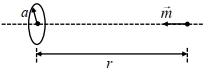
- 2A special metal $S$ conducts electricity without any resistance. A closed wire loop, made of $S$, does not allow any change in flux through itself by inducing a suitable current to generate a compensating flux. The induced current in the loop cannot decay due to its zero resistance. This current gives rise to a magnetic moment which in turn repels the source of magnetic field or flux. Consider such a loop, of radius $a$, with its center at the origin. A magnetic dipole of moment $m$ is brought along the axis of this loop from infinity to a point at distance $r \gg a)$ from the center of the loop with its north pole always facing the loop, as shown in the figure below.View Solution
The magnitude of magnetic field of a dipole $m$, at a point on its axis at distance $r$, is $\frac{\mu_0}{2 \pi} \frac{m}{r^3}$, where $\mu_0$ is the permeability of free space. The magnitude of the force between two magnetic dipoles with moments, $m_1$ and $m_2$, separated by a distance $r$ on the common axis, with their north poles facing each other, is $\frac{k m_1 m_2}{r^4}$, where $k$ is a constant of appropriate dimensions. The direction of this force is along the line joining the two dipoles.
($1$) When the dipole $m$ is placed at a distance $r$ from the center of the loop (as shown in the figure), the current induced in the loop will be proportional to
$(A)$ $\frac{m}{r^3}$ $(B)$ $\frac{m^2}{r^2}$ $(C)$ $\frac{m}{r^2}$ $(D)$ $\frac{m^2}{r}$
($2$) The work done in bringing the dipole from infinity to a distance $r$ from the center of the loop by the given process is proportional to
$(A)$ $\frac{m}{r^5}$ $(B)$ $\frac{m^2}{r^5}$ $(C)$ $\frac{m^2}{r^6}$ $(D)$ $\frac{m^2}{r^7}$
Give the answer or qution ($1$) and ($2$)
- 3A square loop is carrying a steady current $I$ and the magnitude of its magnetic dipole moment is $m$. If this square loop is changed to a circular loop and it carries the same current, the magnitude of the magnetic dipole moment of circular loop will beView Solution
- 4Current $i$ is passed as shown in diagram. If radius of the circle is a, then the magnetic flux density at the centre $P$ will be:View Solution

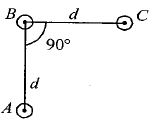
- 5An arrangement of three parallel straight wires placed perpendicular to plane of paper carrying same current $'I'$ along the same direction as shown in figure. Magnitude of force per unit length on the middle wire $'B'$ is given byView Solution
- 6View SolutionA galvanometer can be used as a voltmeter by connecting a
- 7A horizontal overhead powerline is at height of $4\ m$ from the ground and carries a current of $100\ A$ from east to west. The magnetic field directly below it on the ground is. ${\mu _o}$$=4$$\pi $$ \times 10^{-7}$ $\frac{{Tm}}{A}$View Solution
- 8A particle of charge $q$ and mass $m$ starts moving from the origin under the action of an electric field $\vec E = {E_0}\hat i$ and $\vec B = {B_0}\hat i$ with velocity ${\rm{\vec v}} = {{\rm{v}}_0}\hat j$. The speed of the particle will become $2v_0$ after a timeView Solution
- 9A thin circular disk of radius $R$ is uniformly charged with density $\sigma>0$ per unit area. The disk rotates about its axis with a uniform angular speed $\omega$. The magnetic moment of die disk isView Solution
- 10A rigid wire consists of a semicircular portion of radius $R$ and two straight sections. The wire is partially immerged in a perpendicular magnetic field $B=B_0\ {j}$ as shown in figure. The magnetic force on the wire if it has a current $i$ is :View Solution