Question
Considering the case of a parallel plate capacitor being charged, show how one is required to generalize Ampere’s circuital law to include the term due to displacement current.
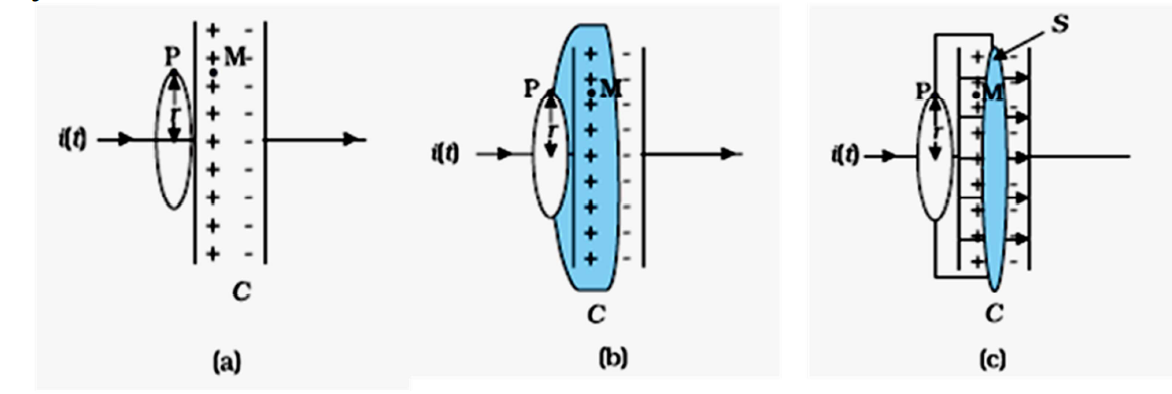 Applying ampere’s circuital law to fig (a) we see that, during charging, the right hand side in Ampere’s circuital law equals $\mu_{0}\text{I}$ However on applying it to the surfaces of the fig (b) or fig (c), the right hand side is zero. Hence, there is a contradiction. We can remove the contradiction by assuming that there exists a current (associated with the changing electric field during charging), known as the displacement current. When this current $( = \frac{\text{d}\phi_{E}}{\text{dt}})$ is added on the right-hand side, Ampere’s circuital law, the inconsistency disappears. It was, therefore necessary, to generalize the Ampere’s circuital law, as$\oint\overrightarrow{\text{B}}\text{d}\overrightarrow{\text{l}} = \mu_{0}\text{I}_{c} + \mu_{0}\in_{o}\frac{\text{d}\phi_{E}}{\text{dt}}.$
Generate a complete, print-ready paper with questions like this in minutes — across 16+ boards, with answer keys.